

Heretics claim whatever opposes them is ambiguous.
Shaykh al-Islam may Allah sanctify his soul said:
The intended meaning here is that every group that holds opinions contradicting the indications of the Qur'an designates those Qur'anic texts as ambiguous (mutashabih).
1/10🧵 x.com
Shaykh al-Islam may Allah sanctify his soul said:
The intended meaning here is that every group that holds opinions contradicting the indications of the Qur'an designates those Qur'anic texts as ambiguous (mutashabih).
1/10🧵 x.com
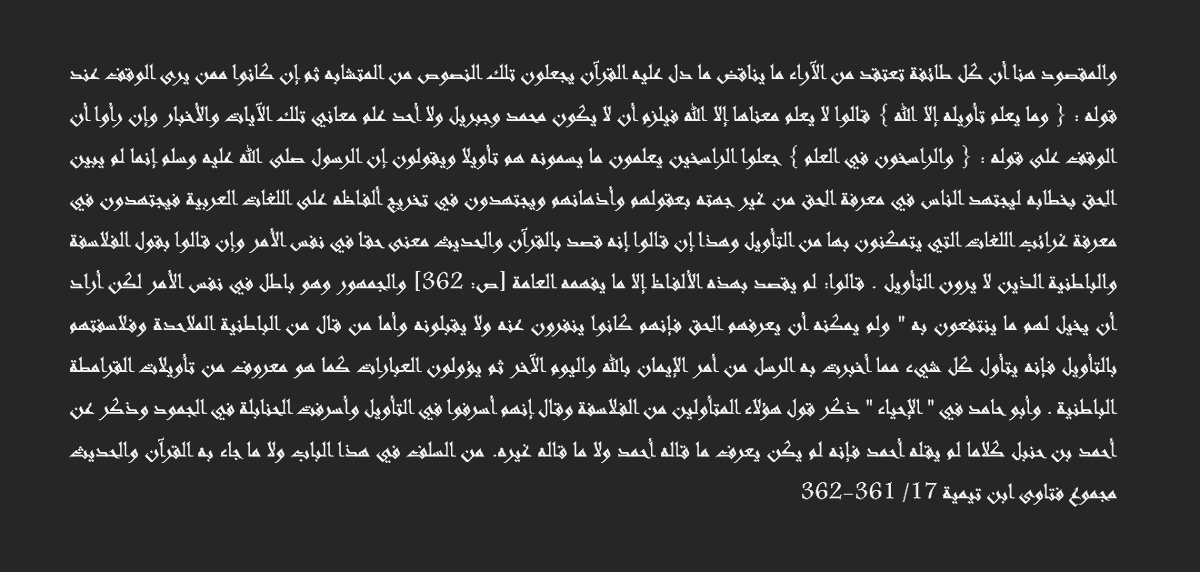
If they are among those who stop at: {And none knows its interpretation except Allah}, they claim that only Allah knows their meaning. This necessitates that neither Muhammad nor Gabriel [peace be upon them], nor anyone else understood the meanings of those verses and narrations.
On the other hand, if they believe the stopping point is at {And those firm in knowledge}, they assert that the firmly grounded in knowledge understand what they themselves call "interpretation" (ta’wil).
They further argue that the Prophet (peace be upon him) did not clarify the truth in his discourse, leaving it for people to strive, through their intellects and reasoning, to discover the truth independently of him.
They exert their effort in interpreting his words upon the various Arabic languages and thus strive to learn the obscure linguistic usages by which they are enabled to exercise interpretation (ta’wil)
This is under the assumption that the Qur'an and hadith intended a true meaning in reality. However, if they adhere to the views of the philosophers and esotericists (batiniyyah), who reject interpretation, they claim that these expressions were only intended to convey meanings
comprehensible to the general public, despite those meanings being false in reality. They argue that the purpose was to evoke imagined concepts that could benefit people. They further contend that the Prophet could not inform them of the truth
since they would have rejected and turned away from it.
As for those among the esotericists, heretics, and their philosophers who adopt ta’wil, they interpret everything the messengers conveyed regarding belief in Allah and the Hereafter.
As for those among the esotericists, heretics, and their philosophers who adopt ta’wil, they interpret everything the messengers conveyed regarding belief in Allah and the Hereafter.
They then reinterpret these expressions, as is well-known from the esoteric (batini) interpretations of the Qaramita sect.
Abu Hamid [al-Ghazali], in Al-Ihya', mentioned the views of these philosophers who engage in ta’wil and said they were excessive in it,
Abu Hamid [al-Ghazali], in Al-Ihya', mentioned the views of these philosophers who engage in ta’wil and said they were excessive in it,
while the Hanbilah were excessive in rigidity. He cited statements attributed to Ahmad ibn Hanbal that Ahmad himself never said, because he was neither familiar with what Ahmad said nor what the Salaf said, nor did he grasp what the Qur'an and hadith conveyed on this matter.
(Majmu’ al-Fatawa 17/361–362)
جاري تحميل الاقتراحات...