
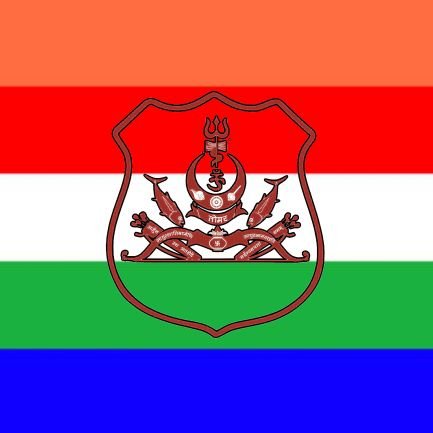

Maharaja Chahadpal Tomar (reigned 1189-1192, also referred to as Rai Kola, Govindraj, Khanderai, Chandraraj) was a sovereign of the Tomar dynasty in Northern India. He was the son of Maharaja Prithviraj Tomar of Delhi and shared his era with Samrat Prithviraj Chauhan of Ajmer.
Lubb ut-tawarikh of Abdul Latif mentioned this Khanderai (Chahadpal Tomar) as a relative of Samrat Prithviraj. Vigrahraj IV & Someshwar were siblings (same father, different mothers). Vigrahraj IV's wife was Desalasevi (daughter of Madanpal Tomar).
This establishes Prithviraj Tomar as a distant cousin of Prithviraj Chauhan, thereby rendering Khanderai (Chahadpal Tomar) a sort of nephew to him.
Under his esteemed rule, amicable diplomatic ties flourished between the illustrious Tomar and Chauhan kingdoms.
In his formative years, Maharaja Chahadpal Tomar attained unparalleled expertise in the art of weaponry, wielding spears and swords with remarkable finesse.
In his formative years, Maharaja Chahadpal Tomar attained unparalleled expertise in the art of weaponry, wielding spears and swords with remarkable finesse.
Hammira Mahakavya on Chandraraja (Chahadpal):
“Chandraraja, by his fame and the beauty of his countenance achieving a double conquest over the moon, vindicated the appropriate significance of his name which means 'Lord of the moon'.”
“Chandraraja, by his fame and the beauty of his countenance achieving a double conquest over the moon, vindicated the appropriate significance of his name which means 'Lord of the moon'.”
“Strange was the power of the fire of his valour, for it burnt bright in the enemy in whom the stream of bravery flowed, while it was extinguished in that enemy who was destitute of this stream.”
The Hammir Mahakavya recounts how the Hindu kings of the western frontier, beleaguered by the relentless assaults of Mohd. Ghori, sought counsel and subsequently designated Rai Chandraraj of Delhi (Chahadpal Tomar) as their esteemed new leader.
In unison with his associates, Rai Chandraraj engaged in a momentous meeting with the Samrat Prithviraj, where they collectively identified Mohd. Chori as a formidable threat to the freedom of Hindu India.
Thus, a formidable alliance was forged, dedicated to the noble cause of liberating the northern and western frontiers from the grasp of Ghurid dominion.
Mohd. Kasim Ferishta, in his work Tarikh i Farishta, alludes to approximately 150 sovereigns of Northern India who revered Maharaja Chahadpal Tomar as their esteemed leader. It is likely that these very chieftains are the ones referenced in the Hammir Mahakavya.
The year 1186 marked the beginning of a tense coexistence between Samrat Prithviraj and Muhammad Ghori, as their territories lay adjacent to one another, setting the stage for inevitable confrontation.
It was during the interval from 1186 to 1191 that numerous clashes erupted between the Rajputs & Ghurids.
The abundance of references to numerous confrontations, ranging from eighteen to twenty, between Samrat Prithviraj and Mohd. Ghori in various Hindu tomes may well be attributed to this very context.
Following the defeat of the Herati Turks in 1190 CE, coupled with the Khwarizmis on the opposing front, Ghori found himself unencumbered and poised to advance into India. His campaign swiftly led to the capture of the Sirhind fort.
Prithviraj Chauhan, accompanied by his brother Hariraja and generals such as Maharaja Chahadpal Tomar, Bhuvanaika Malla, Skanda, and Udayaraja, boldly confronted the Ghurid forces at Tarain.
In the 1st Battle of Tarain, the Rajputs organized themselves into 5 formations: a cavalry unit on the right, an infantry unit also positioned to the right, a central force featuring elephants alongside Samrat Prithviraj, & a left flank comprising both infantry and cavalry units.
The Ghurid army was organized, with its cavalry divided into three distinct wings: the left (maisarah), the center (qalbe), and the right (maimanah). Additionally, a modest rear guard of 5,000 elite horsemen was strategically reserved to ensure the integrity of their formation.
The Ghurids, though numerically inferior, boasted remarkable advancements in military technology that significantly enhanced their capabilities.
The superior breed of Turkish horses, coupled with full-body armor, more efficient Turkish bows, & the highly effective irritation shot technique, greatly improved their prospects on the battlefield.
Yet, in the face of Rajput valor and bravery, these elements ultimately succumbed to ruin.
In the words of Sir Jadunath Sarkar: x.com
In the words of Sir Jadunath Sarkar: x.com

In the midst of the Ghurid army's utter disarray, Muhammad Ghori encountered Maharaja Chahadpal Tomar, who majestically commanded the Rajput forces from atop a grand elephant, guiding them toward triumph.
With a swift and decisive motion, Muhammad Ghori thrust his lance, dislodging two of the Maharaja's teeth. In retaliation, Maharaja Chahadpal Tomar retaliated fiercely, delivering a powerful blow to Muhammad Ghori with his spear.
The ferocity of the strike was such that Muhammad Ghori nearly toppled from his steed, unable to regain his composure. It was a Khalji soldier who, came to his rescue, recognizing the plight of the wounded Muhammad Ghori. x.com

This assault led by Maharaja Chahadpal Tomar against Muhammad Ghori stands as a pivotal moment that significantly contributed to the withdrawal of the Ghurid army, ultimately heralding the victory of the Rajput forces in the First Battle of Tarain.
جاري تحميل الاقتراحات...