

On the heresy of Kalam Nafsi, Imam Abū Naṣr al-Sijzī (d.444 AH) wrote against Ash'aris:
"Know—may Allah guide us and you aright—that there was no disagreement among people, regardless of their diverse beliefs, from the beginning of time until the appearance of Ibn Kullāb,
1/10
"Know—may Allah guide us and you aright—that there was no disagreement among people, regardless of their diverse beliefs, from the beginning of time until the appearance of Ibn Kullāb,
1/10
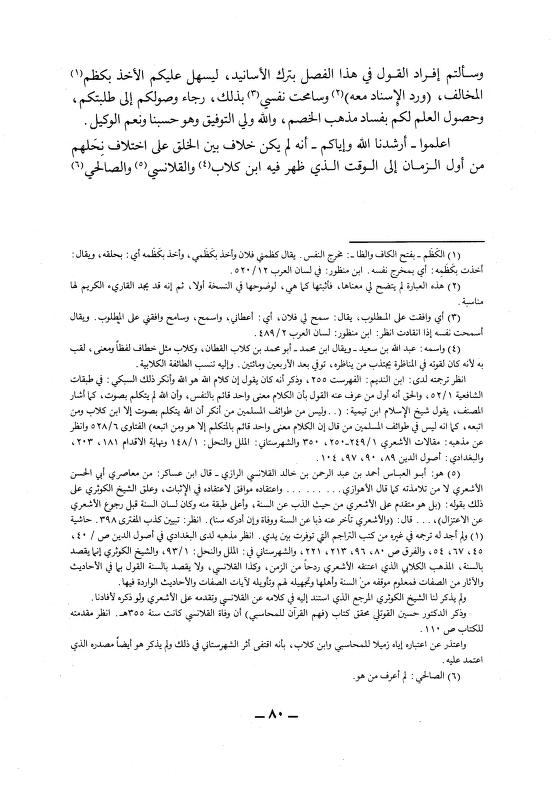
al-Qalānisī, al-Ash‘arī, and their peers, that speech is not except letters and sounds that are composed and arranged, even though languages may differ...Thus, the consensus among rational beings is firmly established that speech is composed of letters and sounds.
However, when Ibn Kullāb and his peers appeared, they attempted to refute the Mu'tazilah solely through rational arguments, without understanding the principles of the Sunnah or the stance of the Salaf. They did not rely on the transmitted reports because they considered them
solitary narrations (āḥād) that do not yield certainty. The Mu'tazilah confronted them by asserting the consensus that speech consists of letters and sounds, involves succession and composition, and such characteristics cannot exist in what we see without movement and stillness,
nor can they exist without parts and components, thus, what possesses these qualities cannot be an attribute of Allah’s essence, as Allah’s essence is not characterized by assemblage or disjunction, totality or partiality, movement or stillness.
The nature of an intrinsic attribute is the same as the nature of the essence itself. They said: Consequently, it is understood from this that the speech attributed to Allah is a creation of His, something He brought into existence and ascribed to Himself, just as we say:
the servant of Allah, the creation of Allah, the act of Allah. Ibn Kullāb and his followers were suffocated by this necessity, due to their lack of knowledge of the Sunnah and their rejection of it. They surrendered themselves entirely to rationalism, thereby conceding
to the Mu‘tazilite’s implication and contradicted the universal consensus among both Muslims and non-Muslims. They told the Mu'tazilah: What you describe is not the true reality of speech; rather, it is called speech metaphorically because it represents or signifies it.
The true nature of speech is a meaning subsisting in the essence of the speaker... Then they claimed based on this, that affirming letters and sounds in Allah’s speech is anthropomorphism, and affirming language therein is tashbīh (likening Allah to creation)."
(Risālat al-Sijzī ilā Ahl Zabid fīl-Radd ‘alā Man Ankar al-Ḥarf wa’l-Ṣawt, p. 115)
جاري تحميل الاقتراحات...