

Wa alaykum salam,
We've established that the later Ash'ari school, following Al-Razi, adopted Aristotle's concept of place as a boundary that encompasses what is within. I mentioned that Ahl al-Hadith, reject such a concept, as we do not say that God is within any entity.
1/24
We've established that the later Ash'ari school, following Al-Razi, adopted Aristotle's concept of place as a boundary that encompasses what is within. I mentioned that Ahl al-Hadith, reject such a concept, as we do not say that God is within any entity.
1/24
This discussion centers around a concept known as Al-Hayyiz al-Adami (non-existent space.) I will provide references from both Ahl al-Hadith and the majority of Ash'aris before Al-Razi affirming this concept as non-existent in opposition to the aforementioned Aristotelian notion.
Shaykh al-Islam said:
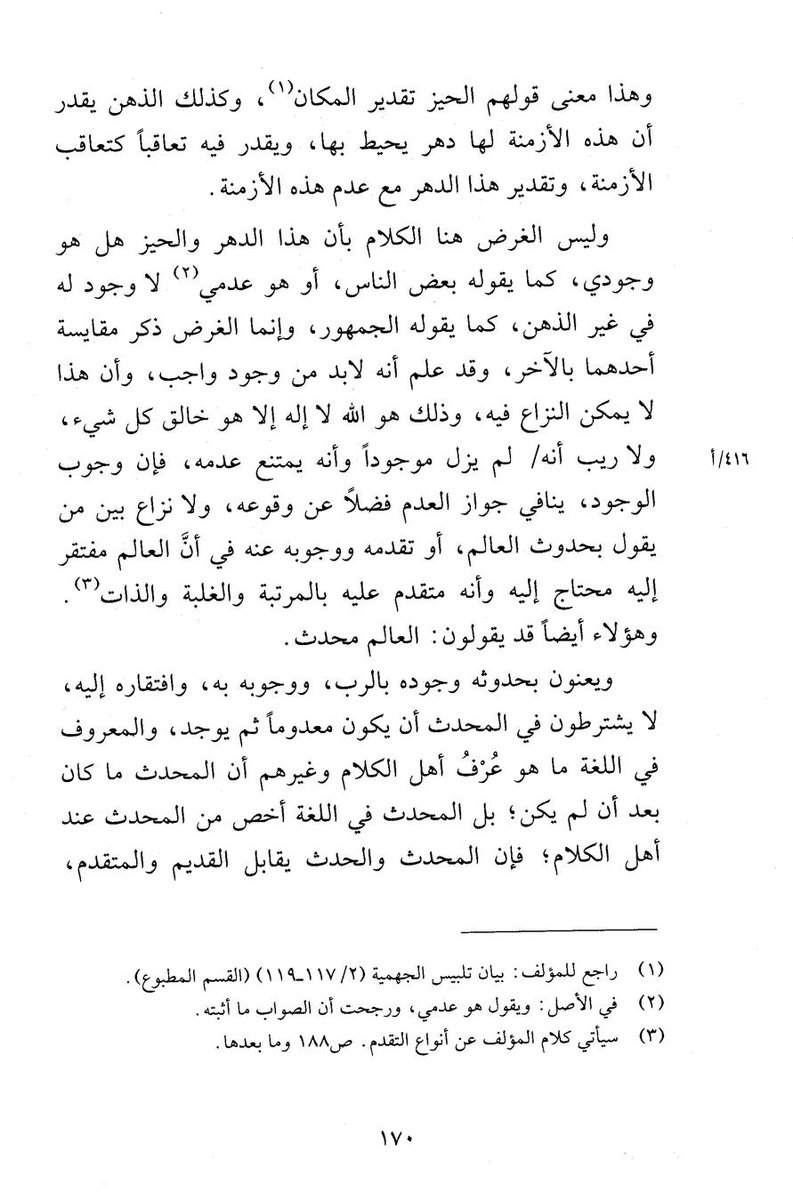
"There is no dispute among followers of religions that Allah, the Exalted, existed before creating these places and times, and that His existence is not necessarily concurrent with the existence of these places and times, as has been previously explained.
"There is no dispute among followers of religions that Allah, the Exalted, existed before creating these places and times, and that His existence is not necessarily concurrent with the existence of these places and times, as has been previously explained.
However, with these created, existent places, the mind conceptualizes boundaries (ahyaaz) containing them, and it does so even in the absence of these places. This is the meaning of their saying 'al-hayyiz' (space) and conceptualizing place.
Similarly, the mind conceptualizes that these times are encompassed by a perpetual duration in which succession occurs, like to the succession of times, and it conceptualizes this perpetual duration even in the absence of these times.
The intention here is not to expand on whether time and space are ontological, as some people claim, or non-existent external from the mind, as the majority say." — Bayān Talbīs al-Jahmiyyah 5/170.
The idea here is that such a thing is non-existent ontologically;
The idea here is that such a thing is non-existent ontologically;
rather, it is conceptualized within the mind to reference the entity itself in question, not some external entity in which the first one is confined.
He also said:
"'Al-Makan' (Place) as it is well-known, represents the well-known entities and what subsists within them,
He also said:
"'Al-Makan' (Place) as it is well-known, represents the well-known entities and what subsists within them,
whether it is said that Makan (Place) is the very bodies upon which or within which something exists, or it is said that Place is the inner surface of the containing body in contact with the outer surface of the contained body."
This means that the term "place" is commonly used to refer to something ontological. This ontological entity could either be the very bodies themselves, such as the Earth or the Moon, or it could refer to a containing body that contains another body within it,
like a garment that encompasses a person. In the terminology of the majority of the Kalamists, "Place" refers to something existent in the external world. It is either something that contains something else within it, or it is the very existing entity itself.
He continues:
"However, with these created, existent places, the mind conceptualizes boundaries containing them, and it does so even in the absence of these places."
This means that the predominant usage of the term al-hayyiz is the conceptualization of Place in the mind,
"However, with these created, existent places, the mind conceptualizes boundaries containing them, and it does so even in the absence of these places."
This means that the predominant usage of the term al-hayyiz is the conceptualization of Place in the mind,
which is a conceptualization that does not exist externally.
When he said previously:
"...Time and space are ontological, as some people claim, or non-existent external from the mind, as the majority say."
The majority he referenced, includes the Ash'aris,
When he said previously:
"...Time and space are ontological, as some people claim, or non-existent external from the mind, as the majority say."
The majority he referenced, includes the Ash'aris,
as they agree al-hayyiz is a non-existent concept like time; neither of them has an existence outside the mind. This is consistent with the principle that external existents must be perceptible by one of the senses, either manifest or latent,
and is one of the reasons the Salaf condemned the Jahmiyyah's denial of vision and pointing to Allah, asserting that what cannot be pointed to or seen is non-existent, as its existence is like mental existents that do not have external reality.
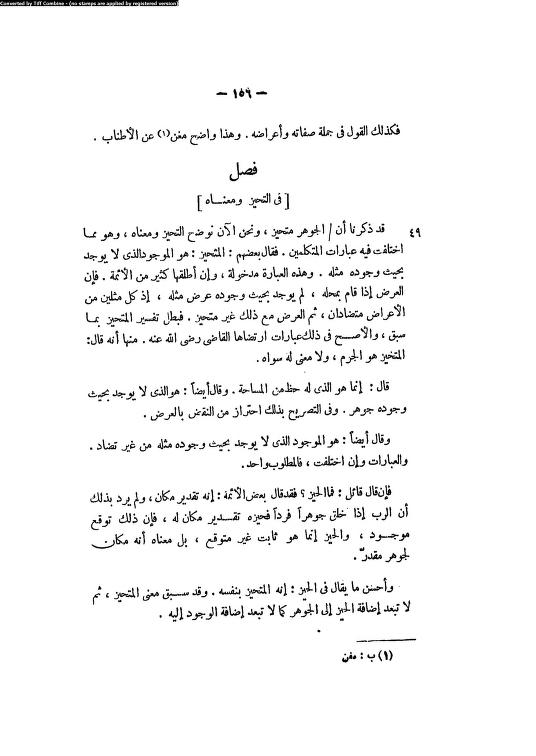
Now, I will mention something similar to what Ibn Taymiyyah affirmed but from Al-Juwayni, the Imam of Ash'aris:
"If someone asks, 'What is al-hayyiz?' Some of the scholars have said that it is the conceptualization of a place,
"If someone asks, 'What is al-hayyiz?' Some of the scholars have said that it is the conceptualization of a place,
but by this, they did not mean that when the Lord creates an indivisible particle (Jawhar), its hayyiz is a conceptualization of a place for it, for that would imply something existent. Rather, al-hayyiz is something that is established without implying existence.
Its meaning is that it is a Makan (place) for a conceptualized entity, and the best that could be said about al-hayyiz is that it refers to the entity itself [The Mutahayyiz.]"
Al-shamil fi usul al-deen p:156
Al-shamil fi usul al-deen p:156
So, Al-Juwayni affirms that the most correct view, which was also agreed upon by Abu Bakr al-Baqillani and the majority view among the Kalamists, is the concept of space that refers to the thing itself in question.
Note: The term 'al-hayyiz' is sometimes used to refer to an existent reality and other times to a non-existent concept. They distinguish between the terms 'al-hayyiz and al-makan'; they say that 'al-makan' is something existent, while 'al-hayyiz' is a conceptualization of place.
Based on what we have stated, when someone says "God is up there" or even mentions "God's place," they are not referring to anything other than God Himself and His existence.
The issue arises because Al-Fakhr Al-Razi chose a different concept, and the later scholars of Ash'arism
The issue arises because Al-Fakhr Al-Razi chose a different concept, and the later scholars of Ash'arism
followed him on it. He himself adopted it from Aristotle, who discussed this in his book "on physics." The reason this creates a problem is that it establishes an epistemological gap that hinders communication. We see this as Ash'aris often think God being over the throne as
implying that He must be confined within a created entity—a belief that is not only a strawman but also stands upon a rational paradox. For me, it is quite shocking to witness the level of argumentation used to deny explicit statements of God,
claiming that reason contradicts them, when in reality, sound reason supports them. Nothing within reason suggests such an Aristotelian concept of Makan; but it contradicts it. I hope that whoever engages in such discussions refrains from employing such low-level critiques
and at least attempts to understand the position better. I can guarantee that once they do, whatever critique they offer against this position—at least in this context—will collapse by their own recognition once they realize the fundamental error.
Wallahu 'Alam.
Wallahu 'Alam.
جاري تحميل الاقتراحات...