

Not quite random observations about #TheRingsOfPower
Should the Elves even be in Middle-earth?
This question lingers in the background for most of Season 1, but it’s also strongly connected to the creative collaboration at the heart of Season 2.
A very long thread 🧵(100+)
Should the Elves even be in Middle-earth?
This question lingers in the background for most of Season 1, but it’s also strongly connected to the creative collaboration at the heart of Season 2.
A very long thread 🧵(100+)
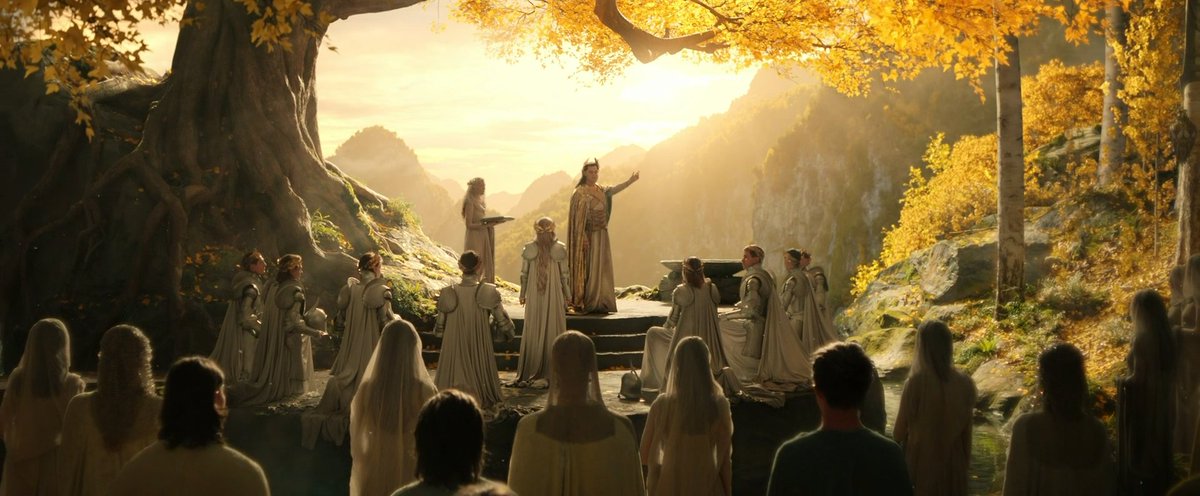
The goal of these threads is not primarily to explain what’s happening in the show, but to explore the themes and ideas in Tolkien’s texts and how they could be used in the kind of adaptation that ‘The Rings of Power’ is (more in the linked thread).
x.com
x.com
📖 EXPLORE THE LORE
At the beginning of ‘The Silmarillion’, in the ‘Ainulinalë’, we read that Ilúvatar chose Arda to be the habitation of his children (Elves and Men).
Some of the Ainur then decide to enter Arda to prepare their home for them, but Melkor has his own motivation.
At the beginning of ‘The Silmarillion’, in the ‘Ainulinalë’, we read that Ilúvatar chose Arda to be the habitation of his children (Elves and Men).
Some of the Ainur then decide to enter Arda to prepare their home for them, but Melkor has his own motivation.
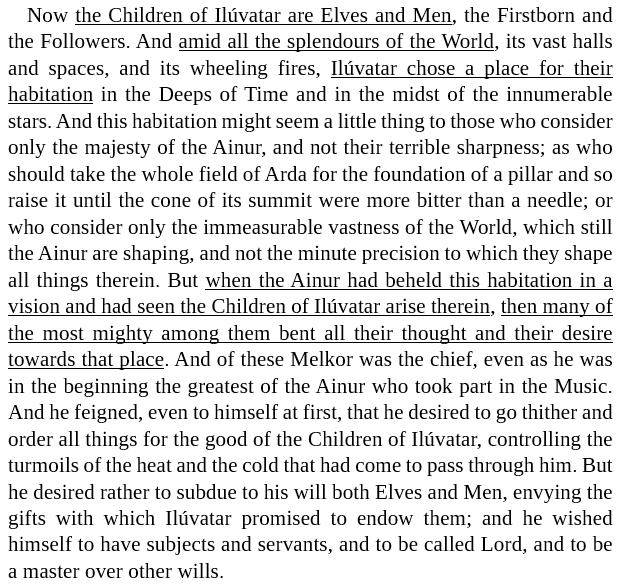
After Tulkas drives Melkor from Arda, the other Ainur in the world, now called ‘Valar’, start to order seas, lands and mountains to create the first home for the Children: a perfectly ordered world in a changeless day, illuminated by two great lamps. (‘Of the Beginning of Days’)
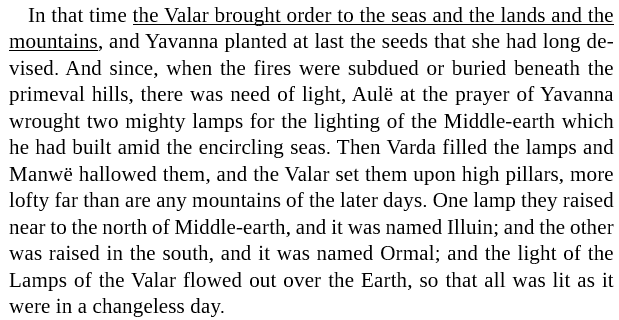
But while the Valar rest from their larbor and hold a feast, Melkor returns and infuses his hatred into the world, thus creating sickness, perilous forests and monsters.
Finally he assails the the two lamps and and the ensuing chaos breaks the symmetry of Middle-earth forever.
Finally he assails the the two lamps and and the ensuing chaos breaks the symmetry of Middle-earth forever.
After the failure of their first attempt, the Valar change their plan and scale down their ambitions. They remove themselves from the center of the world and instead fortify the westernmost of all lands, later called ‘Aman’ or ‘Valinor’, and leave Middle-earth to Melkor’s rule.
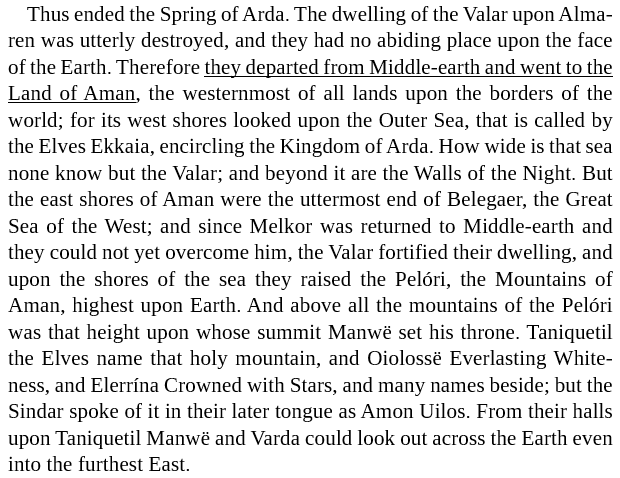
There they create a new home, a blessed realm without fading or withering, corruption or sickness, the dwelling of the Deathless.
But then the Elves awaken not in the light of this new land, but under the starlight next to the Lake of Cuviénen in the far east of Middle-earth.
But then the Elves awaken not in the light of this new land, but under the starlight next to the Lake of Cuviénen in the far east of Middle-earth.
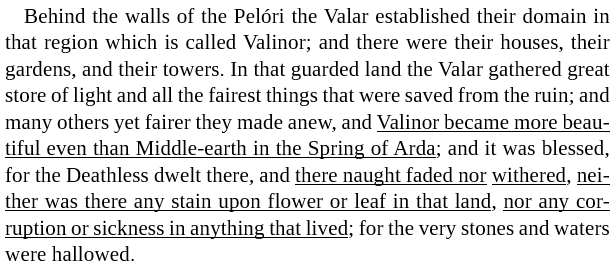
When the Valar find out that the Elves have awoken, Manwë seeks the council of Ilúvater and recieves this revelation: take up again the mastery of Arda and deliver the Elves from Melkor.
So they launch a destructive attack on Utumno and haul Melkor as a captive back to Valinor.
So they launch a destructive attack on Utumno and haul Melkor as a captive back to Valinor.

But they still have to decide what to do with the Elves and in this question they have no divine revelation.
The council is split, but the majority wants to bring the Elves to Valinor to keep them save. But there is also a minority who wants to keep the Elves in Middle-earth.
The council is split, but the majority wants to bring the Elves to Valinor to keep them save. But there is also a minority who wants to keep the Elves in Middle-earth.
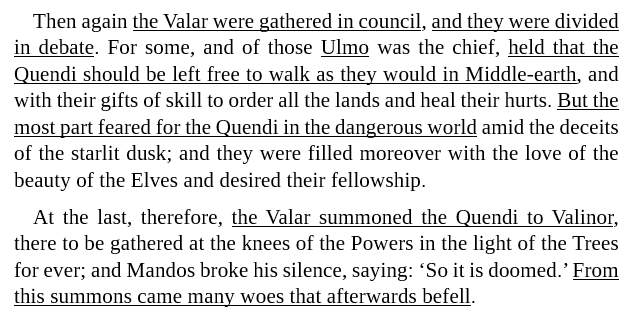
At first the Elves are unwilling to hearken the summons, having only experienced the wrath of the Valar in their fight against Melkor. So three ambassadors are taken to Valinor and are impressed by its glory and splendor. But like the Valar, the Elves are also divided.
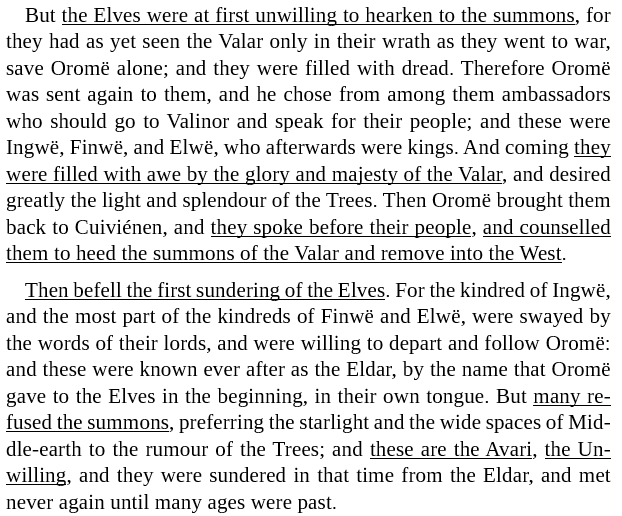
The summons of the Valar leads to the first of multiple sunderings of the Elves, each leaving groups behind. The labels are given by the group that followed the summons and they call the others ‘Moriquendi’ (Elves of the Darkness) and ‘Avari’ (Unwilling). x.com
When Ulmo later ferries the Teleri to Valinor, he follows his own counsel and anchors the island before the coast of Valinor, thus creating Eressëa, a strange place that is part of both and neither worlds.
We now have two competing stories about the home of the Elves.
We now have two competing stories about the home of the Elves.
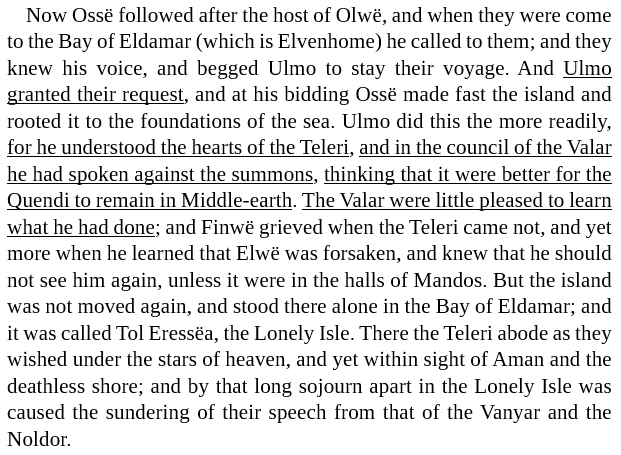
One ist the official policy of Valinor and is backed by Manwë and the council of the Valar: The elves should not be in Middle-earth, but live as pupils of the Valar in their (new) home in Valinor. And another upheld by at least Ulmo in which Middle-earth is still their true home.
But then Melkor’s captivity ends with a pardon. He takes advantage of this tension and whispers a third version of the story into the ears of the Noldor:
They were meant to rule Middle-earth, but the Valar removed them to Valinor out of jealousy to keep them under control.
They were meant to rule Middle-earth, but the Valar removed them to Valinor out of jealousy to keep them under control.
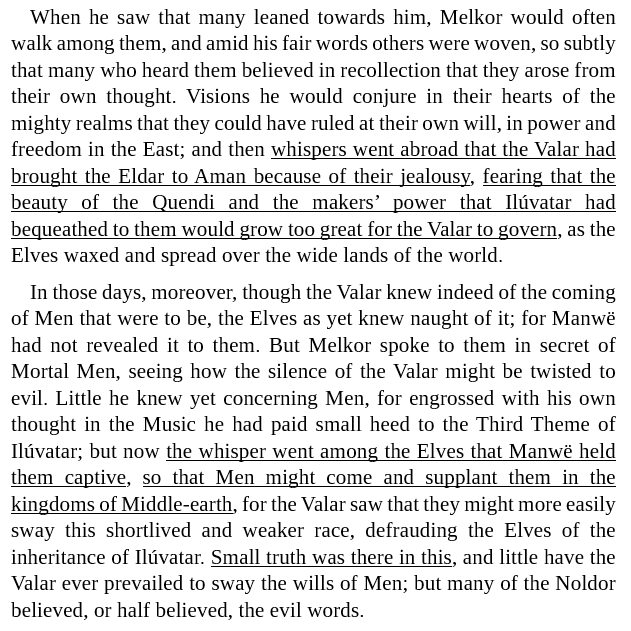
His words bear fruit: After the destruction of the Two Trees and the theft of the Silmarills by Melkor, Fëanor incites the other Noldor to ‘return to our home’. And so most of the Noldor leave Valinor and untertake the dangerous journey to Middle-earth.
x.com
x.com
If we look back in the development of the story, we can see an ambiguity in the decision of the Valar from the very beginning.
Already in ‘The Lost Tales’, we find an allusion to an alternative outcome: a fairer world and happier Elves, had the Gods decided otherwise.
Already in ‘The Lost Tales’, we find an allusion to an alternative outcome: a fairer world and happier Elves, had the Gods decided otherwise.
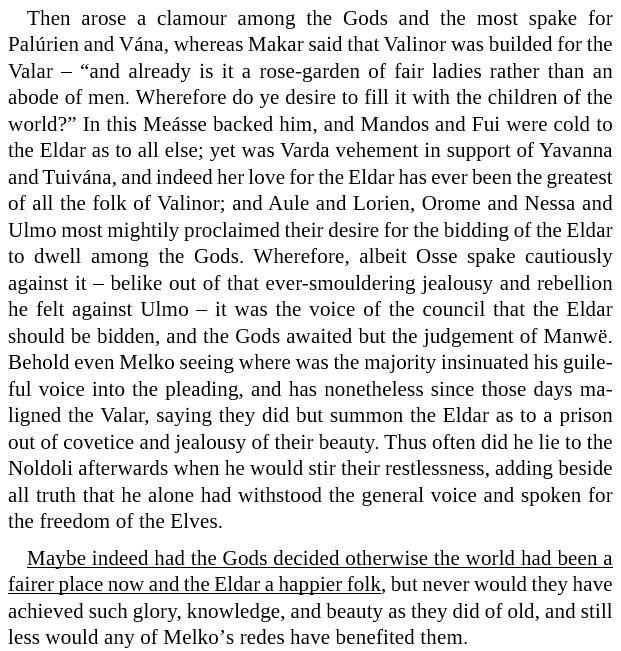
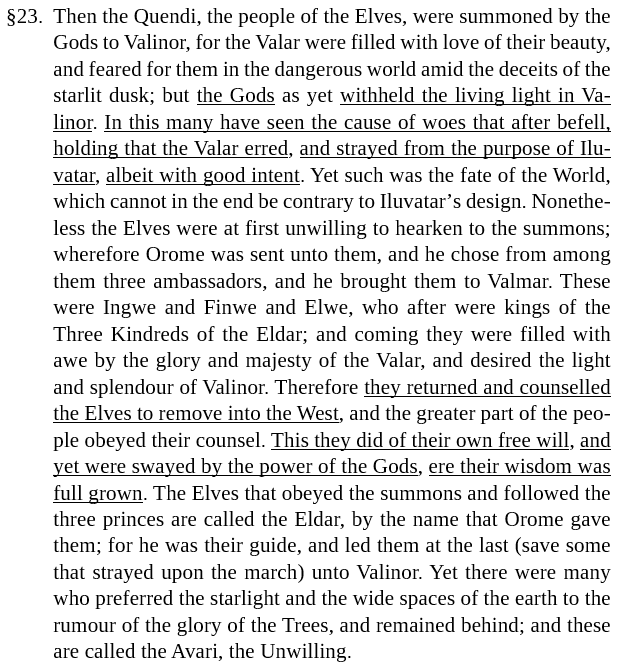
In the ‘Quenta Silmarillion’, written in 1937, Tolkien refers to the opinion of many, ‘that the Valar erred, and strayed from the purpose of Iluvatar, albeit with good intent’.
And he also notices a power imbalance: the Elves decided ‘ere their wisdom was full grown’.
And he also notices a power imbalance: the Elves decided ‘ere their wisdom was full grown’.
About the year 1957, Tolkien revised the ‘Quenta Silmarillion’, creating what is called ‘The Later Quenta Silmarillion’, which was used in ‘The Silmarillion’ (see above).
In this version, criticism on the decision of the Valar only shows up in a refuted attack on their motives.
In this version, criticism on the decision of the Valar only shows up in a refuted attack on their motives.
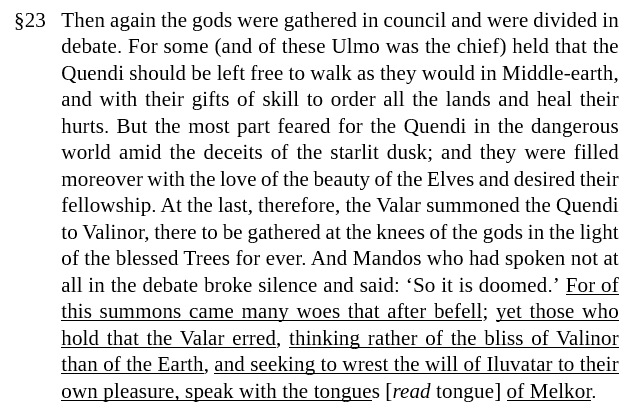
But in 1967, Tolkien wrote a text with the title ‘The Knowledge of the Valar’. This text was later published in ‘The Nature of Middle-earth’.
Here we find again the idea that the Valar themselves where ‘on trial’ and could therefore make wrong decisions.
Here we find again the idea that the Valar themselves where ‘on trial’ and could therefore make wrong decisions.
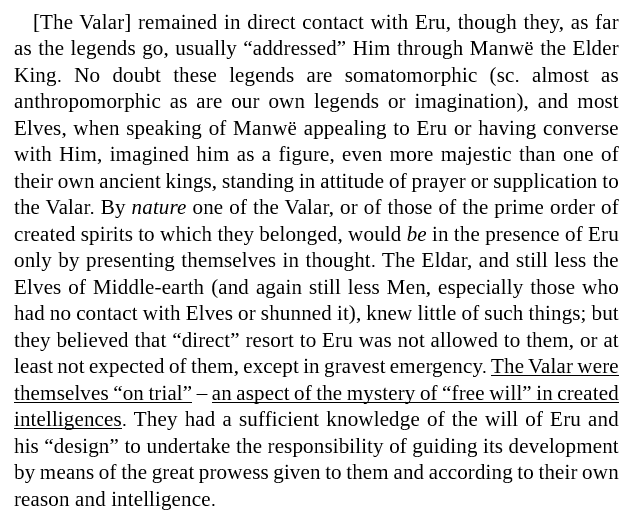
Although the Valar had superior knowledge about the world, the Children of Eru, Elves and Men, and their full purpose remained a mystery to them.
We also meet a more elaborate version of the idea that the Children would heal Arda, mentioned by Ulmo in his argument earlier.
We also meet a more elaborate version of the idea that the Children would heal Arda, mentioned by Ulmo in his argument earlier.
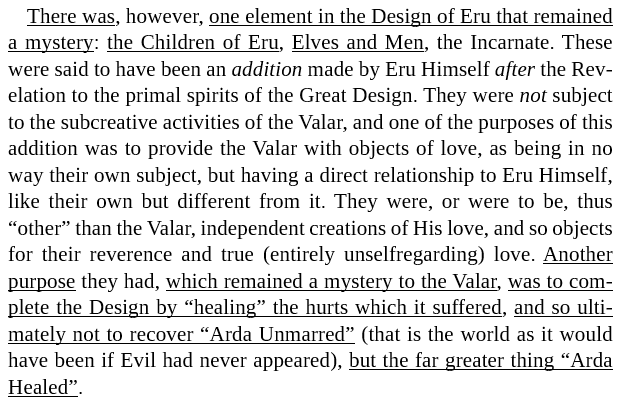
Tolkien then mentions only one absolute prohibition: to use their superior power to dominate the Children, be it by force or fear or just plain impressiveness.
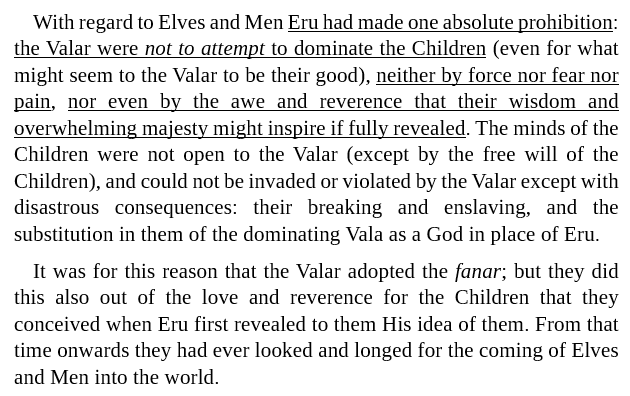
The fanar, the visible body adopted by the Valar, was an answer to this problem (but did not fully solve it).
The fanar, the visible body adopted by the Valar, was an answer to this problem (but did not fully solve it).
And then we find again an opinion ‘held by some’ that the retreat from Middle-earth and the creation of Valinor as a permanent habitation constituted a failure in understanding and trust by the Valar, but on done in good faith.
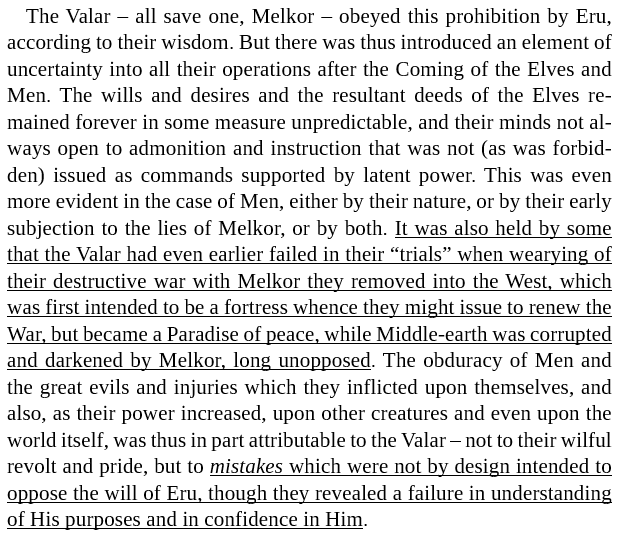
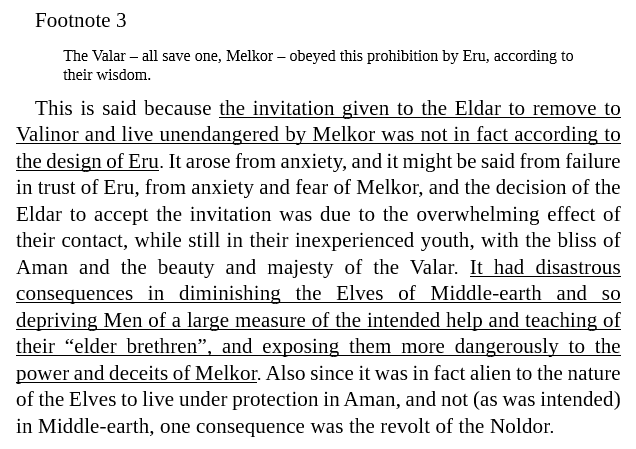
Finally, Tolkien added a footnote to explain the expression ‘according to their wisdom’.
Here we find the strongest form of the counterargument: The decision of the Valar was against the design of Eru, included the overwhelming with shown power and had disastrous consequences.
Here we find the strongest form of the counterargument: The decision of the Valar was against the design of Eru, included the overwhelming with shown power and had disastrous consequences.
In the end, the answer to the question ‘Should the Elves be in Middle-earth?’ depends on who you ask. Manwë and Ulmo will answer it differently and the same is true for various Elves, even inside the same family. And each answer has its own justification and blindspots.
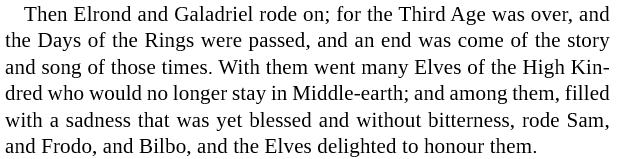
In ‘The Silmarillion’, but also in ‘The Lord of the Rings’, the story of Valinor as Elvenhome proves to be the dominant one and after the end of the Third Age, almost all of the remaining Noldor, including Elrond and Galadriel, leave Middle-earth again. (from: ‘The Grey Havens’)
But in the Second Age, the majority of them still sees Middle-earth as their home and that gives room to explore the follow-up question ‘What's the purpose of the Elves in Middle-earth?’ and its somehow abiguous and enigmatic answers.
🗝️TEST THE KEY
When looking for our themes in Season 1 of the show, we start out by hitting a stumbling block: in the prologue of Episode 1, Galadriel tells us a very incomplete version of the story (not a first for her).
But the whole backstory still looms in the background.
When looking for our themes in Season 1 of the show, we start out by hitting a stumbling block: in the prologue of Episode 1, Galadriel tells us a very incomplete version of the story (not a first for her).
But the whole backstory still looms in the background.
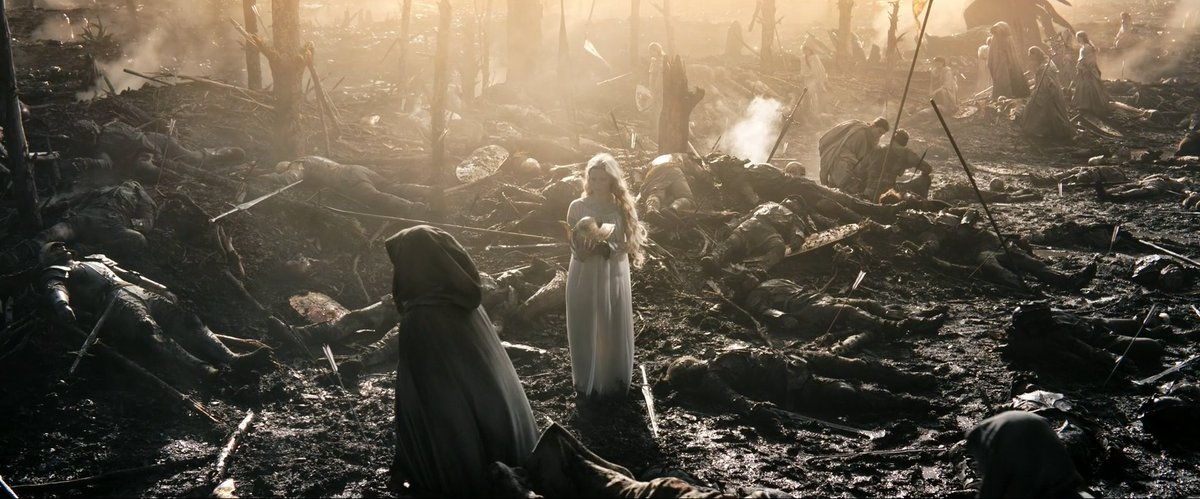
As P. McKay explained: ‘The other trick was to summarize the great big tentpole events of the First Age in a way that would leave room for people who know the lore to fill in the pieces we are skipping over. We are not trying to rewrite or eliminate or change, but to elide over.’

Let’s assume this is true and see how we can connect the script and the lore.
At the start of Episode 1, we hear a song: ‘Mélamar, Eldamar, cene cala lessen’ (Beloved home, Elvenhome, to see light in you). The theme of Elvenhome is obviously central to the entire series.
At the start of Episode 1, we hear a song: ‘Mélamar, Eldamar, cene cala lessen’ (Beloved home, Elvenhome, to see light in you). The theme of Elvenhome is obviously central to the entire series.

The name ‘Eldamar’ refers to the land given to the Noldor and Vanyar in Valinor by the Valar: a deep valley in a gap of the Pelóri, the mountains that guard Valinor. There they raised the hill of Túna and built the city of Tirion as their new home. (‘The Silmarillion’)

After young Galadriel’s talk with her brother Finrod, we can catch a glimpse at the valley, the city of Tirion and the Two Trees in their full glory.
The show presents Valinor as the home of the Elves and it is from here that they go to war and travel to Middle-earth.
The show presents Valinor as the home of the Elves and it is from here that they go to war and travel to Middle-earth.

Galadriel calls Valinor ‘our home’, while Middle-earth is ‘a distant realm […] filled with untold perils and strange creatures’. This fits her own perspective, because she was born in Valinor, but also repeats the sentiment of the Valar of Middle-earth as a dangerous place.

After the title sequence, we get introduced to Elrond who is composing a speech. He reads in Quenya: ‘I Palannúmen... I Alfirimë Nóri... Na metta avantë’ (the Far West, the Undying Lands, at last the are going) and ends with the word ‘home’.

A bit later in the episode we find ourself in the occasion the speech was written for: Gil-galad, High King of the Noldor, grants Galadriel and her company passage to return to Valinor, their home.
Everything looks perfect. We hear the lyrics from the start of the episode again.
Everything looks perfect. We hear the lyrics from the start of the episode again.

But the story (as expected) does not end as planed by Gil-galad: at the entrance to Valinor, when we hear the lyrics for the last time, Galadriel decides to jump ship instead.
Something or someone calls on her to delay her return to Valinor.
Something or someone calls on her to delay her return to Valinor.

The music hints at a connection to Sauron (as stated in Bear McCreary’s blog). It could be either he himself or the task of hunting him. Whatever the answer to this question, it’s fitting that her decision happens in the realm of Ulmo, who wants the elves to be in Middle-earth.
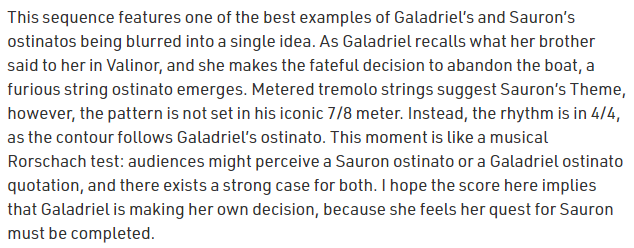
(The reason for Galadriel’s reluctance to return to Valinor in Tolkien’s writing underwent some developement and change over the course of his lifetime, and I save that topic for another occasion.)
But Galadriel is not the only one that is conflicted about returning ‘home’. The relationship of all of the Noldor to Valinor and Middle-earth is overshadowed by Melkor’s version of their story. Things may not be as simple as they appear on the surface.
x.com
x.com
Let’s scratch the surface a little.
In Episode 8, when all the major Elves meet up in Celebrimbor’s workshop, Galadriel explains her actions by what could be easily a counsel of Ulmo: ‘Sometimes the perilous path is the only path.’ But Gilgalad’s answer is more interesting.
In Episode 8, when all the major Elves meet up in Celebrimbor’s workshop, Galadriel explains her actions by what could be easily a counsel of Ulmo: ‘Sometimes the perilous path is the only path.’ But Gilgalad’s answer is more interesting.

‘You should not be standing here at all,’ he pontificates while wearing a crossed sash with the title ‘ARAN EINIOR’, that is ‘Elder King’, Manwë’s chief title, over his breast. One can percieve a mixture of irony and hyprocrisy given the backstory of the Elves in the Second Age.
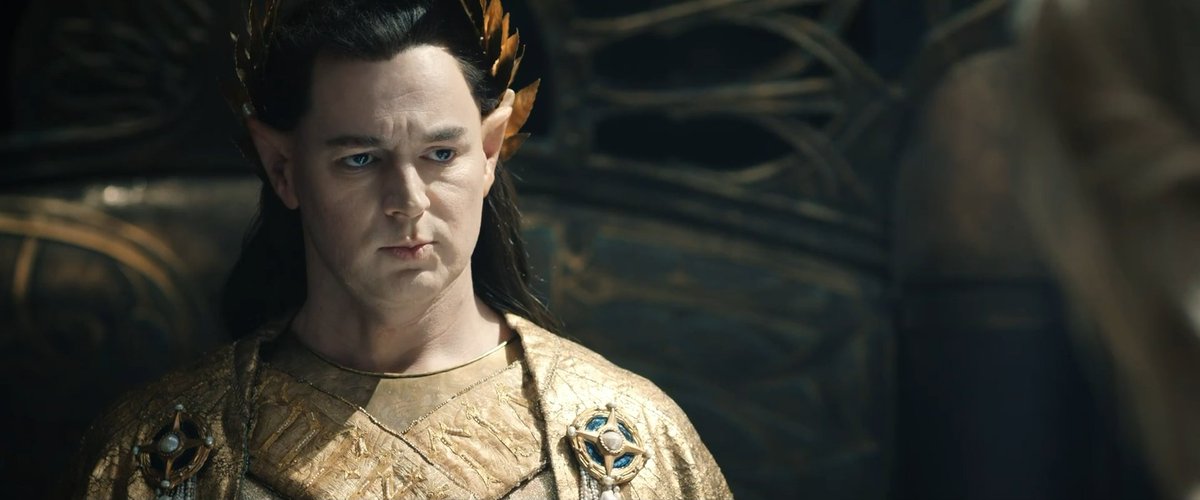
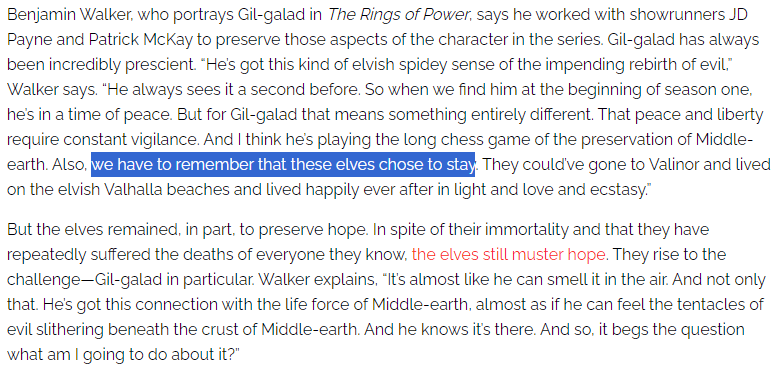
Because the summoning of the Elves to Valinor didn’t happen only once. After Morgoth’s defeat, Eönwe, as herald of Manwë, summoned the Elves of Beleriand to depart from Middle-earth for a second time.
And the Elves who remained in Middle-earth ignored this summons. (Silm)
And the Elves who remained in Middle-earth ignored this summons. (Silm)
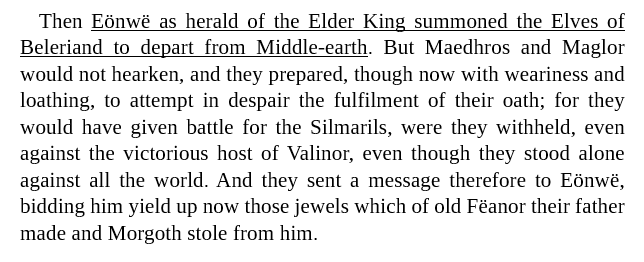
In one of the pre-show interviews, Benjamin Walker acknowledges that ‘these elves chose to stay’, but his explanation for their stay (‘to preserve hope’) seems to elide over something.
But perhaps he could not reveal an objective view of his character (like Charlie Vickers).
But perhaps he could not reveal an objective view of his character (like Charlie Vickers).
In his Letter to Milton Waldman, Tolkien hints at the penitential nature of this second summons: the Elves were not called to return to Valinor, but only to Eressëa, the isle right next to but still outside of Valinor. They faced a quarantine of unknown duration. (Letter 131)
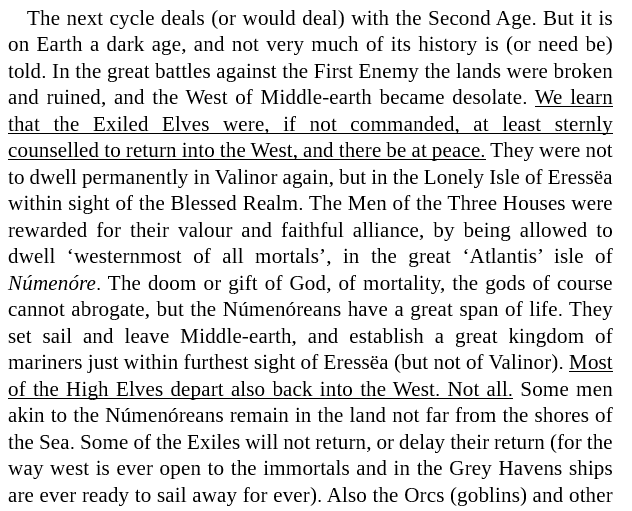
They were not alone in this situation: Sauron was also commanded to return to the judgement of the gods.
But as his return would be even more penitential (‘a sentence of long servitude in proof of his good faith’), he also decided to linger in Middle-earth instead. (Letter 131)
But as his return would be even more penitential (‘a sentence of long servitude in proof of his good faith’), he also decided to linger in Middle-earth instead. (Letter 131)
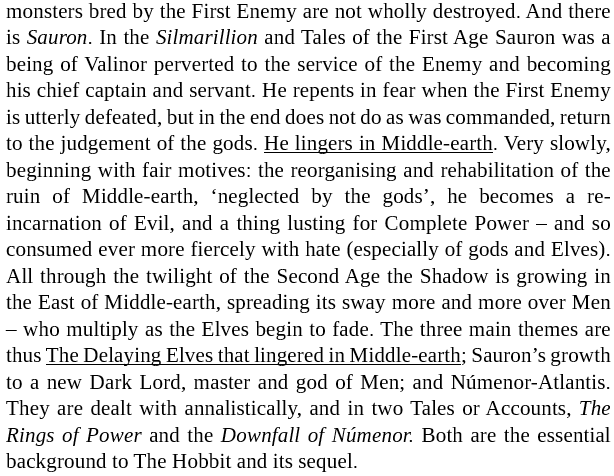
This way we get the recipe for the desaster that Tolkien called ‘a sort of second fall’ of the Elves and it included 3 ingredients: the clinging to a role at the top of the hierarchy, the desire to live in a perfect memory of ‘the West’ and an obsession with fading. (Letter 131)
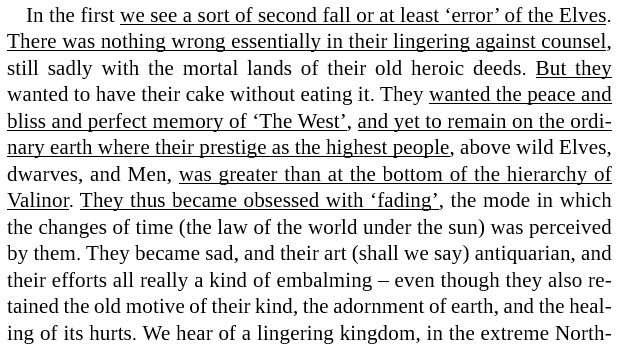
The first ingredient is depicted in Galadriel’s conduct in the court of Númenor. We can see what it looks like for the Elves to feel as ‘the highest people, above wild Elves, dwarves and Men’.
Her attitude didn’t just make the court’s tempers boil.
Her attitude didn’t just make the court’s tempers boil.

Morfydd Clark explained this arrogance as a way to portray a kind of naivety in a millennia old person: ‘Naivety […] for an elf would be arrogance, because they have not yet realized the limits of their own understanding’.
x.com
x.com
But Gil-galad is also no stranger to arrogance, although he is more adept at weaving it into his diplomatic manners.
(He also really doesn’t seem to like his dependence on the help of a ‘low man’.)
(He also really doesn’t seem to like his dependence on the help of a ‘low man’.)

Both Gil-galad and Galadriel were mentioned by the showrunners as characters the viewers should feel negative about at certain points because of how they behave.
I thereforethink it’s save to assume that if something feels wrong about them it probably is.
x.com
I thereforethink it’s save to assume that if something feels wrong about them it probably is.
x.com
The second ingredient can be seen in Lindon: it looks as if the Noldor here succeeded in creating their (slightly oversaturated) perfect memory of Valinor.
And now, after centuries of hunting down the remnants of Morgoth’s armies, their days of peace can finally begin.
And now, after centuries of hunting down the remnants of Morgoth’s armies, their days of peace can finally begin.
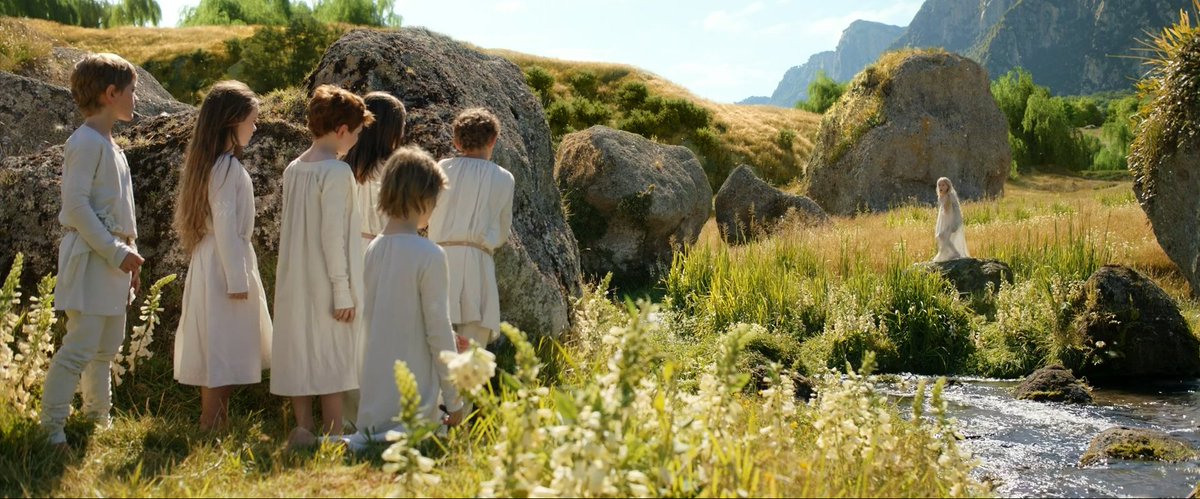
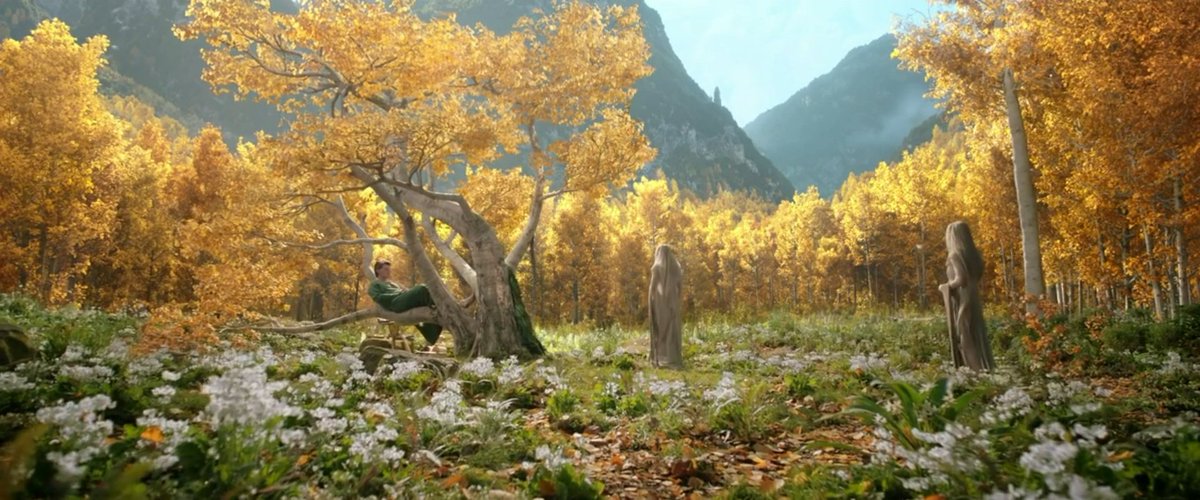
Despite all the talk about Valinor as their home, the rest of them makes no move to head home. On the contrary: Gil-galad speaks to Elrond about a new Sunrise. A sunrise that is connected to a project of singular importance, headed by Celebrimbor, the greatest of Elven-smiths.

In an interview prior to the release of Season 1, Charles Edwards described what seems to have been Celebrimbor’s original project in Eregion: to draw creative talents from all races to ‘recreate a Valinor in Middle-earth’.
x.com
x.com
But whatever the prior purpose of Celebrimbor’s project was, it has been changed by a sudden crisis: Elvenhome is in peril because ‘the light of the Eldar is fading’ and that danger is made visible (again) as a black veined blight upon a tree. And so we have our third ingredient.

I already made a thread about ‘fading’ and how the theme is used in the show. For our purpose here is is enough to note that what’s a slow and barely noticeable process in the lore has been transformed by someone into something more tangible and urgent.
x.com
x.com
And he also casts his shadow over Gil-galad.
When I wrote my thread about the ‘sauronean shadows’ visible in other character’s actions, I didn’t include Gil-galad because I couldn’t see them clearly at that time. But there are actually some for him too.
x.com
When I wrote my thread about the ‘sauronean shadows’ visible in other character’s actions, I didn’t include Gil-galad because I couldn’t see them clearly at that time. But there are actually some for him too.
x.com
Gil-galad’s goal is to save Middle-earth as home for the Elves and the other races, but he (like Sauron) attempts to move the chess pieces without their full knowledge.
Neither Galadriel nor Eldron knew the full purpose behind the ‘Gift of the King’.
Neither Galadriel nor Eldron knew the full purpose behind the ‘Gift of the King’.

It’s not his only manipulation. He also uses the threat of impending doom to overcome Elrond’s reluctance to break his oath (my greatest irritation with the script).
At the same time this threat is used by Sauron to manipulate him (hinted at by a variation of the Sauron theme).
At the same time this threat is used by Sauron to manipulate him (hinted at by a variation of the Sauron theme).

And that is not the only thing that feels wrong in this scene. The inspiring-sounding proverb about the ‘eye of hope’ also shows a dangerous closeness to Sauron, either through direct influence or thematic parallel:
x.com
x.com
And there is another sinister dimension to the ‘Gift of the King’: When Galadriel tells Elrond that she plans to reject her send-off, he reveals that the gift is bound up with a threat: ‘No one in history has ever refused the call. Do so now and it may never come again.’

(The first sentence is really difficult to square with the idea of the 2nd summons, because then everyone of the Elves, including Elrond, would have refused that call. He could mean that everyone sent away by Gil-galad was obedient, but here my construction squeaks and creaks.)
In Episode 8, Galadriel is offered another 'Gift of the King': being Queen to the future king over Middle-earth, Sauron. This time she persists in her refusal, and he threates her and the Elves with the same fading and darkness that already made such an impression on Gil-galad.

Wearing the sash seems to be more than just an innocent devotion to the gods, but rather the sign of a rebellion that has usurped parts of their authority.
(The man below is the next in line to call himself ‘King of Kings’ and angling for Manwë’s job.)
x.com
(The man below is the next in line to call himself ‘King of Kings’ and angling for Manwë’s job.)
x.com
If the position of the Elves and especially their king is at odds with the Valar, it’s no suprise that Sauron targets him first by offering him a crown.
But Gil-galad passes the test (for now; once he starts wearing Vilya, Sauron’s tempation will resume).
x.com
But Gil-galad passes the test (for now; once he starts wearing Vilya, Sauron’s tempation will resume).
x.com
Although the second summons and its rejection are absent in the show (and perhaps stay that way), the themes connected to it can still be observed. And the last High-King of the Elves and his eventual downfall are the perfect place to explore them further.
youtube.com
youtube.com
🔭EXPAND THE MAP
Let’s explore two other ideas about the purpose of the Elves in Middle-earth: to teach and heal the world.
The first summons prevented them from following their vocation, but it also empowered them to be more effective at it once they returned to Middle-earth.
Let’s explore two other ideas about the purpose of the Elves in Middle-earth: to teach and heal the world.
The first summons prevented them from following their vocation, but it also empowered them to be more effective at it once they returned to Middle-earth.
We find some of this tension in the story of ‘The Silmarillion’:
When Men, the Younger Children of Ilúvatar, finally awake in the East, the only Elves there to teach them are the Avari, the Dark Elves. But they are not suppost to be there (according to the plans of the Valar).
When Men, the Younger Children of Ilúvatar, finally awake in the East, the only Elves there to teach them are the Avari, the Dark Elves. But they are not suppost to be there (according to the plans of the Valar).
And when the Edain arrive in Beleriand, they are found by Finrod, Galadriel’s brother, who teaches them about the Valar. He later befriends Andreth and they learn from each other in what is called the ‘Athrabeth Finrod ah Andreth’.
But he isn’t supposed to be there either.
But he isn’t supposed to be there either.
In the show we also see two Elves teaching Men and again both are not supposed to be where they are:
Arondir was born in Beleriand and has never seen Valinor. But he nonetheless teaches Bronwyn about Yavanna, the Valië who ‘watches over growing things and those who tend them’.
Arondir was born in Beleriand and has never seen Valinor. But he nonetheless teaches Bronwyn about Yavanna, the Valië who ‘watches over growing things and those who tend them’.

Galadriel on the other hand follows the example of her brother when she teaches Theo about ‘estel’, the trust in a good end to the greater story.
x.com
x.com
But what about ‘healing the world’? (speculation about S2 storyline from here)
On one hand, the Elves are themselves in the business of healing land. Revion, the watchwarden, hints in Episode 1 at a recultivation of the Southlands, once a barren scrap of rock, through the Elves.
On one hand, the Elves are themselves in the business of healing land. Revion, the watchwarden, hints in Episode 1 at a recultivation of the Southlands, once a barren scrap of rock, through the Elves.

But there is another layer to this problem, one that is connected to the idea of ‘fading’. And it is the main reason why the policy of Manwë wins out in the end: ‘Arda marred’, the world wounded by Melkor, takes its toll on the Elves who still live outside of Valionor.
In a late text titled ‘Aman’ (HoME v.10), Tolkien worked out the difference between living in Valinor and in Middle-earth: When living in ‘Arda marred’, the developement of body and soul gets out of sync, leading in the long run for the Elves to fade.
x.com
x.com
The first symptoms of fading are psychological and therefore the elven healers have to be first and foremost artificers.
Arondir explains their task in Episode 1: ‘It is their labor instead to render hidden truths as works of beauty. For beauty has great power to heal the soul.’
Arondir explains their task in Episode 1: ‘It is their labor instead to render hidden truths as works of beauty. For beauty has great power to heal the soul.’

But keeping the memory of Valinor alive in beautiful objects only alleviates the symptoms but does not reach the roots of the sorrow.
To solve the problem of fading once and for all, the marring of Arda would have to be reversed. Someone would have to create an ‘Arda Unmarred’.
To solve the problem of fading once and for all, the marring of Arda would have to be reversed. Someone would have to create an ‘Arda Unmarred’.
But how could such a thing even be possible?
In his discussion with Andreth, Fingon suddenly concieves in a vision what is a mystery to the Valar: a world in which the marring of Melkor has been undone by the Children: ‘Arda Healed’. (‘Athrabeth Finrod ah Andreth’, HoME v.10)
In his discussion with Andreth, Fingon suddenly concieves in a vision what is a mystery to the Valar: a world in which the marring of Melkor has been undone by the Children: ‘Arda Healed’. (‘Athrabeth Finrod ah Andreth’, HoME v.10)
In another text, Tolkien created a full quenya form for this idea: ‘Arda Envinyanta’. ‘Envinayta’ means ‘to heal’, but more precisely ‘to make new again’. (from the shorter version of (iii) in ‘Notes on Motives’, HoME v.10)

But the healing of the world in both texts is something that could only be archieved with the help of the Creator at the end of the story and not by the children themselves now. And therefore the proper form of ‘hope’ towards such an end is ‘estel’, trust.
x.com
x.com
But not everyone is as wise as Finrod. And the artificers are powerful: Fëanor, the ‘chief artificer of the Elves’, imprisoned the Light of Valinor in the Silmarils.
Yet his possesive attitude towards these gems lead to the (first) fall of the Elves and war. (Letter 133)
Yet his possesive attitude towards these gems lead to the (first) fall of the Elves and war. (Letter 133)
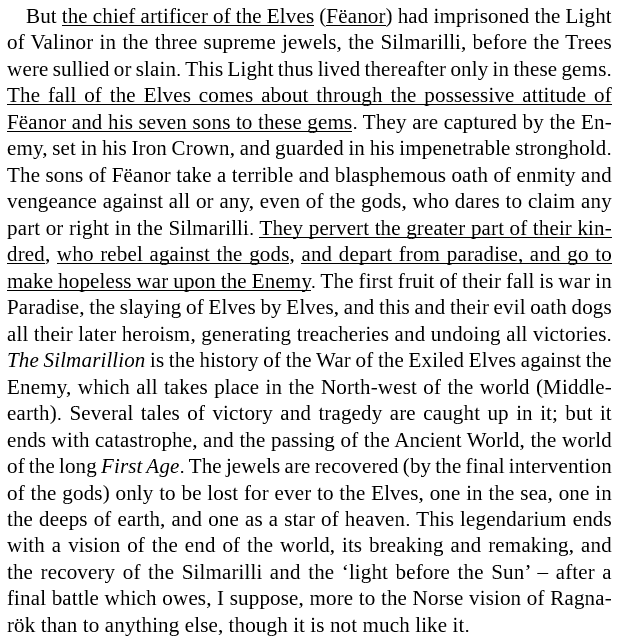
Had not Melkor stolen the Silmarills and so taken the decision from him, Fëanor could have been remembered as a the greatest of elven healers, because the light inside the Silmarils would have been able to save the Two Trees. (‘Of the Flight of the Noldor’)
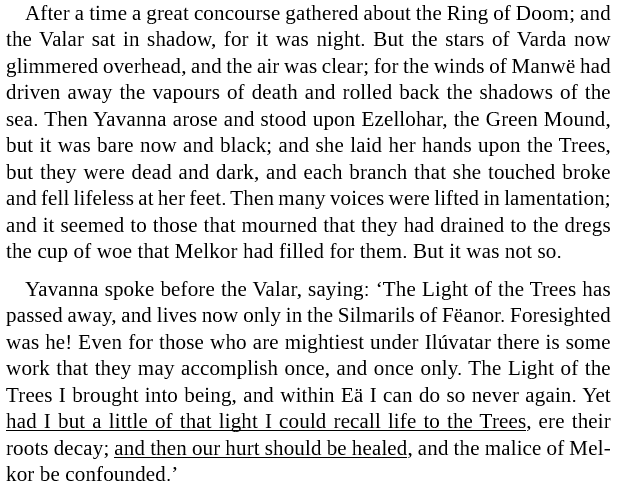
In the show, Celebrimbor, Fëanor’s grandson, wants to change history: ‘An Age ago, our kind brought war to these shores. I want to fill them with beauty’.
But he also wants to ‘grow beyond petty works of jewel-craft, and devise something of real power.’
x.com
But he also wants to ‘grow beyond petty works of jewel-craft, and devise something of real power.’
x.com
And he is not alone with his ambition: Sauron has a similar plan, as described by Adar: ‘healing Middle-earth, bringing its ruined lands together in perfect order’.
The last time such an state existed was when the Valar had ordered Middle-earth during the Spring of Arda.
The last time such an state existed was when the Valar had ordered Middle-earth during the Spring of Arda.

Back then, Melkor (with Sauron’s help) had attacked Middle-earth and ‘the shape of Arda and the symmetry of its waters and its lands was marred’.
But all changed with the first sunrise after Morgoth’s defeat: ‘I knew [...] that I had to heal everything that I had helped ruin.’
But all changed with the first sunrise after Morgoth’s defeat: ‘I knew [...] that I had to heal everything that I had helped ruin.’

And as a Maia he has more power at his disposal than the Elves.
We have seen a preview of his capabilities in Season 1 with the Stranger: a Maia with limited control over his powers, but already capable of healing himself and the orchard burned by the fallout of Orodruin.
We have seen a preview of his capabilities in Season 1 with the Stranger: a Maia with limited control over his powers, but already capable of healing himself and the orchard burned by the fallout of Orodruin.


And there’s the valley of Duranost, which we will revisit at the start of Season 2. Whether it’s Sauron’s blood magic or just the cooling water from the forge acting as a hot spring, the valley certainly looks healed from the frost that plagues Forodwaith.
x.com
x.com
At the start of Season 1, both Sauron and Celebrimbor still lack the power to archive their goals, but in Episode 8, Sauron enters Eregion in disguise and together they figure out a solution to the problem: the Rings of Power.
x.com
x.com
The power of the three Elvenrings offers a foretaste of what could be possible: the marring that threatens the Elves, visualized by the black veins and vines, is reversed and the Great Tree of Lindon is healed (apparently by the light of the Silmaril).
x.com
x.com
A perfect setup for Sauron in his new form as ‘Annatar’, the ‘Lord of Gifts’ to finally pitch his project: ‘Make Middle-earth as fair as Valinor’ (by undoing the marring) combined with a ‘teach the dummies’ for good measure (playing into their arrogance).
x.com
x.com
He offers them a practical way to deal with the problem of ‘Arda Marred’. They don’t have to rely on ‘estel’ anymore but now can take their destiny into their own hands and have ‘amdir’ instead.
But as Gil-galad instictively realized: It’s a fool’s hope.
x.com
But as Gil-galad instictively realized: It’s a fool’s hope.
x.com
The light shines just as brightly reflected in the water as in the sky though.
And the resume of our overwhelmingly bright visitor contains an apprentice to Aulë who is connected with the undoing of Melkor’s marring and the creation of beauty in Valinor.
x.com
And the resume of our overwhelmingly bright visitor contains an apprentice to Aulë who is connected with the undoing of Melkor’s marring and the creation of beauty in Valinor.
x.com
Even when revealed to be Sauron, his pitch would still work. He would just shift his story again to a redemption arc and appeal to Celebrimbor’s stated believes (as he did with Galadriel in Episode 8).
x.com
x.com
But their collaboration ends in betrayal, and none of the rings can heal the world or create a second Valinor although the 3 Elvenrings come closest with their (limited) ability to ward off change.
x.com
x.com
After The One Ring is lost at the end of the Second Age, the 3 bearers of the Elvenrings use their power in their own way.
Galadriel is the one who keeps the old dream alive by creating her own miniature Valinor, a land without stain and change, in Lóthlorien. (‘Lóthlorien’)
Galadriel is the one who keeps the old dream alive by creating her own miniature Valinor, a land without stain and change, in Lóthlorien. (‘Lóthlorien’)
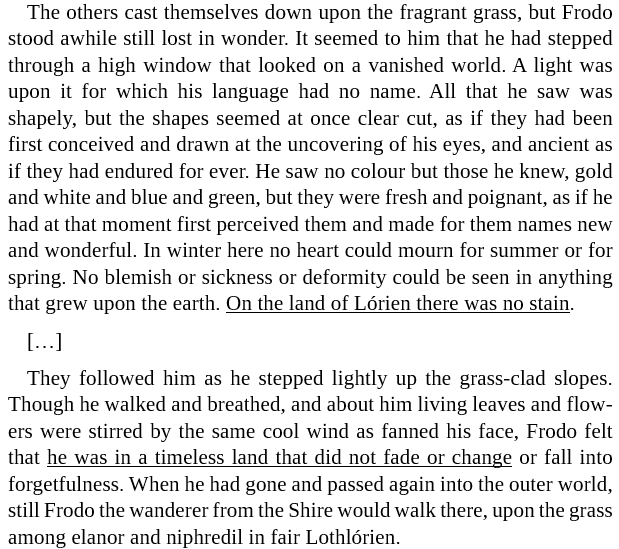
In the end, neither Sauron nor the Elves can find their peace in Middle-earth. With the destruction of the One Ring, Sauron falls into bodiless impotence, while the Elves are forced to abandon their enclaves, which are now defenseless against the tides of time, and return ‘home’.

EPILOGUE
That’s not the whole story though. Throughout this thread I have been quite sloppy with the term ‘Elves’. Celebrimbor, Galadriel and Gil-galad are all Noldor and they dominate the story.
But there also the Elves that never left Middle-earth in the first place. (Silm)
That’s not the whole story though. Throughout this thread I have been quite sloppy with the term ‘Elves’. Celebrimbor, Galadriel and Gil-galad are all Noldor and they dominate the story.
But there also the Elves that never left Middle-earth in the first place. (Silm)
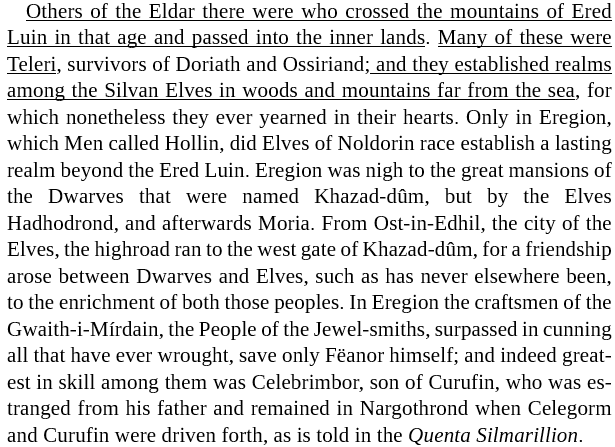
In 'Unfinished Tales' we can find a short text that shows us their perspective: a life in Middle-earth without the disturbance of the Valar (and the Noldor).
At some point, Galadriel will move to Lórien and we (hopefully) will see this conflict play out.
x.com
At some point, Galadriel will move to Lórien and we (hopefully) will see this conflict play out.
x.com
While Galadriel is still bound up on the western side of the Hithaeglir for now, the Stranger and his Harfoot companions are already heading even further east, towards the place where the elves awakened.
x.com
x.com
When Tolkien tried to solve the problem of how to breed a large enough elven host for his story, he added up to 25 generations between the first elves and the 3 ambassadors to Valinor (‘Key Dates’; NoME 1, XIII).
The Elves in Rhûn and beyond could be much older than our Noldor.
The Elves in Rhûn and beyond could be much older than our Noldor.
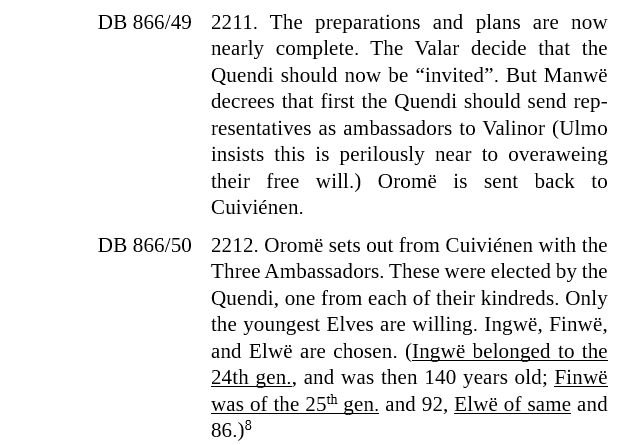
And with them we might encounter yet another story, one in which the role of the Valar again is not seen as positive:
x.com
x.com
But before that, we will meet another one of the so unfittingly called ‘Elves of the Darkness’. He longs to finally see Valinor but has decided to let everyone go first. He’s also an artificer, but his gems are his ships and he built them to serve the purposes of Manwë and Ulmo.
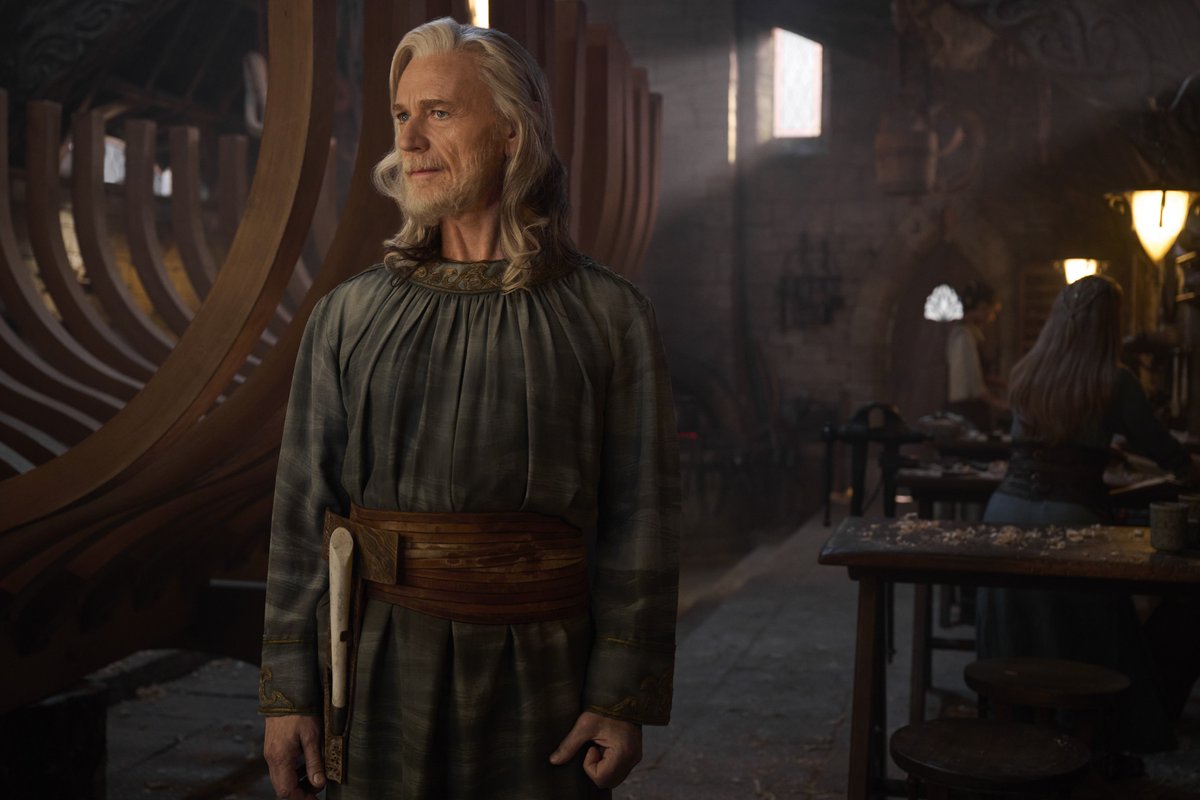
He does not share the machinations of the Aulendili, but the counsel of the Lord of Waters. Yet he still takes care of one of their rings that is so obviously not meant for him. He will complement Gil-galad by guiding Elrond in his role as future leader.
x.com
x.com
جاري تحميل الاقتراحات...