

Large military maneuvers are now underway near a strategic ballistic missile base in Kermanshah, Iran. Israel is bracing for an Iranian attack. So why doesn’t it attack and destroy Iran's ballistic missiles? Why does Israel wait? 🧵 1/13
Two weeks ago, Israel planted a bomb under the bed of Hamas' leader Hanyia right next to the Presidential palace in the heart of Teheran. On the same day, Israel killed Hizballah’s chief of staff in Beirut, months after killing Iran’s General Zahedi in Damascus. 🧵 2/13
If Israel’s military is so precise, why doesn’t it locate and destroy Iran’s ballistic missiles? Israel’s Jets can certainly reach Iran. In July, Israel’s Fighter Jets struck the port of Hodeida, Yemen, 2000 kilometers away. Iran is only 1500 km away. 🧵 3/13

Many assume that Israel can use sophisticated “bunker busters” to try and destroy Iran’s missile sites. But even the largest conventional bombs may not be enough. 🧵 4/13
In northern Iran, the Elburz mountains scrape the sky with peaks reaching 5600 meters, higher than both the Rockies and the Alps. Iran’s Zagros mountains stretch 1500 kilometers from northwestern Iran all the way south towards the Persian Gulf. 🧵 5/13
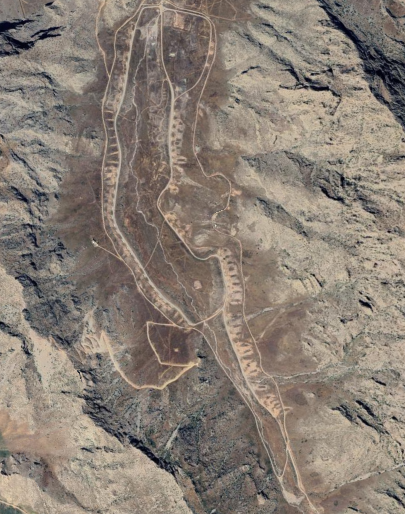
This map of Iran’s known ballistic missile sites reveals that most of them lie under these mountains, where Iran has spent the last 30 years building fortified “missile cities.” 🧵 6/13

Many of Iran’s sites are over 100 meters underground. Even the United States' GBU-57 bomb, designed specifically for a doomsday scenario, can only penetrate up to 60 meters of mountain before it explodes. To destroy these sites, Israel and the US will need a better bomb. 🧵 7/13

But even if such a bomb exists, splitting a mountain is no simple feat. Changing geological densities within different layers of a mountain can shift the direction of even the most sophisticated bomb away from its intended target. 🧵 8/13
And if the bomb arrives, it still needs to destroy a fortified concrete facility. While Israel can try and destroy all of Iran's dozens of “missile cities,” the success of such an attempt is uncertain. 🧵 9/13

Launching such an attack would mean starting a full-scale frontal war with one of the most resource-rich countries in the world. Iran could likely still retaliate with its vast ballistic missile arsenal. 🧵 10/13
This also explains why last week, the US threatened to destroy Iran's economy, instead of threatening to destroy its nuclear and missile capabilities. Destroying Iran’s missiles is a much more difficult task to achieve, even for the US. 🧵 11/13

But within Iran’s natural strength lies a hidden weakness: thousands of kilometers of mountains across its borders also provide the perfect cover for smugglers and spies. This is why so much of Israel’s effort against Iran’s rise to power has been through sabotage. 🧵 12/13
Exploiting this weakness in topography, Israeli spies penetrate time and again into Iran, sabotaging key sites, assassinating nuclear scientists, and even stealing Iran's top secret documents. This recent assassination in Teheran is a clue to what is yet to come.🧵13/13



جاري تحميل الاقتراحات...