
Talked to several former and current German ambassadors about why German diplomacy in general and the Auswärtige Amt in particular must prepare for war – and support the German defense industry much more than in the past. A thread.

Double standards still prevail in 🇩🇪 when it comes to questions about war and peace. Of course, Germans are for peace. But please without weapons! And for free. In public, Germans want their perfect world. The dogs of war must stay outside.

And yet, under the impression of Russia's invasion of Ukraine, something is beginning to change in 🇩🇪. But also in the German Foreign Ministry, which used to see itself as a “Ministry of Peace”? It is high time the ministry abandons its outdated reticence in military matters.
There are indeed tentative signs that this could happen. One example: Recently, the 🇩🇪ambassador to Bulgaria visited an arms fair and gave a reception where she openly said she was “proud” that “German firepower” helps protecting 🇺🇦. Hitherto unthinkable.
x.com
x.com
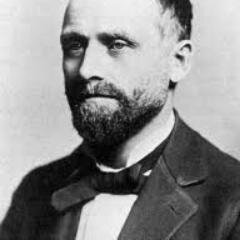
Discussed the issue with Martin Erdmann, who was posted for the unusually long duration 15 consecutive years at the NATO headquarters in Brussels: as German ambassador to the alliance and as Assistant Secretary General to NATO secretary General Jaap de Hoop Scheffer.
Erdmann, arguably one of the most experienced German diplomats when it comes to matters of defense, armaments, and NATO, says: "In Germany, we have been living a lie for decades, which is still being used by top politicians (...) to some extent today.”
“According to this (lie), we live in a basically peaceful world, surrounded by friends with whom we can agree about anything." The attitude of the Auswärtige Amt towards military matters was (is?) a reflection of this misjudgment, several diplomats complained.
The philosophy of the Amt was never about supporting armaments, but rather all about disarmament. It even has its own “Abrüstungsbeauftragter” (disarmament commissioner).
But why there is no “Aufrüstungsbeauftragter” (armaments commissioner), who uses the Foreign office's global contacts and cast network to help German arms manufacturers overcome supply chain bottlenecks so that the Bundeswehr and its NATO partners can be better equipped?
A retired ambassador who was posted the Balkans, the Caucasus and Afghanistan, says: "In these times, armament is more important than disarmament. The Auswärtige Amt should contribute to this (need). But it is simply not in its DNA to make substantial contributions on this."
The diplomat remembers: "Even the word 'armament' had negative connotations (in the Amt). It was almost a dirty word. The arms industry was always seen as somehow immoral, as something evil. German diplomats believed they were called to something higher."
Martin Erdmann, who also served as 🇩🇪 ambassador to Turkey, says: “Despite my affinity for security policy issues, it would never have occurred to me to hold a reception at an arms fair. Completely unthinkable!" French diplomacy was and is completely different, Erdmann adds:
"A French ambassador pours the best champagne and offers the finest Camembert to promote French products at an arms fair. Armaments and defense capabilities are top priorities in France.” (It must be, if you got territories to protect all over the world).
The German case is different. Take 2016, when current 🇩🇪 President Frank-Walter Steinmeier was Foreign Minister and publicly denigrated a NATO maneuver in the Baltics (which included the Bundeswehr) as "saber rattling and war cries.“
reuters.com
reuters.com
Question to non-Germans: Can you imagine your country's foreign minister publicly stabbing his own army in the back like that? Probably not, as that wouldn't happen in other democratic countries. It was not Steinmeier's only gross tactlessness on military issues. That´s just him.
Martin Erdmann, who was the only one of several retired diplomats willing to be quoted with his full name for this text, did not mention Steinmeier, but rather spoke of a "house culture" in the Auswärtiges Amt. A culture he and others disagree with.
Recalling his years with NATO, Erdmann says: "As someone who supported the need for military deterrence and advocated higher military spending (…) I often felt I was perceived as some kind of troublemaker at the Auswärtige Amt."
An active ambassador says: "We don't actually pursue foreign policy in the Auswärtiges Amt, we only simulate it. We pretend to pursue a foreign policy agenda - but in reality, we mainly make grandiose statements about all sorts of things. Little of it is of substance & concrete."
He names security policy as an example, saying: "If you trust your democracy, you should also trust the arms industry that gives your army the means to act as a deterrent against potential attackers and thus defend the democracy you trust." (Take note of the "if").
So will the reluctance of the Auswärtige Amt to consider, support and actively promote the military dimension of foreign policy be overcome in the foreseeable future? Erdmann says he hopes so. But he remains skeptical, as a ministry in a democracy can only be a mirror of society.
So, Germany has work to do. Especially with Russia as the enemy for all democratic-minded Europeans. Containment will be impossible without societies that understand, accept and support the military element of foreign policy. Can the Auswärtige Amt lead with words and actions?
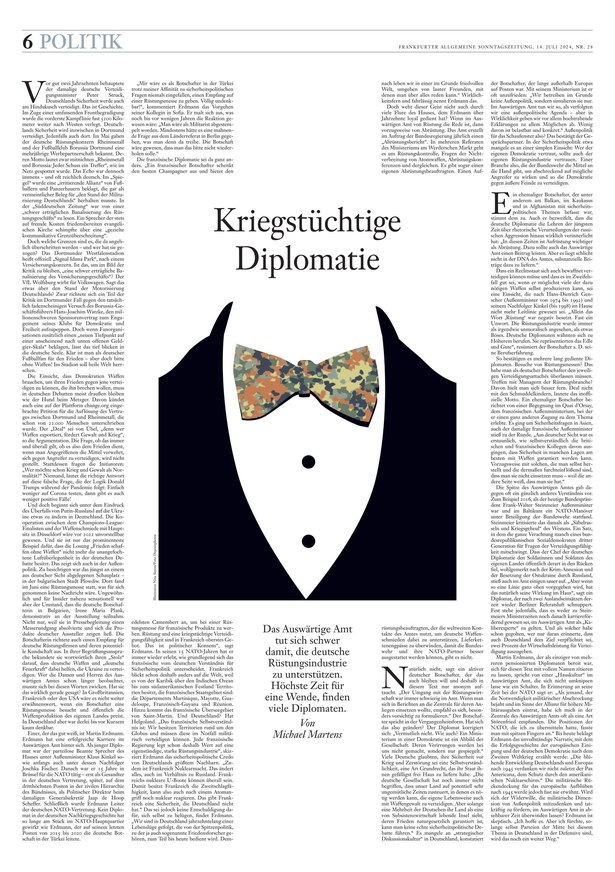
There are many diplomats in the Auswärtige Amt who say it should. For more on what former and acting German ambassadors have to say about their ministry and its relationship to the military element of foreign policy, see Frankfurter Allgemeine Sonntagszeitung:
جاري تحميل الاقتراحات...