

1/n A brief thread on the history of vegetarianism or assistance from meat at certain times from the ancient world. Vegetarianism or reduction of meat consumption isn't a brahminical hindu phenomenon. Hinduism places restrictions on meat eating in many days and at specific phases of one's life. Some communities (many brahmins, Buddhists, Jains etc..) practise complete absistence from meat. But this isn't exclusive to just Hinduism. Almost all non-Abrahamic civilizations after the axial age have advocated for vegetarianism or prudence in meat eating. Read further for examples.
2/n
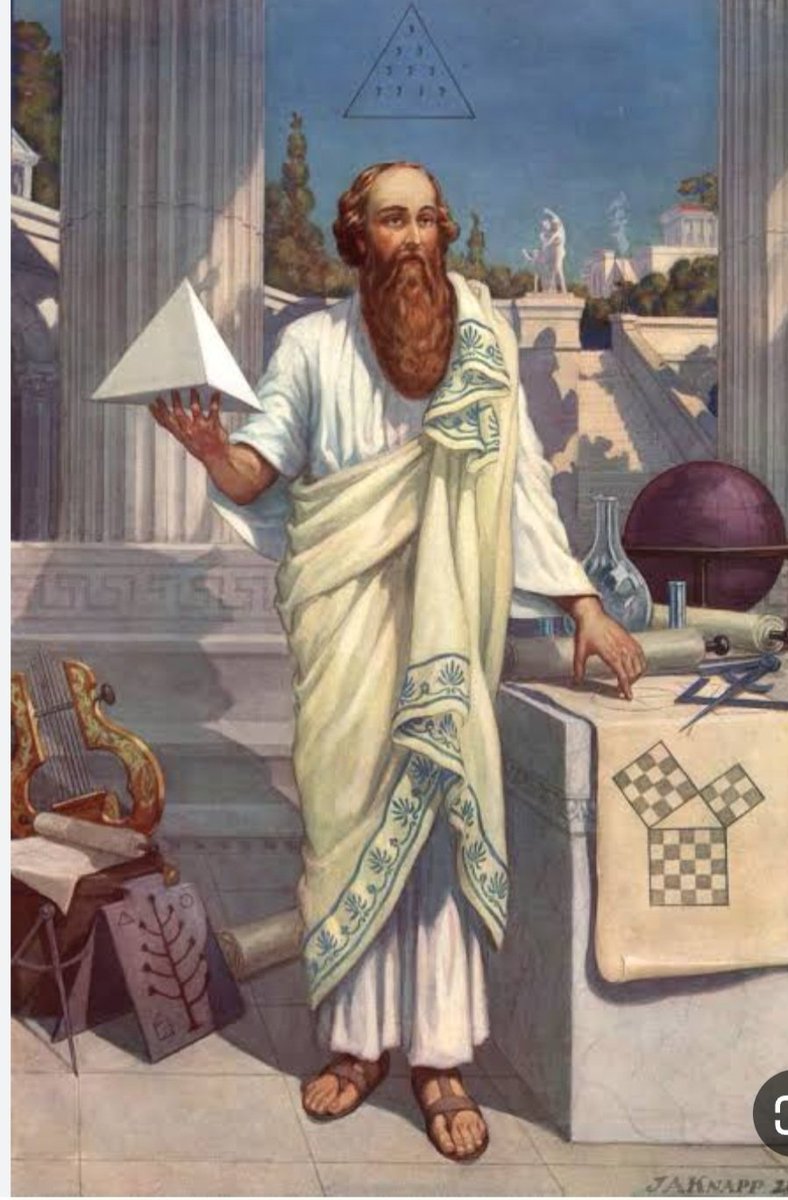
The earliest reference to vegetarianism in Western tradition comes from Pythagoras and his followers.
The following is a quote from the Roman author Ovid (Metamorphoses, Book XV) on Pythagoras:
[Pythagoras says at last] "O human race! Do not, I beg you, and concentrate your minds on my admonitions! When you place the flesh of slaughtered cattle in your mouths, know and feel, that you are devouring your fellow-creature"...
Ovid's description.
There was a man here, Pythagoras, a Samian by birth, who had fled Samos and its rulers, and, hating their tyranny, was living in voluntary exile. Though the gods were far away, he visited their region of the sky, in his mind, and what nature denied to human vision he enjoyed with his inner eye. When he had considered every subject, through concentrated thought, he communicated it widely in public, teaching the silent crowds, who listened in wonder to his words, concerning the origin of the vast universe, and of the causes of things; and what the physical world is; what the gods are; where the snows arise; what the origin of lightning is; whether Jupiter, or the storm-winds, thunder from colliding clouds; what shakes the earth; by what laws the stars move; and whatever else is hidden; and he was the first to denounce the serving of animal flesh at table; the first voice, wise but not believed in, to say, for example, in words like these :
‘Human beings, stop desecrating your bodies with impious foodstuffs. There are crops; there are apples weighing down the branches; and ripening grapes on the vines; there are flavoursome herbs; and those that can be rendered mild and gentle over the flames; and you do not lack flowing milk; or honey fragrant from the flowering thyme. The earth, prodigal of its wealth, supplies you with gentle sustenance, and offers you food without killing or shedding blood.
‘Flesh satisfies the wild beast’s hunger, though not all of them, since horses, sheep and cattle live on grasses, but those that are wild and savage: Armenian tigers, raging lions, and wolves and bears, enjoy food wet with blood. Oh, how wrong it is for flesh to be made from flesh; for a greedy body to fatten, by swallowing another body; for one creature to live by the death of another creature! So amongst such riches, that earth, the greatest of mothers, yields, you are not happy unless you tear, with cruel teeth, at pitiful wounds, recalling Cyclops’s practice, and you cannot satisfy your voracious appetite, and your restless hunger, unless you destroy other life.
The earliest reference to vegetarianism in Western tradition comes from Pythagoras and his followers.
The following is a quote from the Roman author Ovid (Metamorphoses, Book XV) on Pythagoras:
[Pythagoras says at last] "O human race! Do not, I beg you, and concentrate your minds on my admonitions! When you place the flesh of slaughtered cattle in your mouths, know and feel, that you are devouring your fellow-creature"...
Ovid's description.
There was a man here, Pythagoras, a Samian by birth, who had fled Samos and its rulers, and, hating their tyranny, was living in voluntary exile. Though the gods were far away, he visited their region of the sky, in his mind, and what nature denied to human vision he enjoyed with his inner eye. When he had considered every subject, through concentrated thought, he communicated it widely in public, teaching the silent crowds, who listened in wonder to his words, concerning the origin of the vast universe, and of the causes of things; and what the physical world is; what the gods are; where the snows arise; what the origin of lightning is; whether Jupiter, or the storm-winds, thunder from colliding clouds; what shakes the earth; by what laws the stars move; and whatever else is hidden; and he was the first to denounce the serving of animal flesh at table; the first voice, wise but not believed in, to say, for example, in words like these :
‘Human beings, stop desecrating your bodies with impious foodstuffs. There are crops; there are apples weighing down the branches; and ripening grapes on the vines; there are flavoursome herbs; and those that can be rendered mild and gentle over the flames; and you do not lack flowing milk; or honey fragrant from the flowering thyme. The earth, prodigal of its wealth, supplies you with gentle sustenance, and offers you food without killing or shedding blood.
‘Flesh satisfies the wild beast’s hunger, though not all of them, since horses, sheep and cattle live on grasses, but those that are wild and savage: Armenian tigers, raging lions, and wolves and bears, enjoy food wet with blood. Oh, how wrong it is for flesh to be made from flesh; for a greedy body to fatten, by swallowing another body; for one creature to live by the death of another creature! So amongst such riches, that earth, the greatest of mothers, yields, you are not happy unless you tear, with cruel teeth, at pitiful wounds, recalling Cyclops’s practice, and you cannot satisfy your voracious appetite, and your restless hunger, unless you destroy other life.
3/n
Plato - Republic Book 2 - SOCRATES JUSTIFIES WHY A JUST POLIS (CITY) IS VEGETARIAN
Socrates: Would this habit of eating animals not require that we slaughter animals that we knew as individuals, and in whose eyes we could gaze and see ourselves reflected, only a few hours before our meal?
Glaucon: This habit would require that of us.
Socrates: Wouldn’t this [knowledge] hinder us in achieving happiness?
Glaucon: It could so hinder us in our quest for happiness.
Socrates: And, if we pursue this way of living, will we not have need to visit the doctor more often?
Glaucon: We would have such need.
Socrates: If we pursue our habit of eating animals, and if our neighbor follows a similar path, will we not have to go to war against our neighbor to secure greater pasturage, because ours will not be enough to sustain us, and our neighbor will have a similar need to wage war on us for the same reason?
Glaucon: We would be so compelled.
Socrates: Would not these facts prevent us from achieving happiness, and therefore the conditions necessary to the building of a just society, if we pursue a desire to eat animals?
Glaucon: Yes, they would so prevent us.
Thus, Socrates argues the superiority of vegetarianism by
1. Morally (we saw them alive gazing just few hours before they end up in our meal
2. Spiritually eating meat would hinder in search of true happiness
3. Long term Health (need to go to doctor again and again due to more chance of catching diseases from them)
4. Environmental unsustainability - more pastures and hence need for war to expand one's territory
Plato - Republic Book 2 - SOCRATES JUSTIFIES WHY A JUST POLIS (CITY) IS VEGETARIAN
Socrates: Would this habit of eating animals not require that we slaughter animals that we knew as individuals, and in whose eyes we could gaze and see ourselves reflected, only a few hours before our meal?
Glaucon: This habit would require that of us.
Socrates: Wouldn’t this [knowledge] hinder us in achieving happiness?
Glaucon: It could so hinder us in our quest for happiness.
Socrates: And, if we pursue this way of living, will we not have need to visit the doctor more often?
Glaucon: We would have such need.
Socrates: If we pursue our habit of eating animals, and if our neighbor follows a similar path, will we not have to go to war against our neighbor to secure greater pasturage, because ours will not be enough to sustain us, and our neighbor will have a similar need to wage war on us for the same reason?
Glaucon: We would be so compelled.
Socrates: Would not these facts prevent us from achieving happiness, and therefore the conditions necessary to the building of a just society, if we pursue a desire to eat animals?
Glaucon: Yes, they would so prevent us.
Thus, Socrates argues the superiority of vegetarianism by
1. Morally (we saw them alive gazing just few hours before they end up in our meal
2. Spiritually eating meat would hinder in search of true happiness
3. Long term Health (need to go to doctor again and again due to more chance of catching diseases from them)
4. Environmental unsustainability - more pastures and hence need for war to expand one's territory

4/n
In Ancient Greece during Classical antiquity, the vegetarian diet was called abstinence from beings with a soul (Ancient Greek: ἀποχὴ ἐμψύχων)
Commonfolk ancient Greek pagans too had traditions of abstaining from all meat or certain kind of meats at specific occasions or for specific communities.
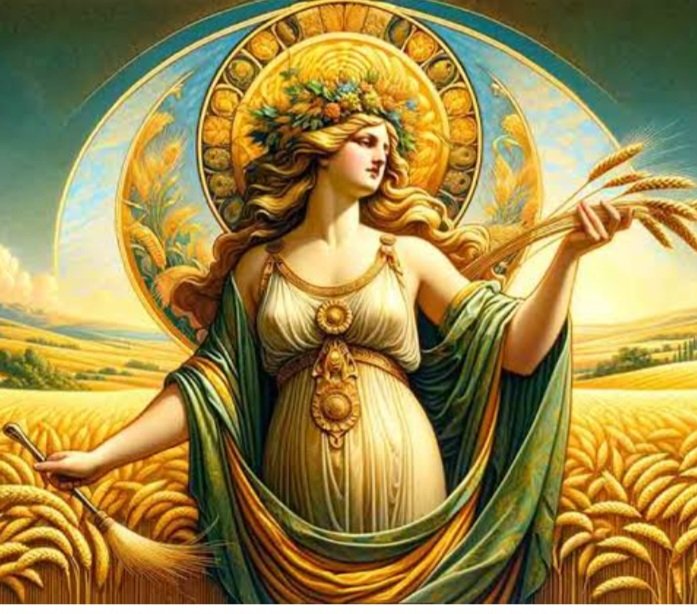
Followers of many Greek cults were complete vegetarians like that of Pythagoreans, Cretans, Orphics, followers of Empedocles, and the followers of some other mystery cults. Vegetarianism was justified by these people by alluding to the supposed three commandments of Demeter (the goddess of grains) to a semi mythical hero Triptolemus which were
1. "Honour your parents"
2. "Honour the gods with fruit"
3. "Spare the animals”
In Ancient Greece during Classical antiquity, the vegetarian diet was called abstinence from beings with a soul (Ancient Greek: ἀποχὴ ἐμψύχων)
Commonfolk ancient Greek pagans too had traditions of abstaining from all meat or certain kind of meats at specific occasions or for specific communities.
Followers of many Greek cults were complete vegetarians like that of Pythagoreans, Cretans, Orphics, followers of Empedocles, and the followers of some other mystery cults. Vegetarianism was justified by these people by alluding to the supposed three commandments of Demeter (the goddess of grains) to a semi mythical hero Triptolemus which were
1. "Honour your parents"
2. "Honour the gods with fruit"
3. "Spare the animals”
5/n
Orphics and strict Pythagoreans also avoided eggs apart from meat and shunned the ritual offerings of meat to the gods, which were an essential part of traditional religious sacrifice.
In the Academy of Plato, the scholarchs (school heads) Xenocrates and (probably) Polemon pleaded for vegetarianism. In the Peripatetic school, Theophrastus, who was Aristotle's immediate successor, supported it. Some of the prominent Platonists and Neo-Platonists in the age of the Roman Empire lived on a vegetarian diet. These included Apollonius of Tyana, Plotinus, and Porphyry.
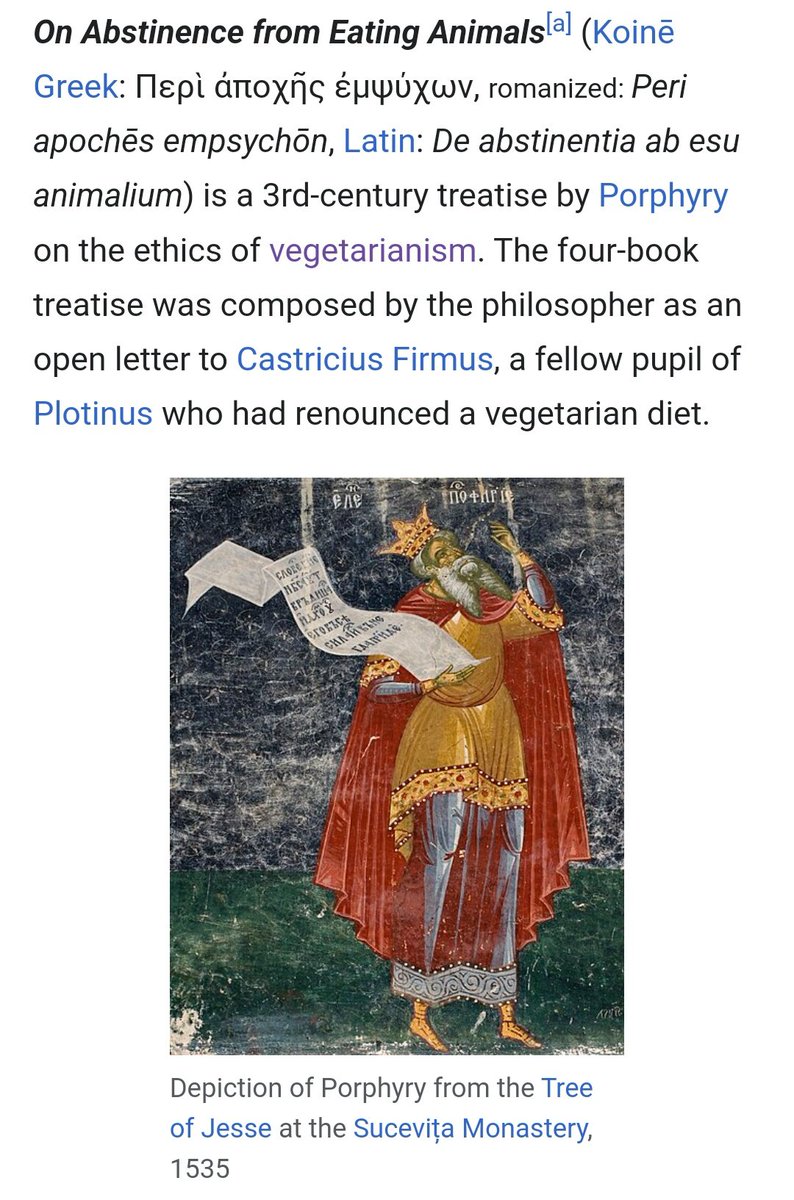
Porphyry wrote a treatise "On Abstinence from Eating Animals", which is the most elaborate ancient pro-vegetarian text known to us. Porphyry believed that animals are aware and capable of evaluating situations, have memory, and can communicate. He urged that by consuming meat, the body becomes corrupt and unhealthy, leading to obesity. Porphyry maintained that killing an animal is no different from taking the life of a human being – and thus became one of the first to state that animal life is equal to that of a human.
Orphics and strict Pythagoreans also avoided eggs apart from meat and shunned the ritual offerings of meat to the gods, which were an essential part of traditional religious sacrifice.
In the Academy of Plato, the scholarchs (school heads) Xenocrates and (probably) Polemon pleaded for vegetarianism. In the Peripatetic school, Theophrastus, who was Aristotle's immediate successor, supported it. Some of the prominent Platonists and Neo-Platonists in the age of the Roman Empire lived on a vegetarian diet. These included Apollonius of Tyana, Plotinus, and Porphyry.
Porphyry wrote a treatise "On Abstinence from Eating Animals", which is the most elaborate ancient pro-vegetarian text known to us. Porphyry believed that animals are aware and capable of evaluating situations, have memory, and can communicate. He urged that by consuming meat, the body becomes corrupt and unhealthy, leading to obesity. Porphyry maintained that killing an animal is no different from taking the life of a human being – and thus became one of the first to state that animal life is equal to that of a human.
6/n
Ancient Greek pagans also had a tradition of abstaining from fish at certain periods of time and complete abstinence from meat for some 40 days in a year and at other days, which is still followed in Catholic and Orthodox Christianity as the Lent fast where they abstain from meat for the 40 days of the year that lead upto Ester day.
Ancient Greek pagans also had a tradition of abstaining from fish at certain periods of time and complete abstinence from meat for some 40 days in a year and at other days, which is still followed in Catholic and Orthodox Christianity as the Lent fast where they abstain from meat for the 40 days of the year that lead upto Ester day.

7/n Pre-Colombian Americas:
The geography of Native Americans could not allow them to forgo meat as there were no high calorific grains (like rice or wheat) native to those continents. But inspite of it, they hunted meat only after they underwent a ritual fasting and/or after they got the permission of the spirit God of that animal species. Also, after hunting, they performed many extensive rituals to honor the hunted animal in front of its carcass which included apologizing to it for killing and thanking it for nourishment. They knew their natural habitat so well that they knew which animals were crucial for breeding and survival to next generation and never hunted those and any other animal with a baby. Wasting meat was considered blasphemous to the spirit god of that species and hence native Americans ensured that meat feasting was communal as part of large groups which ensured that no meat got wasted.
The geography of Native Americans could not allow them to forgo meat as there were no high calorific grains (like rice or wheat) native to those continents. But inspite of it, they hunted meat only after they underwent a ritual fasting and/or after they got the permission of the spirit God of that animal species. Also, after hunting, they performed many extensive rituals to honor the hunted animal in front of its carcass which included apologizing to it for killing and thanking it for nourishment. They knew their natural habitat so well that they knew which animals were crucial for breeding and survival to next generation and never hunted those and any other animal with a baby. Wasting meat was considered blasphemous to the spirit god of that species and hence native Americans ensured that meat feasting was communal as part of large groups which ensured that no meat got wasted.

8/n
Female Cow was considered sacred in ancient Egypt too! The historian Herodotus claimed that the Egyptians abstained from consuming female cows as they were sacred by association with goddess Isis. But the bull was indeed eaten by the wealthy.
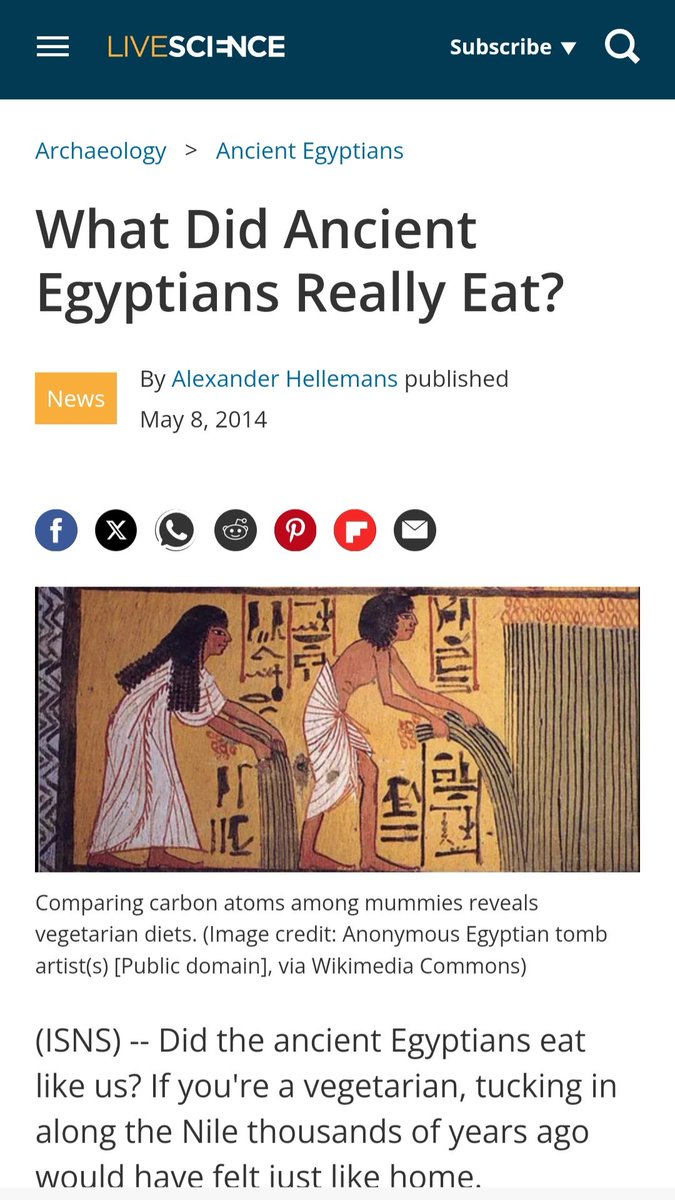
Egyptian diet on the whole, was more inclined on plant based diet, thanks to the fertility provided by the Nile River.
The ancient Egyptian diet was not only influenced by the availability of food resources but also by religious beliefs and cultural practices. The concept of Ma'at, which represented truth, balance, and order, extended to the dietary principles of the ancient Egyptians. They believed in moderation and balance in their diet, cultivating a deep respect for food and its role in maintaining harmony within the body and the cosmos.
Red meat, particularly from cattle and game animals, was reserved only for important feasts and offerings to the gods, symbolizing wealth and abundance. Additionally, they revered certain other animals apart from the cow and abstained from consuming their meat, as these animals were considered sacred.
livescience.com
Female Cow was considered sacred in ancient Egypt too! The historian Herodotus claimed that the Egyptians abstained from consuming female cows as they were sacred by association with goddess Isis. But the bull was indeed eaten by the wealthy.
Egyptian diet on the whole, was more inclined on plant based diet, thanks to the fertility provided by the Nile River.
The ancient Egyptian diet was not only influenced by the availability of food resources but also by religious beliefs and cultural practices. The concept of Ma'at, which represented truth, balance, and order, extended to the dietary principles of the ancient Egyptians. They believed in moderation and balance in their diet, cultivating a deep respect for food and its role in maintaining harmony within the body and the cosmos.
Red meat, particularly from cattle and game animals, was reserved only for important feasts and offerings to the gods, symbolizing wealth and abundance. Additionally, they revered certain other animals apart from the cow and abstained from consuming their meat, as these animals were considered sacred.
livescience.com
9/n
Eating lot of meat and eating meat on par with plant food is a modern phenomenon - post the Judeo-Christo-Islamic age. A
In the Judeo-Abrahamic traditions, while creation, God blows his spirit only inside man during creation and not to any other living being. He gives the commandment to man to subdue and dominate over the rest of creation (covenant with Adam) and explicitly to eat all animals as food (covenant with Noah).
In this worldview, only mankind is endowed with the spirit of God and shares in the divinity of the transcendent God. Rest of nature whether rocks or plants or animals are bereft of any divinity and soulless.
Non Abrahamic religions on the other hand place man as a part of larger nature, all of which is divine. Hence he can't exploit natural resources and plants and animals unduly. Everything in nature is endowed with soul or spirit. Also, they distinguish several levels of soul - the difference between humans and plants or animals or plants or rocks isn't of kind (presence vs absence of soul) but by quantity (the level of soul).
For example, Aristotle distinguishes three types of souls (ψυχη = psychē) for living beings
1. Nutritive soul - ability to grow and reproduce
2. Sensitive and locomotive soul - ability to feel and move around
3. Rational soul - ability to think rationally
According to Aristotle's metaphysics, plants have only level 1 soul while animals have upto level 2 (including level 1) and mankind has upto level 3 soul (including 1 and 2).
Even scientifically, animals and humans share a central nervous system and hence feel pleasure and pain similarly.
So all non Abrahamic traditions had constraints and restrictions for meat eating to avoid large scale exploitation of the animal world.
Eating lot of meat and eating meat on par with plant food is a modern phenomenon - post the Judeo-Christo-Islamic age. A
In the Judeo-Abrahamic traditions, while creation, God blows his spirit only inside man during creation and not to any other living being. He gives the commandment to man to subdue and dominate over the rest of creation (covenant with Adam) and explicitly to eat all animals as food (covenant with Noah).
In this worldview, only mankind is endowed with the spirit of God and shares in the divinity of the transcendent God. Rest of nature whether rocks or plants or animals are bereft of any divinity and soulless.
Non Abrahamic religions on the other hand place man as a part of larger nature, all of which is divine. Hence he can't exploit natural resources and plants and animals unduly. Everything in nature is endowed with soul or spirit. Also, they distinguish several levels of soul - the difference between humans and plants or animals or plants or rocks isn't of kind (presence vs absence of soul) but by quantity (the level of soul).
For example, Aristotle distinguishes three types of souls (ψυχη = psychē) for living beings
1. Nutritive soul - ability to grow and reproduce
2. Sensitive and locomotive soul - ability to feel and move around
3. Rational soul - ability to think rationally
According to Aristotle's metaphysics, plants have only level 1 soul while animals have upto level 2 (including level 1) and mankind has upto level 3 soul (including 1 and 2).
Even scientifically, animals and humans share a central nervous system and hence feel pleasure and pain similarly.
So all non Abrahamic traditions had constraints and restrictions for meat eating to avoid large scale exploitation of the animal world.

جاري تحميل الاقتراحات...