
A little chart I made that tries illustrate what kinds of different readings there are.
There are two main categories:
1. Uthmanic readings (which follow the Uthmanic text)
2. Non-Uthmanic readings (those that do *not* follow the Uthmanic text)
There are two main categories:
1. Uthmanic readings (which follow the Uthmanic text)
2. Non-Uthmanic readings (those that do *not* follow the Uthmanic text)
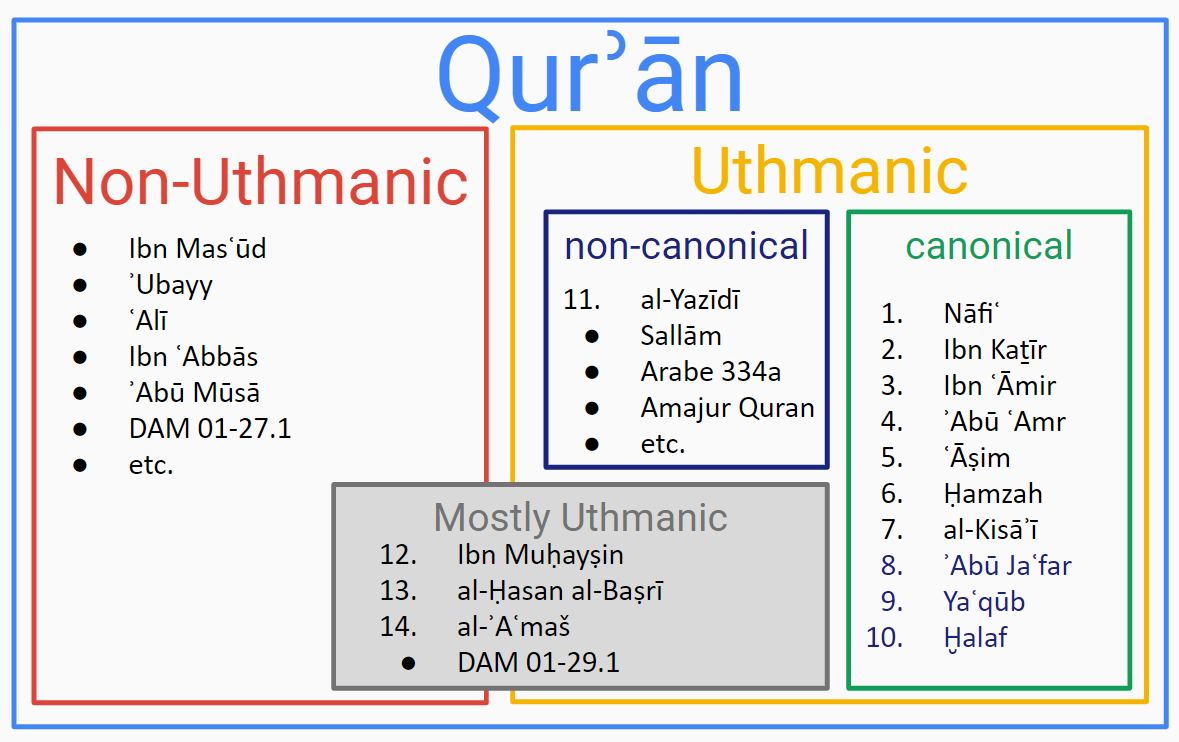
Among the Uthmanic readings there are 7, and later three more readers that have come to be considered canonical.
But there are also countless readers that likewise follow the Uthmanic text (and have a good isnad and good grammar) which are not considered canonical.
But there are also countless readers that likewise follow the Uthmanic text (and have a good isnad and good grammar) which are not considered canonical.
Some notable ones among the non-canonical Uthmanic readings are those by al-Yazīdī (one of the readers of the "fourteen"), Yaʿqūb's teacher Sallām, ʾAbū Ḥātim, ʾAbū ʿUbayd, ʿĀṣim al-Ǧaḥdarī, etc.
But also most early vocalised manuscripts are Uthmanic but do not reflect the ten
But also most early vocalised manuscripts are Uthmanic but do not reflect the ten
Non-Uthmanic readings are primarily those which are reported by the Islamic tradition as companion readings. These deviate notably from the standard text, because they predate the existence of that text.
The lower text of the Sanaa Palimpest (DAM 01-27.1) is non-Uthmanic too!
The lower text of the Sanaa Palimpest (DAM 01-27.1) is non-Uthmanic too!
Finally there is a small category of readers, the three remaining readers of the fourteen, whose reading is so close to the Uthmanic text that it clearly influenced their reading, but who nevertheless sometimes deviate from this. The Sanaa manuscript DAM 01-29.1 is like this too.
جاري تحميل الاقتراحات...