

Aren't scientists also just humans? Scientific Integrity | 🧵
Stuart Ritchie's "Science Fictions"
Every field of profession requires at least some level of critical thinking for it to function progressively and achieve beneficial results. We, however live in times where...
Stuart Ritchie's "Science Fictions"
Every field of profession requires at least some level of critical thinking for it to function progressively and achieve beneficial results. We, however live in times where...
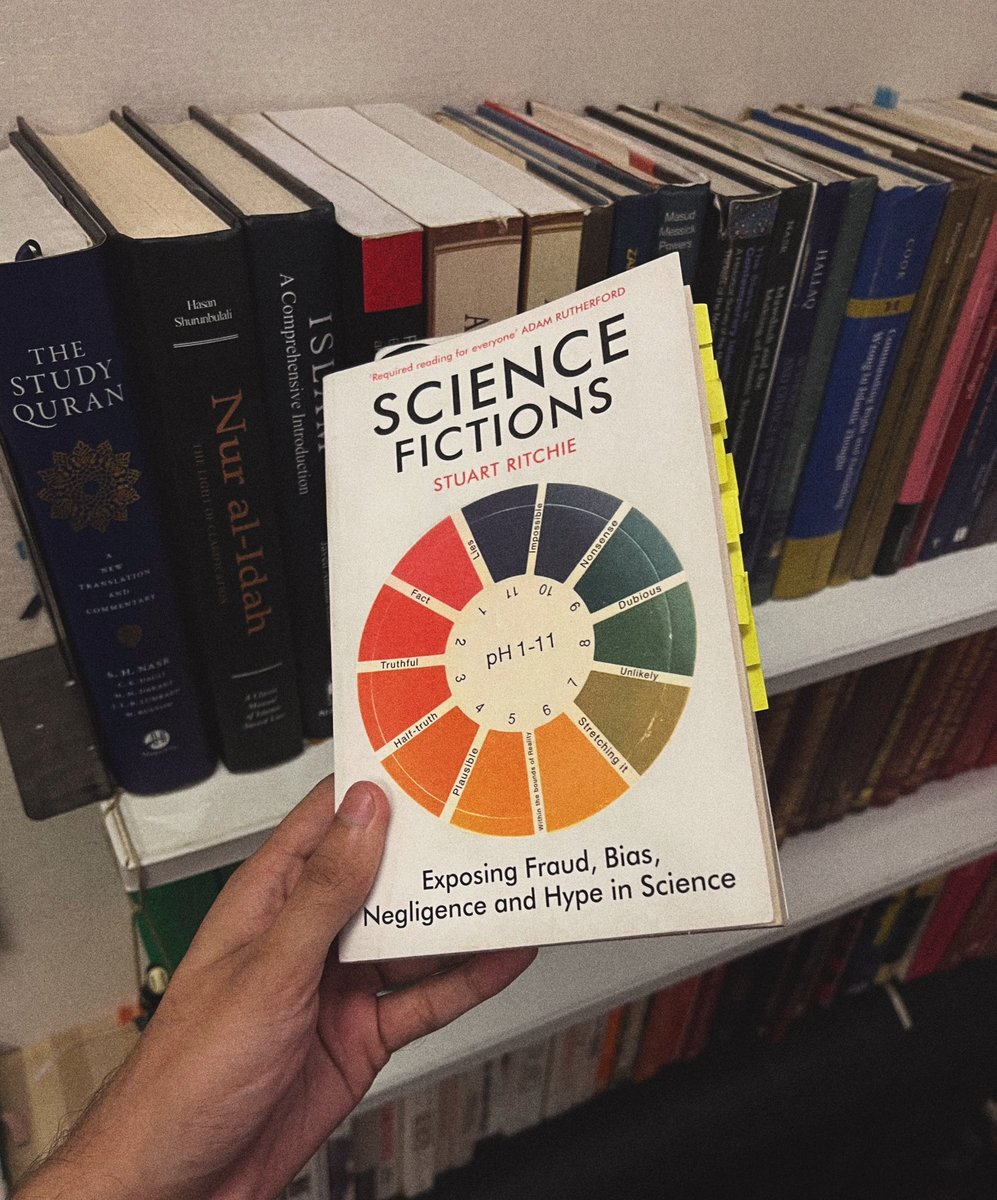
every community of religious, governmental and philosophical academia/institutions has lost trust in the eyes of masses, mainly due to their allegedly widely known incompetence or insincerity in dealing with their work and duties. Not only academic spheres, in fact people now
doubt and undermine the integrity of all institutions of services and sciences, no community is completely free from the negative judgements of the masses yet somehow the scientific academia is still assumed to be the most honest flag bearers of sincere critical thinking.
There's this subtle assumption that although experts of all fields think and conduct their research through some sort of rationality, its only the scientists who conduct their skills and research with utmost integrity. Some would even place the scientists at a pedestal of...
infallibility when it comes to committing unethical acts. This precise understanding of the scientific academia is what the authors dismantles in his book. The book is filled with dozens of studies that surely strip off the cape of perfection that the public assumes...
every scientist wears. And it does that simply by showcasing the necessary humanly side of the ones doing 'science'. The fact that scientists too have communal politics, how they too, at the end of the day are emotional beings motivated by factors beyond the mere results of their
rational faculties. Like any other humans, those trying to run their kitchen, or trying to receive those grants for their research or trying to establish their names in prestigious journals do have 'unprofessional' incentives to present altered data, to exaggerate
their findings, to hide their errors, to knowingly champion incorrect hypothesis. Not only that on top of hidden incentives, scientists too have political, racial and cultural biases which affect their research and their methodologies,the book goes through many such cases.
The scientific community is at the end of the day a bunch of humans, who think and interact like humans in any other department of life and because science in itself is a social-interactive system
its naturally built in a manner that only a select few can test and conduct the processes and report findings, findings - that are mostly based on a communal trust in the integrity, honesty and the skills of other scientists involved in the greater study
hence making the entire process way more prone to errors committed due to incompetence, insincerity or negligence on the part of any single individual involved. The author states multiple incidents of such sort at the highest possible levels, with at times, the greatest amount
of risk involved such as cancer studies or NASA researchers or Nobel winning teams or the scientists at CERN, nobody is immune to the 'humanly (social) error'.
Moreover it's not as if the scientists don't have an ethical code of conduct, the Mertonian Norms are 5 core values
Moreover it's not as if the scientists don't have an ethical code of conduct, the Mertonian Norms are 5 core values
of science, stated to maintain the spirit of scientific integrity, just how every other department of sciences and services have ethical guidelines for it. But again, humans being humans always end up ignoring them for ulterior motives and scientists are no exceptions.
However people aren't aware of scientific blunders or misconduct usually because of the technical nature of those cases of incompetence and fraud. But the mistakes of religious scholars or other experts are easy to spot thus generalising them as 'mostly dishonest/ignorant' and...
the scientists as 'mostly genuine/smart'. Therefore in order to understand the actual dynamics of the scientific community, their humanly nature, them being guided by their biases and personal incentives and how even their absolute blunders make it to...
curriculum books (which then gets cited by various groups for the support of their own social/political/religious views), bestselling charts and influence governmental policies at international level without people even realising the significance of their mistakes - i would...
highly suggest a reading of this book since it's becoming necessary for many to realise the fact that...
"Science" is no separate identity built 'solely' on codes run by supercomputers or absolutely binding logical/mathematical proofs, those programs, those equations, those machines are run by the same species that governs every other area of human life. Consequently...
giving "science" too an integral layer of identity, it gives to any other field it governs so the masses should learn to interpret and view science at least as a product of humans rather than some species from a higher dimension.
جاري تحميل الاقتراحات...