
#Thread #Update #Space
Here We Go: @isro, which is attempting to launch #Chandrayaan3 at 2.35pm Friday (Jul 14) onboard #LVM3, has spent nearly 4yrs — after #Chandrayaan2 failure — anticipating failure scenarios and ensuring they’re addressed. Scroll down for more... 1/n
Here We Go: @isro, which is attempting to launch #Chandrayaan3 at 2.35pm Friday (Jul 14) onboard #LVM3, has spent nearly 4yrs — after #Chandrayaan2 failure — anticipating failure scenarios and ensuring they’re addressed. Scroll down for more... 1/n
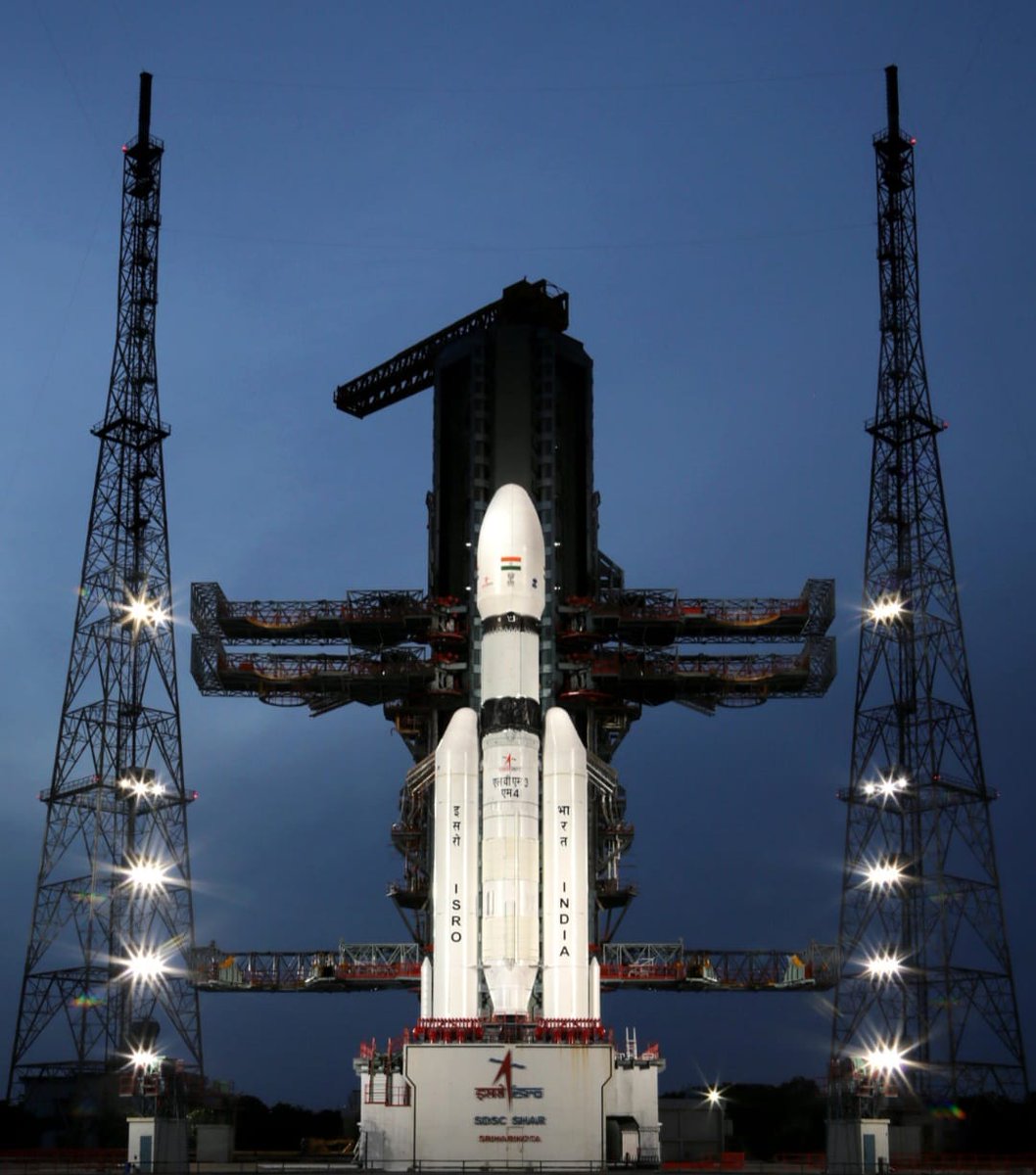
Among several changes introduced will be the first orbit #Chandrayaan3 gets injected into Friday, while most changes are in the last phase of the mission. 2/n
Isro chairman S Somanath told me that #LVM3 will place #Chandrayaan3 in an apogee of 36,500km as against 45,475km during #Chandrayaan2. The perigee will be around 170km, nearly the same as last time. “This is being done to get more stability,” he said. 3/n
Another scientist explained: “In #Chandrayaan2, we took the ‘burn to depletion’ — use the last drop of fuel — approach with the cryogenic upper stage to achieve high altitude. However, that creates post-launch tracking challenges given that we use international stations. 4/n
…So, we’ve decided to go to a definitive orbit (36,500km), making initial tracking and operations that follow more efficient.” 5/n
Isro will then conduct multiple Earth-bound manoeuvres to increase #Chandrayaan3’s orbit before commands for trans-lunar insertion (TLI) that will kick off the spacecraft’s journey towards Moon, are given. 6/n
Multiple scientists explained that Isro will perform four major manoeuvres — No 1, 3, 4 and 5 — to raise the apogee, while the second manoeuvre will be a minor perigee-rising one. 7/n
If all goes as planned, TLI will be done on July 31. #Chandrayaan3 will then travel towards Moon for about five-and-a-half days and lunar orbit insertion is expected around August 5. These are estimations for nominal performance. 8/n
“Spacecraft will initially be on a greater apolune & multiple perilune manoeuvres will altitude eventually to a 100km X 100km orbit. It’s too early to speak about dates for this milestone,” a scientist said, adding there could be 5 lunar-bound manoeuvres before final descent. 9/n
After #Chandrayaan3 reaches 100km X 100km orbit, lander module (Vikram & Pragyan) will separate from the propulsion module and be eventually brought to a 100km X 30km orbit, from where commands for deboost and final descent is expected on August 23. 10/n
Other than changes on Vikram — strengthening of legs, new sensor, solar panels, etc — which I have reported earlier, Somanath said, a key change is the increased landing area. 11/n
“In #Chandrayaan2, landing site was 500m X 500m & we wanted to land at the centre, which resulted in some limitations. Now, landing site is 4km X 2.5km… 12/n
…At nominal conditions, we’ll attempt landing at the centre, otherwise, #Vikram can land anywhere in this area, giving it greater flexibility,” he said, adding that high-resolution images from Chandrayaan-2 orbiter have also made landing site understanding better. 13/n
Explaining what went wrong last time, Somanath said: “The plan was to image the landing area just before landing and attempt landing in the subsequent orbit. Lander engines developed a slightly higher thrust, but within specifications… 14/n
…However, errors on account of such differences accumulated during the last (camera coasting) phase when spacecraft needed to be very steady to take pictures and make corrections.” 15/n
“...Accumulated errors meant lots of corrections. Craft had to turn very quickly as it had already attained an altitude too close to the surface. When it was doing that, its ability to turn was limited by software as we'd not anticipated such high rate of errors,’ he added. 16/n
This time, onboard systems won’t let errors accumulate. “They'll be corrected within 96 milli-seconds, almost in real-time,” Somanath said, adding that the lander is also equipped with additional TTC (tracking, telemetry and command) antennas. n/n
جاري تحميل الاقتراحات...