
Interesting (Mysterious) Facts of Jagannath Ratha Yatra Puri (जगन्नाथ रथ यात्रा)
#Longthread
"रथे तु वामनं दृष्ट्वा पुनर्जन्म न विद्यते"
A glimpse of the Vamana, an incarnation of Shri Jagannath, is sure to ensure emancipation, release from the cycle of birth and death. The festival is also known as Gundicha Yatra, Ghosa Yatra, Navadina Jatra, Dasavatara Yatra and by a variety of other names.
Rath Yatra being unique among all Yatras is the grandest festival of the supreme divinity who has manifested himself in the Kali Yuga to emancipate humanity and to relieve them from their sufferings.
Shri Jagannath is identified fully with Krishna. In his original manifestation as Nilamadhaba, he was worshipped in a sacred Nyagrodha Briksha or banyan tree. The metaphysical branches of the tree had spread for several miles and any one entering this area was instantly emancipated and was relieved of the travails of the birth and rebirth.
In fact, the influence of Yama, the God of Death, is supposed to have been curtailed in the sacred city of Puri; Srikshetra on account of the presence of Shri Jagannath and therefore it is also called the Yamanika Tirtha.
There are three new chariots made for Lord Jagannath, Balabhadra and Subadhra each. Each of these three chariots have distinct designs, colours and qualities. Every Rath has 2 gatekeepers, one accompanying deity and 9 parshvadevata or subsidiary deities.
Lord Jagannath’s chariot is called as Nandighosha. This chariot is one of the tallest and grandest. It has a a height of 44′ 2″ and length and breadth of 34’6″ x 34’6″. There are 16 wheels (each of seven-foot diameter) attached to this Rath and it utilizes 832 wooden pieces. It is forty-five feet high and forty-five feet square at the wheel level. It has sixteen , and is decked with a cover made of red and yellow cloth.
The flag : Trailokyamohini
Garuda is the guardian of the chariot and Daruka is the charioteer.
There are 4 white horses attached to the Rath, these are- Shankha, Balahaka, Suweta and Haridashwa.
The rope : Sankhachuda Naguni Presiding Nine Deities : (i) Varaha (ii) Gobardhan (iii) Krushna, Gopi Krushna (iv) Nrusingha (v) Rama (vi) Narayan (Vii) Trivikrama (viii) Hanuman (ix) Rudra...
Lord Jagannatha is identified with Krishna, who is also known as Pitambara, the one attired in golden yellow robes and hence the distinguishing yellow stripes on the canopy of this chariot. Bright red and yellow canopies are attached to the chariot featuring the famous applique work of Pipli.
The Chariot of Lord Balarama, called the Taladhwaja, is the one with the Palm Tree on its flag. It has fourteen wheels, each of seven-foot diameter and is covered with red and blue cloth. This chariot has a height of 43′ 3″ and length and breadth of 33′ x 33′. It has 763 wooden pieces used in its creation. Red and blueish-green canopies are attached to the chariot featuring the famous applique work of Pipli. Vasudev is the guardian and Matali is the charioteer. A palm tree is also placed onto the chariot.
The flag : Unnani
There are 4 black horses attached to the rath, these are- Tribra, Ghora, Dirghasharma and Swornanava.
The rope : Basuki Naga
Presiding Nine Deities : (i) Ganesh (ii) Kartikeya (iii) Sarvamangala (iv) Pralambari (v) Hatayudha (vi) Mrutyunjaya (vii) Natamvara (viii) Mukteswar (ix) Sheshadeva...
The Chariot of Subhadra, known as Dwarpadalana, literally "trampler of pride". This chariot has a height of 42′ 3″ and length and breadth of 31’6″ x 31’6″. It has a total of 12 wheels (each of seven-foot diameter) and 593 wooden pieces are used in its construction.
This Chariot is decked with a covering of red and black cloth - black being traditionally associated with Shakti and the Mother Goddess.
Guarded by : Jayadurga
Name of the charioteer : Arjuna
The flag : Nadambika
There are 4 red horses attached to the rath, these are Rochika, Mochika, Jita and Aparajita.
#Longthread
"रथे तु वामनं दृष्ट्वा पुनर्जन्म न विद्यते"
A glimpse of the Vamana, an incarnation of Shri Jagannath, is sure to ensure emancipation, release from the cycle of birth and death. The festival is also known as Gundicha Yatra, Ghosa Yatra, Navadina Jatra, Dasavatara Yatra and by a variety of other names.
Rath Yatra being unique among all Yatras is the grandest festival of the supreme divinity who has manifested himself in the Kali Yuga to emancipate humanity and to relieve them from their sufferings.
Shri Jagannath is identified fully with Krishna. In his original manifestation as Nilamadhaba, he was worshipped in a sacred Nyagrodha Briksha or banyan tree. The metaphysical branches of the tree had spread for several miles and any one entering this area was instantly emancipated and was relieved of the travails of the birth and rebirth.
In fact, the influence of Yama, the God of Death, is supposed to have been curtailed in the sacred city of Puri; Srikshetra on account of the presence of Shri Jagannath and therefore it is also called the Yamanika Tirtha.
There are three new chariots made for Lord Jagannath, Balabhadra and Subadhra each. Each of these three chariots have distinct designs, colours and qualities. Every Rath has 2 gatekeepers, one accompanying deity and 9 parshvadevata or subsidiary deities.
Lord Jagannath’s chariot is called as Nandighosha. This chariot is one of the tallest and grandest. It has a a height of 44′ 2″ and length and breadth of 34’6″ x 34’6″. There are 16 wheels (each of seven-foot diameter) attached to this Rath and it utilizes 832 wooden pieces. It is forty-five feet high and forty-five feet square at the wheel level. It has sixteen , and is decked with a cover made of red and yellow cloth.
The flag : Trailokyamohini
Garuda is the guardian of the chariot and Daruka is the charioteer.
There are 4 white horses attached to the Rath, these are- Shankha, Balahaka, Suweta and Haridashwa.
The rope : Sankhachuda Naguni Presiding Nine Deities : (i) Varaha (ii) Gobardhan (iii) Krushna, Gopi Krushna (iv) Nrusingha (v) Rama (vi) Narayan (Vii) Trivikrama (viii) Hanuman (ix) Rudra...
Lord Jagannatha is identified with Krishna, who is also known as Pitambara, the one attired in golden yellow robes and hence the distinguishing yellow stripes on the canopy of this chariot. Bright red and yellow canopies are attached to the chariot featuring the famous applique work of Pipli.
The Chariot of Lord Balarama, called the Taladhwaja, is the one with the Palm Tree on its flag. It has fourteen wheels, each of seven-foot diameter and is covered with red and blue cloth. This chariot has a height of 43′ 3″ and length and breadth of 33′ x 33′. It has 763 wooden pieces used in its creation. Red and blueish-green canopies are attached to the chariot featuring the famous applique work of Pipli. Vasudev is the guardian and Matali is the charioteer. A palm tree is also placed onto the chariot.
The flag : Unnani
There are 4 black horses attached to the rath, these are- Tribra, Ghora, Dirghasharma and Swornanava.
The rope : Basuki Naga
Presiding Nine Deities : (i) Ganesh (ii) Kartikeya (iii) Sarvamangala (iv) Pralambari (v) Hatayudha (vi) Mrutyunjaya (vii) Natamvara (viii) Mukteswar (ix) Sheshadeva...
The Chariot of Subhadra, known as Dwarpadalana, literally "trampler of pride". This chariot has a height of 42′ 3″ and length and breadth of 31’6″ x 31’6″. It has a total of 12 wheels (each of seven-foot diameter) and 593 wooden pieces are used in its construction.
This Chariot is decked with a covering of red and black cloth - black being traditionally associated with Shakti and the Mother Goddess.
Guarded by : Jayadurga
Name of the charioteer : Arjuna
The flag : Nadambika
There are 4 red horses attached to the rath, these are Rochika, Mochika, Jita and Aparajita.
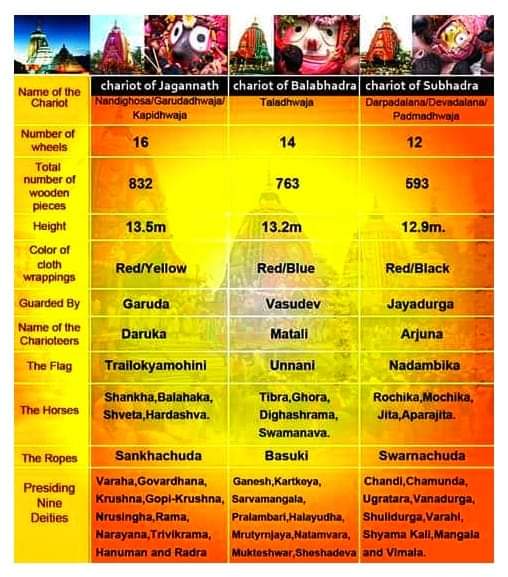
The rope : Swarnachuda Naguni Presiding Nine Deities : (i) Chandi (ii) Chamunda (iii) Ugratara (iv) Vanadurga (v) Shulidurga (vi) Varahi (vii) Shyamakali (viii) Mangala (ix) Bimala...
The making of the Puri raths for the Jagannath Rath Yatra is the responsibility of a separate group of carpenters and artisans who have been undertaking this profession for generations. The wood is carved with designs inspired by Odisha temple architecture. The frames and wheels of the chariots are also colourfully painted with traditional designs. Each chariot also has a crest banner and is tied with 4 ropes made of coconut fibres at the front part of the chariot.
What leaves the devotees awestruck and mesmerised at first glance is the decoration of the Rath. Every single part of the Rath is splashed with strokes of colour and patterns.
The intricacies in the designs of all three chariots showcase how socially and culturally significant these Raths are. It also displays the diligence of the craftsmen and their attention to the smallest of details. Every single portion of these Raths is designed and created with utmost love, devotion and precision.
The cloths with the applique work feature various patterns and motifs. These motifs feature floral patterns, greenery and other mythical designs like Rahu and Chandra. Moreover, several flower garlands are also placed at the front of the Raths.
The two brothers, Balabhadra and Jagannatha are decorated with large, elaborate floral decorations called ‘tahia’. These are like huge crowns or tiaras fixed at the back of their heads. These are made of various white, orange and lotus flowers, leaves and pieces of cork that are then fixed to a semi-circular heart shaped bamboo frame. Chumki flowers are also added to the chariots in order to enhance their beauty and magnificence.
Chariot making process starts on auspicious day of Akshaya Tritiya. Seedlings, Water Adhivas Abhishek, done by Deul Purohit. Also Home in front of Padhiari house in the morning of Pusha Purnima Vadrava Shukla pakhya (Home in Anant Basudeva Temple on the day before Vaman Janmotsav (Preaching work on the pedestal in Ashwin Sod Puja). Joining the Navakbar Forestry for Banajaga.
The main carpenters and artisan group responsible for making the chariots are known as Viswakarma Sevakas (Service is genealogical). The carpenters and artisans belong to the family of hereditary carpenters and they have been doing the job for centuries. The making of the chariot involves a large number of artisans and workers with a variety of special skills. Each group makes specific parts of the chariots.
Ratha Yatra mentioned in Vedic Scriptures
Several mentions of Raths have also been found in Hindu scriptures – the Body Rath. Yama, the Lord of Hell reveals to young Natchiketa the Rath with which one can attain Brahma-vidya (knowledge of Brahman).
रथे तु वामनं दृष्ट्वा पुनर्जन्म न विद्यते।
आत्मानं रथिनं विद्धि शरीरं रथमेव तु।
बुद्धिं तु सारथिं विद्धि मनः प्रगहमेव च॥ (Katha Upanishad 1/3/3-4)
Our body is the chariot and our very Self or soul is its charioteer, intellect is its driver, the mind is its reins, the sense organs are the horses pulling the chariot. The atman is Rathi - owner of the `chariot' - the body, The intellect is the Sarathi - driver, The mind is the rein, The senses are the horses, and The Panch Vishayas - material objects of the five senses - are the fields of pasture for the horses. i.e. The person whose Sarathi - intellect - is wise, whose mind fully controls the senses, can traverse Samsara to reach the desired goal - the Lord's abode. Through Yogic practices this chariot will start its spiritual journey towards Paramatma, where lies the Parama Dhama, the abode of ever blissful state.
The metaphysical interpretation of Ratha Yatra states that it is a spiritual journey of the individual soul towards the Supreme Soul.
The making of the Puri raths for the Jagannath Rath Yatra is the responsibility of a separate group of carpenters and artisans who have been undertaking this profession for generations. The wood is carved with designs inspired by Odisha temple architecture. The frames and wheels of the chariots are also colourfully painted with traditional designs. Each chariot also has a crest banner and is tied with 4 ropes made of coconut fibres at the front part of the chariot.
What leaves the devotees awestruck and mesmerised at first glance is the decoration of the Rath. Every single part of the Rath is splashed with strokes of colour and patterns.
The intricacies in the designs of all three chariots showcase how socially and culturally significant these Raths are. It also displays the diligence of the craftsmen and their attention to the smallest of details. Every single portion of these Raths is designed and created with utmost love, devotion and precision.
The cloths with the applique work feature various patterns and motifs. These motifs feature floral patterns, greenery and other mythical designs like Rahu and Chandra. Moreover, several flower garlands are also placed at the front of the Raths.
The two brothers, Balabhadra and Jagannatha are decorated with large, elaborate floral decorations called ‘tahia’. These are like huge crowns or tiaras fixed at the back of their heads. These are made of various white, orange and lotus flowers, leaves and pieces of cork that are then fixed to a semi-circular heart shaped bamboo frame. Chumki flowers are also added to the chariots in order to enhance their beauty and magnificence.
Chariot making process starts on auspicious day of Akshaya Tritiya. Seedlings, Water Adhivas Abhishek, done by Deul Purohit. Also Home in front of Padhiari house in the morning of Pusha Purnima Vadrava Shukla pakhya (Home in Anant Basudeva Temple on the day before Vaman Janmotsav (Preaching work on the pedestal in Ashwin Sod Puja). Joining the Navakbar Forestry for Banajaga.
The main carpenters and artisan group responsible for making the chariots are known as Viswakarma Sevakas (Service is genealogical). The carpenters and artisans belong to the family of hereditary carpenters and they have been doing the job for centuries. The making of the chariot involves a large number of artisans and workers with a variety of special skills. Each group makes specific parts of the chariots.
Ratha Yatra mentioned in Vedic Scriptures
Several mentions of Raths have also been found in Hindu scriptures – the Body Rath. Yama, the Lord of Hell reveals to young Natchiketa the Rath with which one can attain Brahma-vidya (knowledge of Brahman).
रथे तु वामनं दृष्ट्वा पुनर्जन्म न विद्यते।
आत्मानं रथिनं विद्धि शरीरं रथमेव तु।
बुद्धिं तु सारथिं विद्धि मनः प्रगहमेव च॥ (Katha Upanishad 1/3/3-4)
Our body is the chariot and our very Self or soul is its charioteer, intellect is its driver, the mind is its reins, the sense organs are the horses pulling the chariot. The atman is Rathi - owner of the `chariot' - the body, The intellect is the Sarathi - driver, The mind is the rein, The senses are the horses, and The Panch Vishayas - material objects of the five senses - are the fields of pasture for the horses. i.e. The person whose Sarathi - intellect - is wise, whose mind fully controls the senses, can traverse Samsara to reach the desired goal - the Lord's abode. Through Yogic practices this chariot will start its spiritual journey towards Paramatma, where lies the Parama Dhama, the abode of ever blissful state.
The metaphysical interpretation of Ratha Yatra states that it is a spiritual journey of the individual soul towards the Supreme Soul.
Jagat+Nath = Jagannath, Jagat is the spinal cord consisting of various Chakras starting from Muladhara Chakra up to Ajna Chakra and Natha is the Supreme Soul of the Crown Chakra, Sahasrara. The Yogic way in order to realize Lord Jagannath has to start the spiritual journey from the root chakra to the crown chakra raising the Kundalini to the Sahasrara where Lord Jagannath is placed on the Ratna Simhasana.
रथारूढो गच्छन् पथि मिलित भूदेव पटलैः
स्तुति र्पादुर्भावं प्रतिपदमुपाकर्ण्य सदयः।
दयासिन्धुर्बन्धुः सकलजगतां सिन्धु सुतया
जगन्नाथः स्वामी नयन पथ गामी भवतु मे II (Jagannathaṣṭakam - 5)
The compassionate Lord Jagannatha, who moves along the road mounted on his chariot, is thronged at every step by devotees singing his praises, the ocean of mercy and the friend of all the worlds, may he, along with Lakshmi, be the object of my vision.
Ramayana – The Samsara Rath
Lord Ramachandra describes his chariot to Vibhishan, with which he is always victorious. Courage and tenacity are its wheels, Immutable truth and character are its flags, Strength, discrimination, self-control and charity are its horses, Forgiveness, mercy and equanimity are the reins, and Devotion to the Lord is its Sarathi. With such a chariot one can surely traverse Samsara.
Mahabharat - The Life Rath
Shri Krishna says in the Gita (18/78) that, where there is Krishna and Arjuna, there’s wealth, victory, power and immutable morality. This was borne out during the battle when the mighty warrior Bhishma vowed to kill Arjuna on the tenth day. Lord Krishna anxiously searched for Arjuna and found him asleep. Bewildered, Lord Krishna asked him how he could sleep with such a pledge looming over his life. To his astonishment Arjuna answered, “Because you are awake!”
The ultimate essence of the chariot stories is that the Jiva should unwarrantedly surrender to the supreme Sarathi - God or the God-realised Sadhu, if he wishes to successfully traverse the yatra of life, Samsara.
The observance of the Rath Yatra of Jagannath dates back to the period of the Puranas. Vivid descriptions of this festival are found in Brahma Purana, Padma Purana, and Skanda Purana. Kapila Samhita also refers to Rath Yatra. In Mughal period also, King Ramsingh of Jaipur, Rajasthan has been described as organizing the Rath Jatra in the 18th Century. In Odisha, Kings of Mayurbhanj and Parlakhemundi organized the Rath Jatra which was the grandest festival in terms of scale and popularity that took place at Puri.
Moreover, Starza notes that the ruling Ganga dynasty instituted the Rath Jatra at the completion of the great temple around 1150 AD. This festival was one of those Hindu festivals that was reported to the Western world very early. Since last 50 years this festival is more popular in west and celebrated more than 73 countries across the world.
#spiritualbharat #RathaYatra #जगन्नाथ #रथयात्रा #PuriJagannadh #jagannathtemple #RathYatra2023
रथारूढो गच्छन् पथि मिलित भूदेव पटलैः
स्तुति र्पादुर्भावं प्रतिपदमुपाकर्ण्य सदयः।
दयासिन्धुर्बन्धुः सकलजगतां सिन्धु सुतया
जगन्नाथः स्वामी नयन पथ गामी भवतु मे II (Jagannathaṣṭakam - 5)
The compassionate Lord Jagannatha, who moves along the road mounted on his chariot, is thronged at every step by devotees singing his praises, the ocean of mercy and the friend of all the worlds, may he, along with Lakshmi, be the object of my vision.
Ramayana – The Samsara Rath
Lord Ramachandra describes his chariot to Vibhishan, with which he is always victorious. Courage and tenacity are its wheels, Immutable truth and character are its flags, Strength, discrimination, self-control and charity are its horses, Forgiveness, mercy and equanimity are the reins, and Devotion to the Lord is its Sarathi. With such a chariot one can surely traverse Samsara.
Mahabharat - The Life Rath
Shri Krishna says in the Gita (18/78) that, where there is Krishna and Arjuna, there’s wealth, victory, power and immutable morality. This was borne out during the battle when the mighty warrior Bhishma vowed to kill Arjuna on the tenth day. Lord Krishna anxiously searched for Arjuna and found him asleep. Bewildered, Lord Krishna asked him how he could sleep with such a pledge looming over his life. To his astonishment Arjuna answered, “Because you are awake!”
The ultimate essence of the chariot stories is that the Jiva should unwarrantedly surrender to the supreme Sarathi - God or the God-realised Sadhu, if he wishes to successfully traverse the yatra of life, Samsara.
The observance of the Rath Yatra of Jagannath dates back to the period of the Puranas. Vivid descriptions of this festival are found in Brahma Purana, Padma Purana, and Skanda Purana. Kapila Samhita also refers to Rath Yatra. In Mughal period also, King Ramsingh of Jaipur, Rajasthan has been described as organizing the Rath Jatra in the 18th Century. In Odisha, Kings of Mayurbhanj and Parlakhemundi organized the Rath Jatra which was the grandest festival in terms of scale and popularity that took place at Puri.
Moreover, Starza notes that the ruling Ganga dynasty instituted the Rath Jatra at the completion of the great temple around 1150 AD. This festival was one of those Hindu festivals that was reported to the Western world very early. Since last 50 years this festival is more popular in west and celebrated more than 73 countries across the world.
#spiritualbharat #RathaYatra #जगन्नाथ #रथयात्रा #PuriJagannadh #jagannathtemple #RathYatra2023
جاري تحميل الاقتراحات...