
Bulgaria may be setting a record in the EU next year: In the first quarter of 2023, it might have to hold parliamentary elections for the fifth time in less than two years.
Elections in April, July and November 2021 resulted in either no government or no lasting government. The same seems valid for the elections in October 2022. Potential elections in 2023 might also not change much. So does Bulgaria face a never-ending cycle of elections?
And if Bulgaria goes from inconclusive election to inconclusive election, what will that mean for the acceptance of the parliamentary system in Bulgaria as such? Voter turnout has already hit record lows in the 2022 elections.
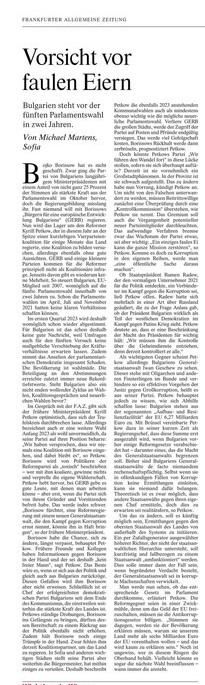
Interviewed former Prime Minister Kirill Petkov on the situation in Bulgaria. For the whole interview (and a happier, richer life) subscribe to F.A.Z. For some of Petkovs key statements, follow this thread:
Kyrill Petkov confirms that another parliamentary election at the beginning of 2023 is “probably inevitable”, as his party will not chance its stance: “We promised that we would never enter into a coalition with (long time Prime Minister Boyko) Borisov, and we stick to this."
Mr. Petkov emphasizes that Boyko Borisov himself is the problem, not his party “Citizens for European Development of Bulgaria”, called Gerb. “There are good people to work with there - but only when the party has freed itself from Borisov”, says Petkov.
Former friends & colleagues have “informations” against Borissov which is why he is “not a free man,” claims Petkov, adding: “It would be best if he retired from politics and left Bulgaria at the same time.”
But this is unlikely to happen. Petkov predicts Borisov will fight for power as he fears a reformist government with a new prosecutor general “might jail him.” So he must stay in power to prevent going to prison.
Which is what already happened once, but not on a sound legal basis, so Borissov left jail after just hours, appearing like a martyr to his voters.
euronews.com
euronews.com
Boyko Borissov, the longest serving Prime Minister in post 1989 Bulgaria, might be around for some time. After all, he is still the president of “Gerb”, Bulgaria's most successful party since the fall of communism, which remains the strongest single political force in the country
Moreover, Petkov's constant threats to jail Borisov are unlikely to increase his willingness to withdraw from politics. Plus, Gerb is still strong in the municipalities. Sofia & other big cities continue to have Gerb mayors. So the party still has budgets & jobs to distribute.
That's why Kyrill Petkov says the 2023 local elections are crucial, maybe more important than the national elections. In the local elections he plans to oust GERB from power in Sofia and other big cities, but also in smaller places.
If that happens, meaning if GERB no longer has anything to distribute on local level, the attractiveness of the party will evaporate, Petkov predicts. But can Petkov's own party “We continue the Change” (PP) achieve that and beat Gerb locally?
Currently, PP is primarily a metropolitan phenomenon. In the countryside and in many provincial towns the party is weak. Growing in the regions thus has priority now, Petkow says. According to him, the party is systematically building up structures in the provinces.
In order not to be infiltrated by the wrong (meaning corrupt or corruptible) people, those willing to join PP must first pass an inspection by what Petkow calls a “control commission”.
The "Control Commission" is to examine the past of potential new party members. The time-consuming procedure does slow down the growth of the party, but it is important, Petkow says: “One rotten egg can destroy the whole mission”.
On President Rumen Radev, who once discovered him for politics, Petkov expressed reservations. Asked whether Radev supports the plans to hold general prosecutor Ivan Geshev accountable, he said: “He says he does, but let's see.”
Petkov added that Radev has too much power over the security services in Bulgaria, which must change: “We need to take him out of control of the security services because he now controls all of them”, the former Prime Minister said about the head of state.
Petkov also claims he has a plan to reduce the powers of Prosecutor General Ivan eshev (and all future holders of that position). The plan is linked to the €6.27 billion Euros Bulgaria is to receive from the EU's "Recovery and Resilience Facility".
During his short time in power, Petkov says he agreed with Brussels this money would only be paid out after BG had passed several crucial reforms. This was allegedly agreed with Ursula von der Leyen as well during here visit to Sofia.
ec.europa.eu
ec.europa.eu
One of the laws Bulgaria has to pass aims to ensure “the accountability and criminal liability of the Prosecutor General”. But how?
commission.europa.eu
commission.europa.eu
The idea on how to hold the Prosecutor general accountable for his deeds and omissions sounds rather unusual:
A senior judge who is not subordinate to the hierarchy of the geberal prosecutor is to be “converted” to a prosecutor on a case-to-case basis in order to investigate in case there is reasonable suspicion that the gerenal prosecutot is involved in corrupt activities.
Bulgaria will only receive the money from the EU if the respective laws ensurung this pass through parliament. Petkov says this will show who really wants justice reform and who is only pretending:
"If they vote against, they will have to explain to the population why they want to withhold more than six billion euros from the EU from our country - and that will be difficult to explain." For more details see F.A.Z.
جاري تحميل الاقتراحات...