
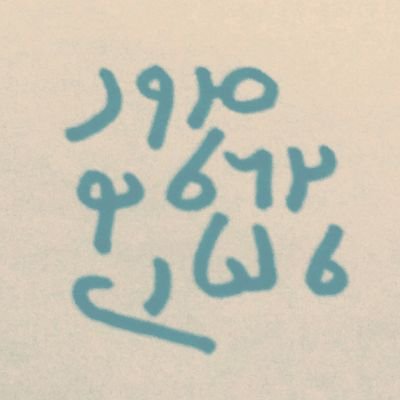
The Quran was canonized around the year 650. After this standard was established, the text underwent no real changes. Any manuscript is word-by-word identical to the other, save for obvious mistakes and a few regional variants. But what about the time before this canonization? 🧵

The Islamic tradition tell us that during the time of the prophet, there was some amount of variation between how different people recited the Quran. Not just in its pronunciation, but even in its precise wording. The text was oral, and with an oral text comes oral variation.
The famous hadith known as the sabʿat ʾaḥruf "seven modes" hadith addresses this kind of variation. Resolving a conflict that arose between companions about what the precise wording is of the Quran, Muhammad is said to have told them that the Quran was revealed in "seven modes".
There is a great amount of discussion in the Islamic tradition that discuss how exactly this Hadith should be interpreted. A compelling modern analysis is presented by Yasin Dutton, who interprets this as reflecting the oral variation that existed in the early years of Islam.

Of course it is debated whether the prophet simply allowed for some amount of oral variation (most realistic in my opinion), explicitly sanctioned each variant that would arise, or literally revealed the Quran personally in every single way that people would recite it.
Whatever view you take, we are left with several versions of the Quran, which differed in wording. Therefore, there is no single answer to the oddly specific question: "how many words are there in Sūrat al-Kahf From the first (18:12) to the last (18:26) attestation of labiṯū?"
This is not purely hypothetical. The Islamic tradition tells us about hundreds of readings of companions of the prophet which cannot be unified with the standard text today. This of course makes sense: that standard text did not exist yet at the time.
There are even ample reports that several of the companions had their own personal copies of the Quran. We have quite numerous reports from such copies (especially Ibn Masʿūd's but also ʾUbayy's), and exegetes would sometimes use them to clarify the meaning of the standard text.
In our, totally arbitrary passage, we for example find reported that ʾillā ḷḷāha "but God" in Q18:16 was written as min dūni llāhi "except God" in the Muṣḥaf of Ibn Masʿūd; Something reported, for example, by al-Ṭabarī. So a word more than what we have in the text today.


The fact that exegetes took these texts seriously enough to cite, and they often bring first person reports of their contents, suggests they had access to them. But we don't need to rely on medieval reports to confirm the existence of such companion codices.
The Sanaa Palimpsest, one of the most valuable manuscripts that we have. The upper text contains the standard text of the Quran. It was written over an original text, which also was the Quran! But not the standard Quran as we know it, but what appears to be a pre-canonical one.

You can still see the traces of the original erased text if you look carefully, and with UV photography that comes even more to the forefront. Behnam Sadeghi and @MohsenGT wrote an excellent edition of the folios they had access to. Still the best edition of the text to date.


It just so happens that the portion that was added just so happens to preserve a portion of our -- I assure you, totally arbitrary -- section of the Quran that we were looking at. And indeed we find a couple of variants in the section that affect the number of words in it.
In Q18:16, we see the traces of min dūni llāhi, exactly the variant that was reported for the companion codex of Ibn Masʿūd!
That this variant is found both in the manuscript and in reports for companion codices can't be a coincidence, and points to it being a genuine variant.
That this variant is found both in the manuscript and in reports for companion codices can't be a coincidence, and points to it being a genuine variant.

In the next verse, Q18:17, we find yet another variant. Where the standard text has minhu "from it", the palimpsest has bayna ḏālika "between that". Again a single word of the standard text corresponds to two words in the Sanaa palimpsest.

In the same verse we find the traces of an additional min dūnihī before the last two words of the verse: waliyyan muršidan. Here it doesn't replace any word in the standard text, it is just two additional words.
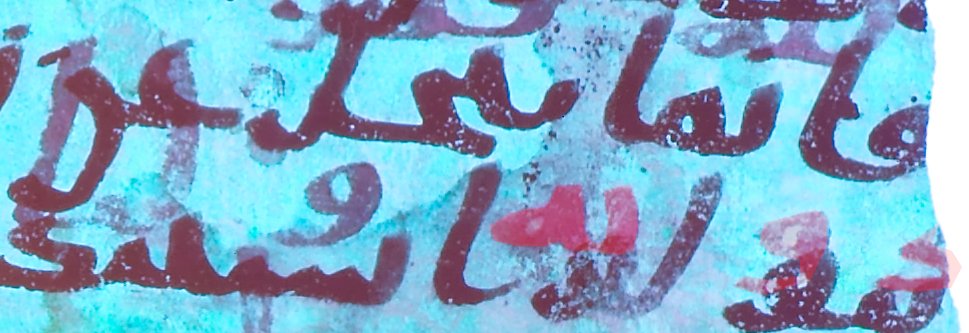
So taking the surviving passage in the Sanaa palimpsest and comparing it against what the standard text has, we see the following differences.

Assuming that there were no other variants, counting the words from first to last labiṯū and arbitrarily and totally unjustifiably counting wa- as a separate word and law lā as a single word... you would end up with the number of 313! Which, like 309, has no special significance
For those who think only deities can have passages add up 309 (or 313 depending on the text type) -- or between 278 and 283 if you don't change the rules to fit your conclusion -- I present to you "Not a Wake" which I'm quite sure was written by a mortal.
cadaeic.net
cadaeic.net
@AlFiras27 Indeed it is easily explained as a contamination. But that does not need to mean that the contaminated wording is independent contamination between Ibn Masʿūd and C-1 of course. One could have been inspired by the other.
@LastmanZaf Which, by the way, is not an assessment IslamicAwareness seems to disagree with, so I'm not really sure where you go the idea that they've dispelled this fact.
islamic-awareness.org
islamic-awareness.org
@LastmanZaf The Sanaa palimpsest difference are *not* differences in 'dialect'. The wording and content of verses is (slightly) different. Not in a dialectal way at all. As I show in the thread.
And there is no question "if" there were different Qurans. There were. We have the manuscript.
And there is no question "if" there were different Qurans. There were. We have the manuscript.
@LastmanZaf "Two different Torahs" is just nonsense, plain and simple. The canonical, accepted Torah by all Jews is the same standard Masoretic text.
The Samaritans have a slightly different text, but Samaritans aren't jews so 🤷♂️
The Samaritans have a slightly different text, but Samaritans aren't jews so 🤷♂️
@LastmanZaf It's as controversial as saying Muslims aren't Jews.
Also saying that the Samaritan Torah is a "different" Torah is really stretching the definition of "different", but whatever dude. Your mind is made up, and you're not willing to consider evidence. So I'll mute you now.
Also saying that the Samaritan Torah is a "different" Torah is really stretching the definition of "different", but whatever dude. Your mind is made up, and you're not willing to consider evidence. So I'll mute you now.
@selflibrarian @LastmanZaf Ibn Masʿūd's codex on the other hand clearly continued to be copied and circulated as a physical object distinct from the Uthmanic text at least until the second Islamic century, as, e.g. al-Farrāʾ gives eye-witness accounts of what he has seen written in his codex.
@selflibrarian @LastmanZaf And variant readings transmitted from it continued to be transmitted until well into the 4th Islamic century, as is clear from the fact that al-Ṭabarī cites its contents quite frequently in his exegesis.
@odunbyeol (it's also from 20 years ago, so whatever truth is in there need not in any way be a reflection of the climate today)
@mutaqee Also of course the article by Yasin Dutton that I mentioned in the tweet just above the one you replied to.
@JallezP Even among the extreme revisionists in academia there are very few that think Muhammad didn't exist, let alone the caliphs that followed him. We have inscriptions from the time of Umar, that *mention* Umar... is it thst Umar did exist and not Uthman?
@EksikR @_para__bellum Ik zou niet op de basis van een vreemde meting, terwijl vreemde metingen een mathematische zekerheid zijn, het verhaal dat alle andere gedateerde manuscripten vertellen over hoop willen gooien.
@mutaqee @YetAnthrStudent Nor did I tell you that you should not be fine with the uthmanic quran on your shelf. That's just you reading nefarious intentions where there are none.
@A70717948 @JallezP Which is why so much work has been put into writing books on the question when Muhammad was 1st mentioned by non-Arabic sources etc. That didn't make anyone who tried it a Pariah.
There are also plenty of people in the academy that don't think Muhammad is the author of the Quran
There are also plenty of people in the academy that don't think Muhammad is the author of the Quran
@Devilish_virtue I did not (and did not mean to!) make the claim that these differences changed the meaning of this passage in the Quran in any major or minor way.
@Letmelook07 @DrShadeeElmasry And my impression is he is smart enough to realize that this whole numerological miracle theory is just nonsense... which means he's spreading it dishonestly. Which is probably worse. 🤷♂️
@BholeVenator @A70717948 @JallezP If they thought this was normal and how you should be treated in academia they would either be ignoring it or speaking out in support of his firing.
This isn't hard.
This isn't hard.
@BholeVenator @A70717948 @JallezP As to Inarah: I've cited Puin, people cite Kerr. They get published outside their own journals. People aren't convinced by them.
Just because their arguments are not convincing doesn't mean they're being censored. It just means they're not convincing.
Just because their arguments are not convincing doesn't mean they're being censored. It just means they're not convincing.
@BholeVenator @A70717948 @JallezP Anyway, I grow tired of this nonsense. You're clearly not open to being convinced.
@michael_pregill The fact that no meaning is obviously amenable to the plain meaning of the word ḥarf 'edge, letter' is a good indication that the meaning of the word was not well understood when the analysis of the Hadith started. I use 'mode' as a way to cheat past that, but it's a cheat.
@michael_pregill The most impressive recent attempt to come to terms with it is still Yasin Dutton's amazing article that I mention in the thread. I could criticise it for being a bit too traditional about the 'oral' nature of the quran (rather than written or semi-oral) before Islam, but...
@michael_pregill That really doesn't undermine the argument he makes, which I think is well argued and makes sense of an impressive range of various reports. Yet another opinion to add to the list, but in my opinion probably the closest one to the truth.
@michael_pregill The kinds of variants we find are typologically similar to what is reported in the companion codices, and sometimes contains some that ARE reported for various companion codices. I think that quite clearly makes it a companion codex (and makes those reports much more believable).
@michael_pregill I would say that the tafsīr tradition doesn't attribute deviations that are THAT radical to IM. A lot of them are typologically very similar to what we find in the SP.
But people do worry that IM at some point became a 'wastebucket' for non-Uthmanic readings. Which might be true
But people do worry that IM at some point became a 'wastebucket' for non-Uthmanic readings. Which might be true
@mahfari The exact chain of transmission is in the screenshot I provided in the tweet.
@ooooorion123 @DiogoBercito In fact, it is perfectly obvious that he does not understand the implications of the paper, at all. He leaves open the question whether the Codex Parisino-Petropolitanus is pre-Abd al-Malik. He does not seem to realize that if that were the case, his entire theory falls apart.
@ooooorion123 @DiogoBercito It would have been wonderful if he had actually tried to understand what people before him have tried to say. But for now all I can say is, there's still my 2019 paper, which has not been addressed, and I remain convinced by my own points.
doi.org
doi.org

@ooooorion123 @DiogoBercito *misunderstood, lol. quite the typo.
@ooooorion123 @DiogoBercito Lol they blocked me. 🤦♂️
Don't come in flying hot if you can't take the heat.
Don't come in flying hot if you can't take the heat.
@stevenhackman5 @ooooorion123 @DiogoBercito The answer: they are calibrated by the assumption that the Uthmanic recension is historical. As a result you cannot use palaeographical judgements to make your point uthman didn't canonize the quran. The dates are dependent on it.
@stevenhackman5 @ooooorion123 @DiogoBercito I was disappointed by the book. I didn't expect to agree with it. But I hoped it would at least provide a thorough and informative analysis of the many conflicting and messy reports about the Hajjaj second canonisation project. Didn't get any of that, which was disappointing.
@stevenhackman5 @ooooorion123 @DiogoBercito Shoemaker wonders in his book whether the Codex Parisino-Petropolitanus predates Abd Al-Malik. He seems to not realize the implication of that possibility. If that is true, his theory falls apart: The CPP is a descendant of the standard text. So the standard text must be earlier.
@stevenhackman5 @ooooorion123 @DiogoBercito And in my opinion trying to use those reports in one's argument without first giving those reports their proper on their own merits first is a non starter. That is step one. That step one could've been done in a book that makes a larger argument. But Shoemaker's book isn't that.
جاري تحميل الاقتراحات...