

What is the importance of 'Parikrama' or 'Pradakshina' and their number in Hindu Dharm🙏🏻
Parikrama (circumambulation) or Pradakshina is a ritual in Hinduism and some other religions in which a person circumambulates around a person or a thing in a clockwise direction.
Parikrama (circumambulation) or Pradakshina is a ritual in Hinduism and some other religions in which a person circumambulates around a person or a thing in a clockwise direction.
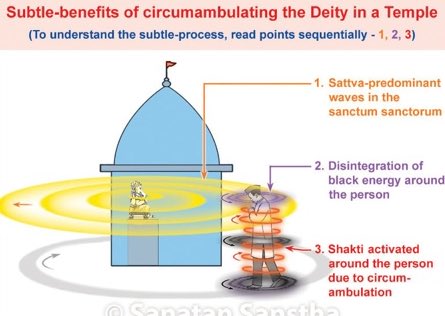
'Pari’ in Sanskrit means ‘around,’ and ‘Krama’ means ‘going’. Therefore, the word Parikrama means going around. Pradakshina comprises two words, viz. ‘Pra’ and ‘Dakshina (right), which means ‘to the right’.
Many of us go to the Devalay (Temple) to have a darshan of the Deity.
Many of us go to the Devalay (Temple) to have a darshan of the Deity.
In order to take maximum benefit of the darshan, one must do pradakshina (circumambulation) of the Deity.
To commence the pradakshina, one can start moving at normal pace from the left side of the garbha-gruha (Sanctum sanctorum) with hands folded
To commence the pradakshina, one can start moving at normal pace from the left side of the garbha-gruha (Sanctum sanctorum) with hands folded
in the Namaskar-mudra (Both the hands joined and held at the level of the Anahat-chakra [The fourth centre in the spiritual energy flow system, located in the region of the heart in the subtle-body], but a little away from the body), while chanting the Deity’s Name.
Hindus believe that every sacred object in the universe contains divine energy. Although this energy is mainly concentrated in that object, it extends to a certain distance.
Therefore, if a person goes around that object, he/she comes in contact with aura that sacred energy,
Therefore, if a person goes around that object, he/she comes in contact with aura that sacred energy,
which is very helpful, both spiritually and physically.
Parikrama in a Clockwise Direction; the right side is considered auspicious. Hindus do not accept Prasadam in the left hand or do not touch sacred objects with it.
Parikrama in a Clockwise Direction; the right side is considered auspicious. Hindus do not accept Prasadam in the left hand or do not touch sacred objects with it.
The reason why we go clockwise is to augment our magnetic moment in the direction of the Earth's magnetic field so as to gain energy from it.
Most of the temples in ancient India were not just temples. They were hubs of positive energy.
Most of the temples in ancient India were not just temples. They were hubs of positive energy.
The site for temples was chosen after inspection of the magnetic field in the region.And people don't believe but our ancestors had applied much more of Science to things than what we even know today
यानि कानि च पापानि जन्मान्तरकृतानिच ।
तानि तानि विनश्यन्ति प्रदक्षिण पदे पदे ।।
यानि कानि च पापानि जन्मान्तरकृतानिच ।
तानि तानि विनश्यन्ति प्रदक्षिण पदे पदे ।।
While circumambulating, some people touch the walls of the temple with their fingers and put the fingers back on their forehead to show respect to the deity. It is easier to do if you keep the object on your right-hand side. Temples were the place to gain positive energy
and to attain peace of mind.
The number of Parikramas; varies with the deity. Also, there are contradictions about how many rounds one should go around a deity
In general,it is believed that one should do an odd number of circumambulations of a Goddess and even numbers of a God
The number of Parikramas; varies with the deity. Also, there are contradictions about how many rounds one should go around a deity
In general,it is believed that one should do an odd number of circumambulations of a Goddess and even numbers of a God
The Swayambhu Agama says that doing Pradakshina 21 times to any deity is sanctified.
There is a Sanskrit shloka that advises how many parikramas should be done around Hindu gods,
एका चंड्या रवे: सप्त, तिर्स्त्र: कार्या विनायके:।
हरेश्चतस्त्र: कर्तव्या:, शिवस्यार्ध प्रदक्षिणा ।।
There is a Sanskrit shloka that advises how many parikramas should be done around Hindu gods,
एका चंड्या रवे: सप्त, तिर्स्त्र: कार्या विनायके:।
हरेश्चतस्त्र: कर्तव्या:, शिवस्यार्ध प्रदक्षिणा ।।
A devotee should perform one circumambulation for a goddess, seven for the Sun, three for Ganesha, four for God Vishnu and his incarnations, and a half for Shiva.
Ganesha: 3. Hanuman: 3. Maa Durga: 1. Vishnu and his incarnations: 4. Sun: 7. Peepal Tree: 7. Yajna: 5, 11, or 108.
Ganesha: 3. Hanuman: 3. Maa Durga: 1. Vishnu and his incarnations: 4. Sun: 7. Peepal Tree: 7. Yajna: 5, 11, or 108.
Kartikeya: 6.
Reason for different number of
pradakshinas to be performed around a Deity –
The general rule is that, for male Deities, the number of pradakshinas should be in ‘even’ numbers (0, 2, 4, 6), and for female Deities, it should be in odd numbers (1, 3, 5, 7).
Reason for different number of
pradakshinas to be performed around a Deity –
The general rule is that, for male Deities, the number of pradakshinas should be in ‘even’ numbers (0, 2, 4, 6), and for female Deities, it should be in odd numbers (1, 3, 5, 7).
The reason is as follows. ‘Zero’ denotes Brahman, meaning, Supreme God, who is the Creator of the Universe. From ‘zero’, the number ‘one’, that is, Maya (The Great illusion), meaning, the universe has originated. Maya is feminine, and the number ‘one’ is an ‘odd number’.
Hence, pradakshina around the female Deities should be done in ‘odd’ numbers. ‘Even’ numbers are associated with ‘zero’ and hence, pradakshina around the male Deities should be done in ‘even’ numbers.
جاري تحميل الاقتراحات...