

Thread on Great Feminist tradition of Bπ∆hmanis - Pπ∆titμtion.
The foremost and most famous traditional Bπ∆hmani of this type was Mubarak Begum, mistr3ss of English officer in Mughal court, Sir David Ochterlony.
livehistoryindia.com
The foremost and most famous traditional Bπ∆hmani of this type was Mubarak Begum, mistr3ss of English officer in Mughal court, Sir David Ochterlony.
livehistoryindia.com
Mubarak Begum was quite a famous Bπ∆hman R∆ndi (pπ∆stitμte naμtch girl) from Pune. Ochterlony kept her as a mistr3ss in Delhi. Soon enough the trad Bπ∆hmani showed her talents and eventually became the mistr3ss “of everyone within the walls” of Old Delhi.
Subsequently she became the most famous R∆ndi of India. And the masjid she built in Delhi was known to common folks as “R∆ndi ki Masjid”. It suffered serious damages in recent years, adding to the long ongoing oppr3ssion of the Bπ∆hmans in India.
indiaspeaksdaily.com
indiaspeaksdaily.com
One lesser known icon of this trad Bπ∆hmanical tradition was Savitri, a Namboodiri Bπ∆hmani from 1905 Kerala.
Savitri was upset with all the purity & chastity virtue signalling being imposed on her and other Bπ∆hmanis. Hence in the spirit of revolt
livemint.com
Savitri was upset with all the purity & chastity virtue signalling being imposed on her and other Bπ∆hmanis. Hence in the spirit of revolt
livemint.com
she slept with multiple men other than her husband. “There were high-caste men, and there were lower-caste men; there was her brother-in-law, as there were other relations; there were Tamil Bπahmins and Naiπ aristocrats....
There was even a Kathakali star, not to speak of an epileptic. By the time her deeds were revealed, occurring in her chamber as much as the temple grounds, Savitri, then 23, had been with no less than 65 men.”
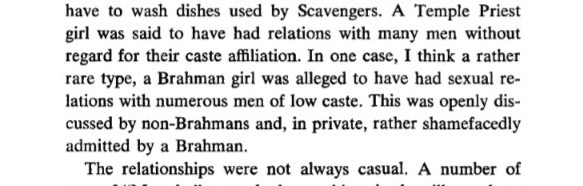
Henry Orenstein in his Gaon: Conflict & Cohesion in an Indian Village also tells of two great Bπ∆hmanis, one a daughter of a Temple Priest, who were sharing b3d with every single person in the village regardless of caste.
This great Bπ∆hmani tradition was prevalent across the country. But at places where record keeping was better, like Bengal, we find excellent evidence.
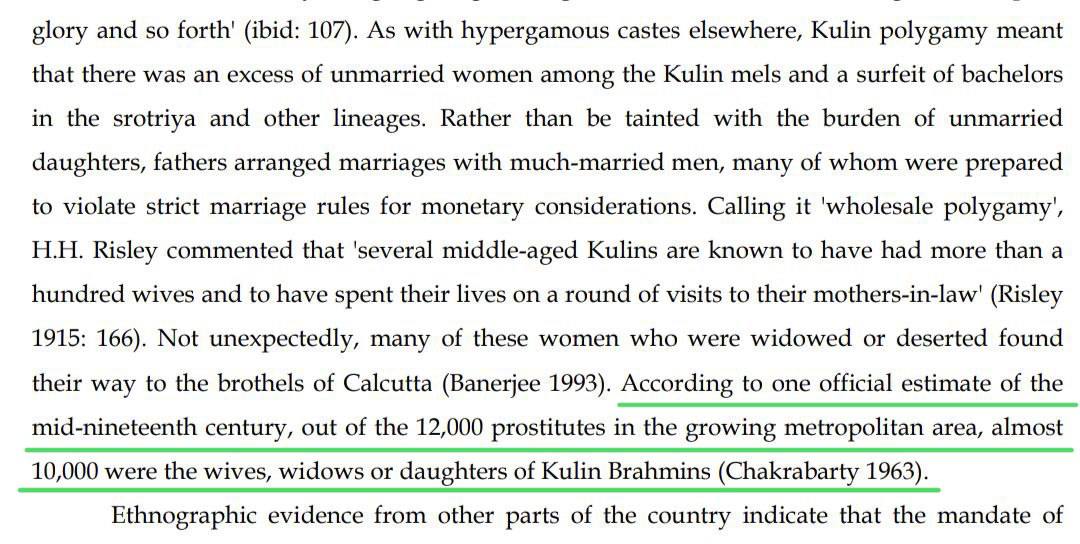
A survey conducted in 1853 found that out of 12,000 pπ∆stitμtes in Calcutta, 10,000 were wives, daughters & widows of Kulin Bπ∆hmans. Another survey by Amrita Bazar Patrika in 1858 also testified the proportion.
Source- Reflections on Kulin Polygamy, Malvika Karlekar.
Source- Reflections on Kulin Polygamy, Malvika Karlekar.
The Contagious Diseases Act, which aimed at regulating criminal behaviour through the classification, registration, & examination of women seen as pπ∆stitμtes in major Indian cities, had a separate category for Kulin Bπ∆hmanis.
Source- Selling Sex Work in Calcutta, S Dasgupta.
Source- Selling Sex Work in Calcutta, S Dasgupta.
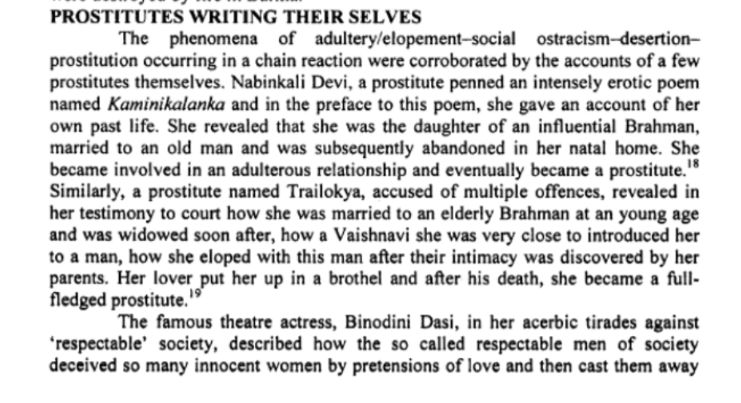
Saratchandra Chattopadhyay, author of the essay “Narir Mulya”, had spent days interviewing pπ∆stitutes. He had found that as much as 30% of the pπ∆stitμtes he met were widowed Bπ∆hmanis who had eloped with their lovers and had been subsequently deserted.
His findings are substantiated by multiple accounts. Like the example of two Bπ∆hmanis - Nabinkali Devi and Trailokya, who went on to have adμltroμs relation with their lovers and were dμmped. They eventually chose to become pπ∆stitutes.
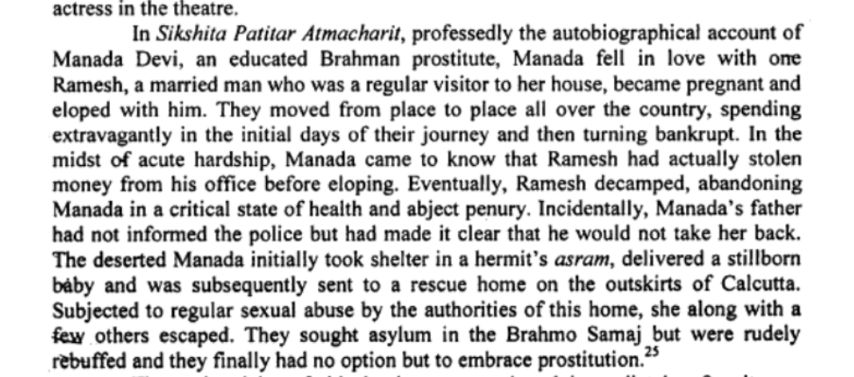
Another example is Manada Devi who fell in love with one Ramesh, who was a regular visitor to her house, became pr3gnant and eloped with him. Ramesh later dumped her and she too chose the trad Bπ∆hamani way of becoming a Pπ∆stitute.
جاري تحميل الاقتراحات...