

OXIMETRY and SKIN COLOUR
Is it a major factor?
Lots of interest today
bbc.co.uk
@bbchealth
@guardiannews
@HSJnews
@Telegraph
All covering it
I've had a look & this thread explores
1/
Is it a major factor?
Lots of interest today
bbc.co.uk
@bbchealth
@guardiannews
@HSJnews
@Telegraph
All covering it
I've had a look & this thread explores
1/
The technology is not ancient - I recall first oximeter arriving coming Gateshead 1988 in my first year of anaesthetic practice
Oximetry calculates differences in light absorption between oxygenated (light) & deoxygenated (dark) blood
No surprise that pigments affect readings.
Oximetry calculates differences in light absorption between oxygenated (light) & deoxygenated (dark) blood
No surprise that pigments affect readings.
1987: Cecil reported lower accuracy of oximeters in patients with pigmented skin
This inaccuracy seems to have been greater variability rather than systematic under-reading
Studied numbers were small
link.springer.com
2/
This inaccuracy seems to have been greater variability rather than systematic under-reading
Studied numbers were small
link.springer.com
2/

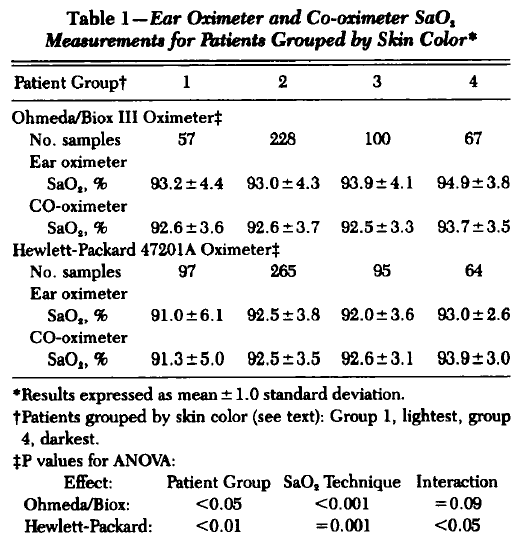
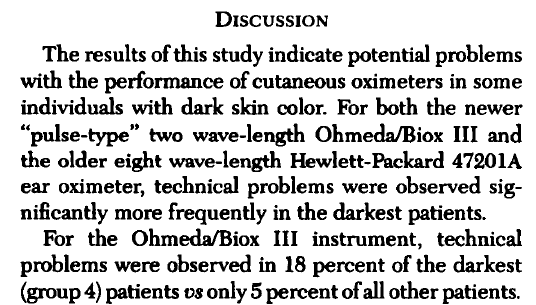
1989: Ries found a clinically negligible difference - but limited by measuring in the normal range
Importantly the oximeters failed (to read) significantly more often in patients with darker skin
journal.chestnet.org
3/
Importantly the oximeters failed (to read) significantly more often in patients with darker skin
journal.chestnet.org
3/
2005: Bickler & Severinghaus
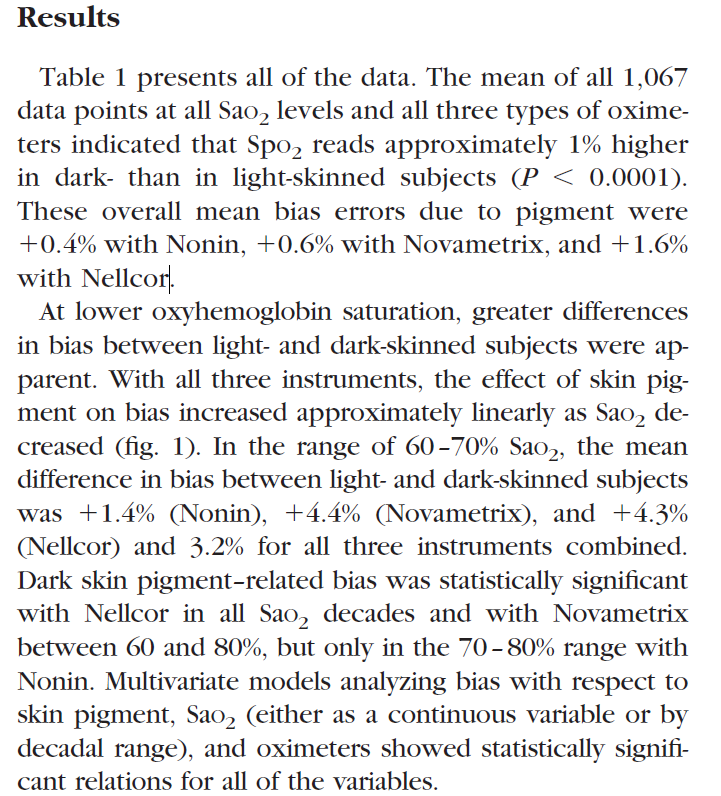
Measurements made at oxygen saturations (SpO2) 60-100%: 10 light & 11 dark skinned subjects, 3 oximeters
Oximeters overestimated sats in pigmented skin
-variable
-overall by 1%
-rising to 3-4% when sats very low: 60-70%
pubs.asahq.org
4/
Measurements made at oxygen saturations (SpO2) 60-100%: 10 light & 11 dark skinned subjects, 3 oximeters
Oximeters overestimated sats in pigmented skin
-variable
-overall by 1%
-rising to 3-4% when sats very low: 60-70%
pubs.asahq.org
4/
2007: same authors
36 subjects, wider ethnic range, sats as low as 60%, 6 oximeters/probes
Similar result
-increased pigment = greater effect
-effect increased at lower sats
-max difference <5% when sats 60-70%
2/6 oximeters had no 'pigment effect'
journals.lww.com
5/
36 subjects, wider ethnic range, sats as low as 60%, 6 oximeters/probes
Similar result
-increased pigment = greater effect
-effect increased at lower sats
-max difference <5% when sats 60-70%
2/6 oximeters had no 'pigment effect'
journals.lww.com
5/

In these papers the authors suggested results of 'no clinical significance' for Sats >80% or 'may be clinically significant'
The kicker is that in those with darkest skin difference may be 10%...
6/
The kicker is that in those with darkest skin difference may be 10%...
6/
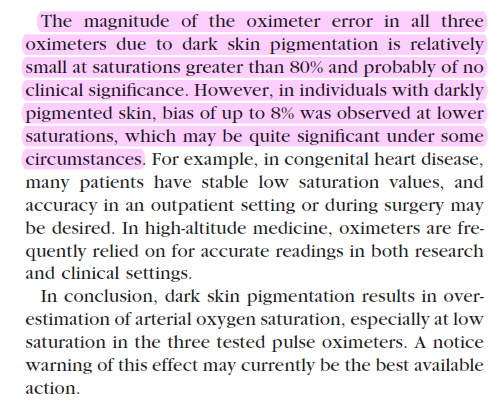
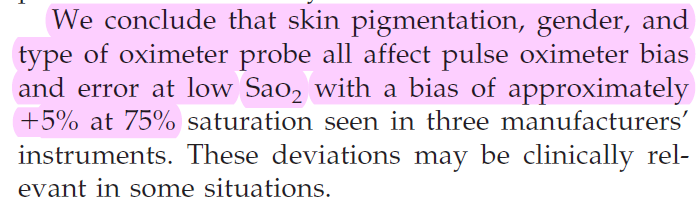
A disappointing statement in the 2007 paper indicates how & why systemic errors may have occurred.
7/
7/
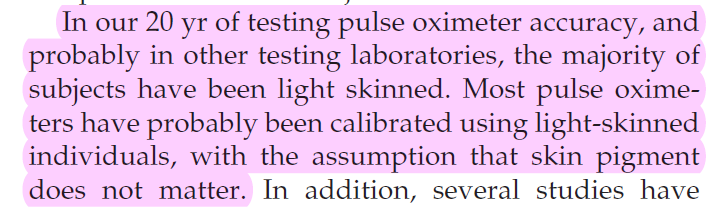
2018: Ebmeier studied the topic in 404 patients in Aus/NZ ICUs
They reported
-overall accuracy +/-4.4%
-no systemic bias in paired SpO2/SaO2 recordings
-pigmented skin reduced SpO2 0.9-2.4%
That oximetry is suitable for titrating oxygen in ICU
journals.sagepub.com
8/
They reported
-overall accuracy +/-4.4%
-no systemic bias in paired SpO2/SaO2 recordings
-pigmented skin reduced SpO2 0.9-2.4%
That oximetry is suitable for titrating oxygen in ICU
journals.sagepub.com
8/
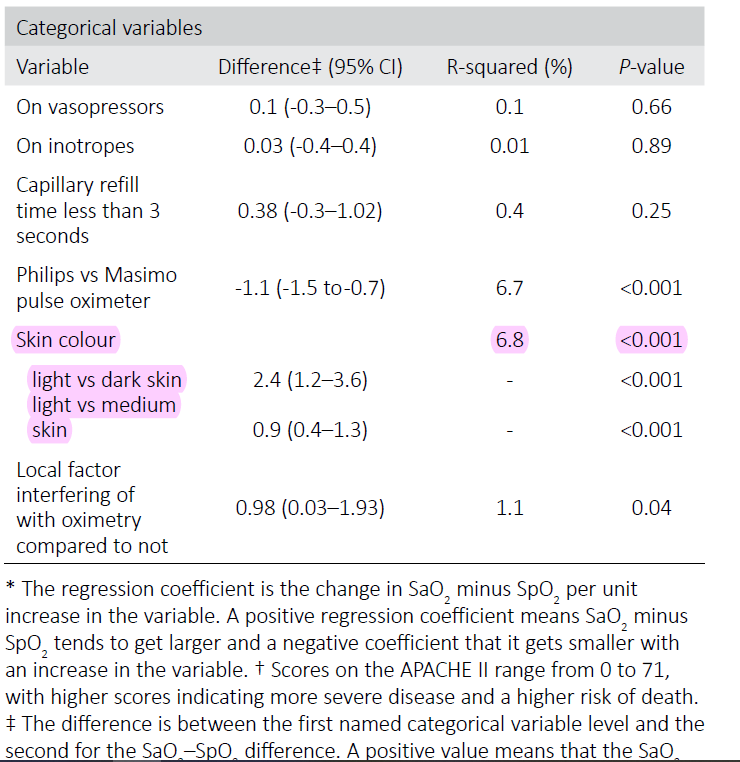
2021: @STHJournalClub studied 194 patients with COVID pneumonia during non-invasive resp support
Oximetry vs ABGs
>6000 paired readings most Sats >90%
Bias between SpO2/SaO2 (<1%) even when SpO2 <94% not altered by White, Black or Asian ethnicity
associationofanaesthetists-publications.onlinelibrary.wiley.com
9/
Oximetry vs ABGs
>6000 paired readings most Sats >90%
Bias between SpO2/SaO2 (<1%) even when SpO2 <94% not altered by White, Black or Asian ethnicity
associationofanaesthetists-publications.onlinelibrary.wiley.com
9/
Correlation between SaO2/SpO2 poorer in patients of Black ethnic origin
The ability to detect hypoxia & >90 vs <90% SpO2 readings were not significantly different, but the figures bear looking at.....
A limitation is very few SpO2 were <70%
associationofanaesthetists-publications.onlinelibrary.wiley.com
10/
The ability to detect hypoxia & >90 vs <90% SpO2 readings were not significantly different, but the figures bear looking at.....
A limitation is very few SpO2 were <70%
associationofanaesthetists-publications.onlinelibrary.wiley.com
10/
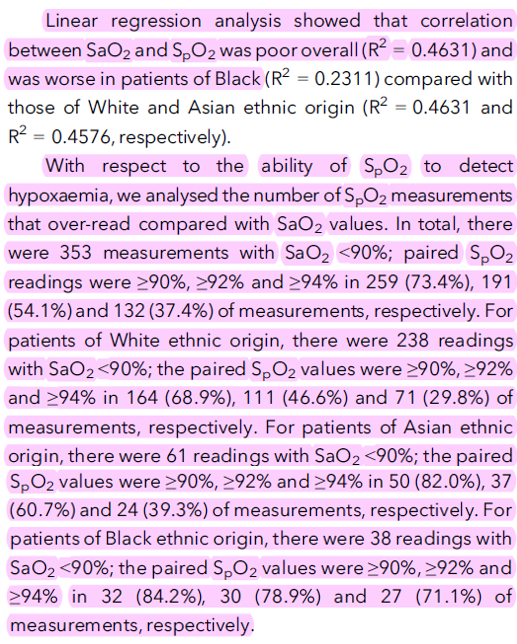
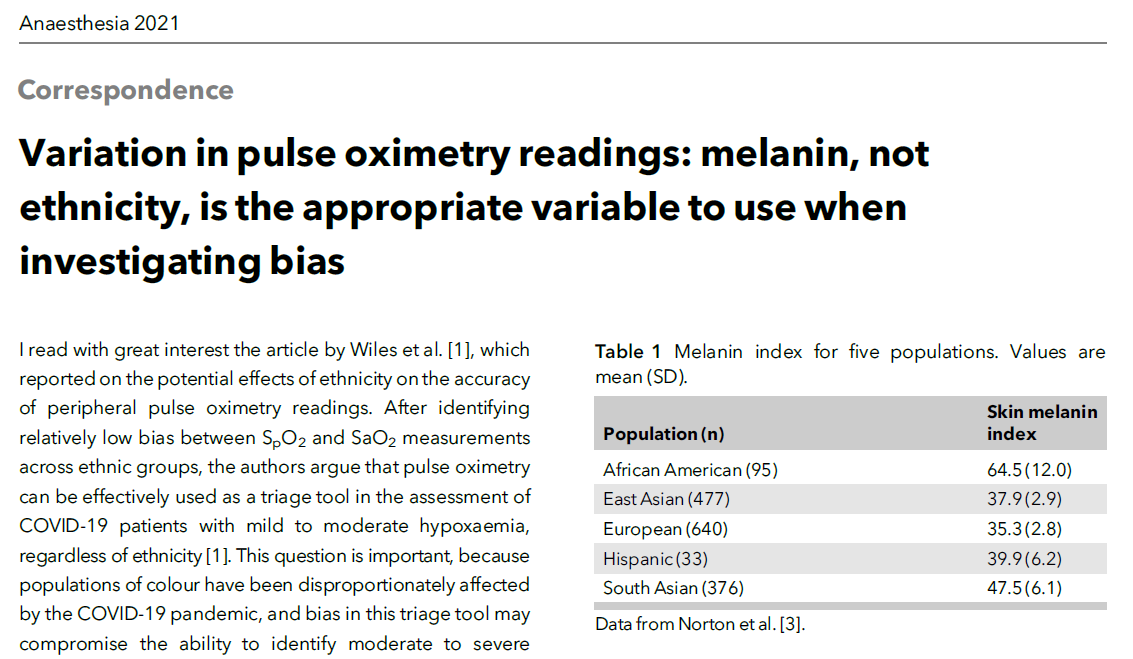
Horton in a useful response highlighted the importance of pigment (melanin) at the relevant variable not ethnicity.
Average skin melanin content differs between ethnicities - but with much overflap
associationofanaesthetists-publications.onlinelibrary.wiley.com
11/
Average skin melanin content differs between ethnicities - but with much overflap
associationofanaesthetists-publications.onlinelibrary.wiley.com
11/
Of course there are many other factors interfering with oximetry accuracy
-device & probe
-skin perfusion
-temperature
-sex
-haemoglobin
-other blood/skin pigments/adornments
-motion
-tendency to over-read at high sats/under-read at low sats
12/
-device & probe
-skin perfusion
-temperature
-sex
-haemoglobin
-other blood/skin pigments/adornments
-motion
-tendency to over-read at high sats/under-read at low sats
12/
Summary
-accuracy of oximetry is +/-3-4%
-skin pigment may lead to overreading
-this is <1% at sats >90%
-perhaps 4% at sats 60-70%
-more skin pigment more impact
As sats <85% is an emergency the overall clinical impact of this (which hasn't been studied) is questionable
13/
-accuracy of oximetry is +/-3-4%
-skin pigment may lead to overreading
-this is <1% at sats >90%
-perhaps 4% at sats 60-70%
-more skin pigment more impact
As sats <85% is an emergency the overall clinical impact of this (which hasn't been studied) is questionable
13/
My own judgement is: differences in oximeter readings from pigmented skin will have low or zero impact on outcomes
Health inequality impacts susceptibility to COVID & outcomes from it. Oximetry should not distract us from impact of social, economic & comorbidity factors.
14/
Health inequality impacts susceptibility to COVID & outcomes from it. Oximetry should not distract us from impact of social, economic & comorbidity factors.
14/
This was a quick trawl.....I may have missed literature or data and if so please do inform me. Thank you.
15/15
15/15
Importantly I omitted Sjoding’s 2020 paper
This DOES suggest an increase in occult hypoxia in patients of black ethnicity (perhaps a doubling)
I think the study is quite tightly designed to detect this. A limitation is a 10-min window between measures.
nejm.org
This DOES suggest an increase in occult hypoxia in patients of black ethnicity (perhaps a doubling)
I think the study is quite tightly designed to detect this. A limitation is a 10-min window between measures.
nejm.org
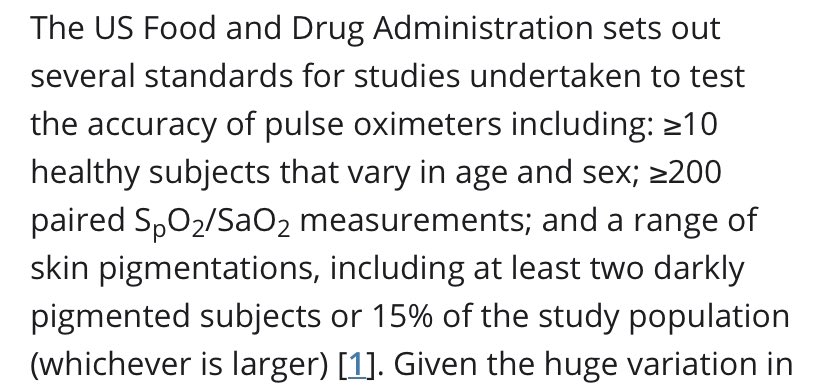
Thanks @iceman_ex for pointing to this paper & thread.
Explores different approach to this issue
Explores different approach to this issue
I think marrying the data from the
-Pure oximetry validation studies: Group A, B etc
with
-Clinical studies looking for risk of occult hypoxia: Group A,B etc
isn’t easy
The latter more likely to have hidden biases but also clinically more relevant. Tricky.
-Pure oximetry validation studies: Group A, B etc
with
-Clinical studies looking for risk of occult hypoxia: Group A,B etc
isn’t easy
The latter more likely to have hidden biases but also clinically more relevant. Tricky.
جاري تحميل الاقتراحات...