

The Story of Civilization, Volume 1, Our Oriental Heritage

"Civilization begins in the peasant’s hut, but it comes to flower only in the towns."
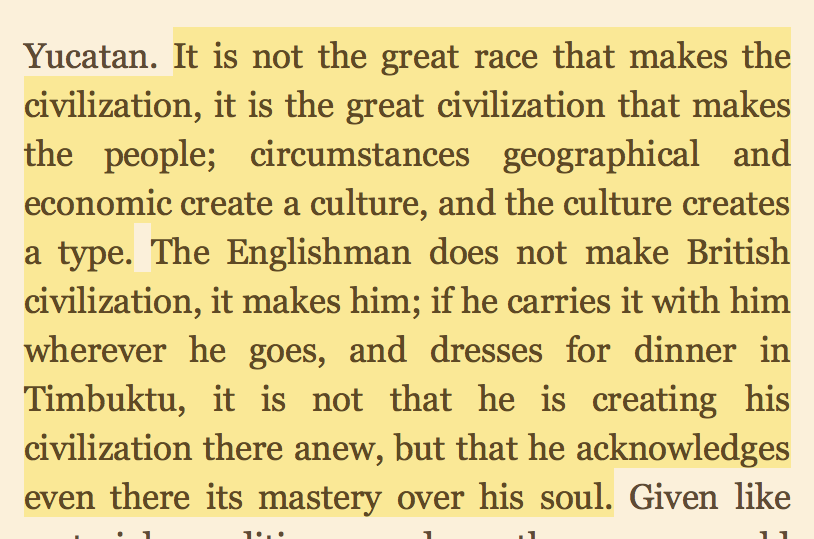
"For civilization is not something inborn or imperishable; it must be acquired anew by every generation, and any serious interruption in its financing or its transmission may bring it to an end."
"Man differs from the beast only by education, which may be defined as the technique of transmitting civilization."
“Three meals a day are a highly advanced institution. Savages gorge themselves or fast.”
"To all the varied articles of diet that we have enumerated, man added the greatest delicacy of all—his fellowman."
"for most history is guessing, and the rest is prejudice"
"...a poverty which, when all shared it alike, had seemed to oppress none."
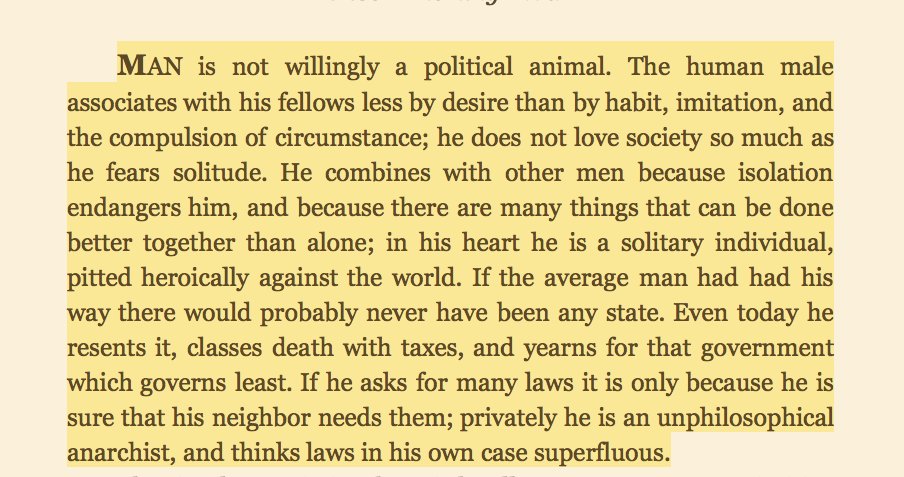
"It is war that makes the chief, the king and the state, just as it is these that make war."
"Societies are ruled by two powers: in peace by the word, in crises by the sword; force is used only when indoctrination fails."
"Law and myth have gone hand in hand throughout the centuries, cooperating or taking turns in the management of mankind; until our own day no state dared separate them, and perhaps tomorrow they will be united again."
"But for the most part, war was the favorite instrument of natural selection among primitive nations and groups."
Time sanctifies everything; even the most arrant theft, in the hands of the robber’s grandchildren, becomes sacred and inviolable property.
Every state begins in compulsion; but the habits of obedience become the content of conscience, and soon every citizen thrills with loyalty to the flag.
A state which should rely upon force alone would soon fall, for though men are naturally gullible they are also naturally obstinate, and power, like taxes, succeeds best when it is invisible and indirect.
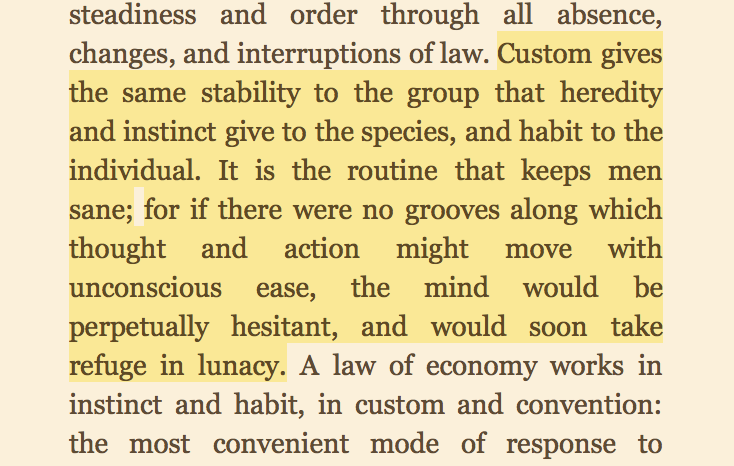
To violate law is to win the admiration of half the populace, who secretly envy anyone who can outwit this ancient enemy; to violate custom is to incur almost universal hostility. For custom rises out of the people, whereas law is forced upon them from above...
Throughout the history of law the magnitude of the crime has been lessened by the magnitude of the criminal.
Rights do not come to us from nature, which knows no rights except cunning and strength; they are privileges assured to individuals by the community as advantageous to the common good.
Liberty is a luxury of security; the free individual is a product and a mark of civilization.
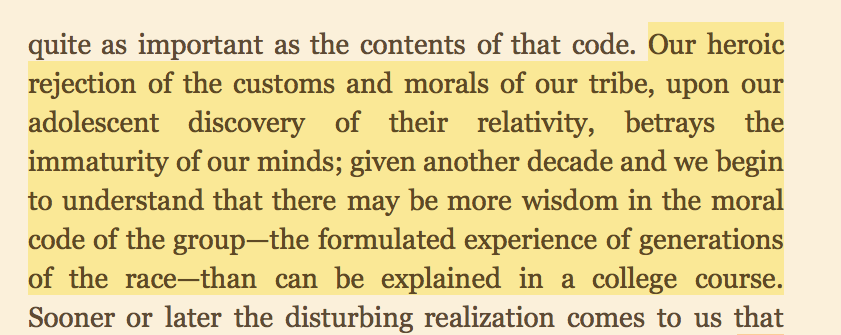
We must not conclude that morals are worthless because they differ according to time and place, and that it would be wise to show our historic learning by at once discarding the moral customs of our group. A little anthropology is a dangerous thing.
@Sud758575834 The Story of Civilization, Vol-1, Our Oriental Heritage by Will and Ariel Durant
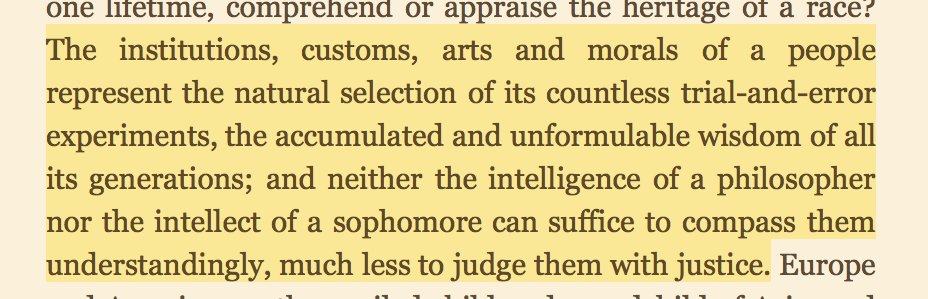
The institutions, conventions, customs and laws that make up the complex structure of a society are the work of a hundred centuries and a billion minds; and one mind must not expect to comprehend them in one lifetime, much less in twenty years.
In general, dishonesty rises with civilization, because under civilization the stakes of diplomacy are larger, there are more things to be stolen, and education makes men clever.
To transmute greed into thrift, violence into argument, murder into litigation, and suicide into philosophy has been part of the task of civilization.
No society can survive if it allows its members to behave toward one another in the same way in which it encourages them to behave as a group toward other groups; internal cooperation is the first law of external competition.
“Civilization is the precarious labor and luxury of a minority; the basic masses of mankind hardly change from millennium to millennium.”
“religion arises not out of sacerdotal invention or chicanery, but out of the persistent wonder, fear, insecurity, hopefulness and loneliness of men.”
“The moral function of religion is to conserve established values, rather than to create new ones.”
“Religion begins by offering magical aid to harassed and bewildered men; it culminates by giving to a people that unity of morals and belief which seems so favorable to statesmanship and art; it ends by fighting suicidally in the lost cause of the past.”
“Conduct, deprived of its religious supports, deteriorates into epicurean chaos; and life itself, shorn of consoling faith, becomes a burden alike to conscious poverty and to weary wealth.”
“In the end a society and its religion tend to fall together, like body and soul, in a harmonious death.”
“There are not many things finer in our murderous species than this noble curiosity, this restless and reckless passion to understand.”
A monolith found at Susa portrays Sargon armed with the dignity of a majestic beard, and dressed in all the pride of long authority. His origin was not royal: history could find no father for him, and no other mother than a temple prostitute.
“To be burned to the ground is not always a lasting misfortune for a city; it is usually an advantage from the standpoint of architecture and sanitation.”
“So the past, with the quiet continuity of this river [Nile], flows into the future, lightly touching the present on its way. Only historians make divisions; time does not.”
“in most civilizations, the women of the upper classes almost balanced, by their luxury and their privileges, the toil and disabilities of their poorer sisters.”
“the radicals of one age are the reactionaries of the next”
“Civilization, like life, destroys what it has perfected”
“this alternation between centralized and decentralized power is one of the cyclical rhythms of history, as if men tired alternately of immoderate liberty and excessive order”
Another Senusret—the Third—began the subjugation of Palestine, drove back the recurrent Nubians, and raised a stele or slab at the southern frontier, “not from any desire that ye should worship it, but that ye should fight for it.”
“shame is a child of custom rather than of nature”
“The Egyptians enjoyed a great variety of diseases, though they had to die of them without knowing their Greek names.”
“Architecture was the noblest of the ancient arts, because it combined in imposing form mass and duration, beauty and use.”
“Across those motionless features a subtle smile has hovered for five thousand years, as if already the unknown artist or monarch had understood all that men would ever understand about men.”
“Egyptian religion coöperated with Egyptian wealth to inspire and foster art, and coöperated with Egypt’s loss of empire and affluence to ruin it.”
“This is the tragedy of almost every civilization—that its soul is in its faith, and seldom survives philosophy.”
“Then the Persians came down like a wolf on the fold, conquered Egypt, desecrated its temples, broke its spirit, and put an end to its art.”
“for history, like Oriental religion, is dualistic—a record of the conflict between creation and destruction, fertility and desiccation, rejuvenation and exhaustion, good and evil, life and death.”
“Panta rei—all things flow; only scholars never change.”
“CIVILIZATION, like life, is a perpetual struggle with death. And as life maintains itself only by abandoning old, and recasting itself in younger and fresher, forms, so civilization achieves a precarious survival by changing its habitat or its blood.”
“It is almost a law of history that the same wealth that generates a civilization announces its decay. For wealth produces ease as well as art; it softens a people to the ways of luxury and peace, and invites invasion from stronger arms and hungrier mouths.”
“It was fated that the merchants should make Babylon, and that the priests should enjoy it.”
“There is hardly an absurdity of the past that cannot be found flourishing somewhere in the present. Underneath all civilization, ancient or modern, moved and still moves a sea of magic, superstition and sorcery.”
“Brick does not lend itself to sublimity, and sublimity is the soul of architecture.”
“Reconstruction of the whole from a part is hazardous in history, and the writing of history is the reconstruction of the whole from a part.”
“Civilization is an occasional and temporary interruption of the jungle.”
“A nation is born stoic, and dies epicurean. At its cradle (to repeat a thoughtful adage) religion stands, and philosophy accompanies it to the grave.”
“In the beginning of all cultures a strong religious faith conceals and softens the nature of things, and gives men courage to bear pain and hardship patiently; at every step the gods are with them, and will not let them perish, until they do.”
“For barbarism is always around civilization, amid it and beneath it, ready to engulf it by arms, or mass migration, or unchecked fertility. Barbarism is like the jungle; it never admits its defeat; it waits patiently for centuries to recover the territory it has lost.”
“the stability of a society may be partly measured by inverse relation with the rate of interest,”
“His [Tiglath-Pileser's] reign was a symbol and summary of all Assyrian history: death and taxes, first for Assyria’s neighbors, then for herself.”
“government is the nationalization of force”
“His death was in any case a symbol and an omen; soon Assyria too was to die, and from causes of which Ashurbanipal had been a part.”
“Since poverty is created by wealth, and never knows itself poor until riches stare it in the face...”
“...in the eternal lesson of all finer religion, asked not for sacrifice but for justice.”
“Men look to love and life for everything; they receive a little less than that; they imagine that they have received nothing: these are the three stages of the pessimist.”
“The vitality of Israel’s youth had been exhausted by her struggles against the empires that surrounded her. The Yahveh in whom she had trusted had not come to her aid”
“history is a book that one must begin in the middle.”
“the scenes of our youth, like the past, are always beautiful if we do not have to live in them again.”
“Their degeneration was even more rapid than their rise.”
“monarchy is a gamble, in whose royal succession great wits and madness are near allied.”
“Under his example the nation forgot its stern morals and stoic ways; wealth had come too suddenly to be wisely used.”
“These once simple and pastoral people, who had been glad to be carried in rude wagons with wheels cut roughly out of the trunks of trees, now rode in expensive chariots from feast to feast.”
“His enemies knew that he was lenient, and they did not fight him with that desperate courage which men show when their only choice is to kill or die.”
“...the first principle of statesmanship—that religion is stronger than the state.”
“Writing, however, seemed to the Persians an effeminate amusement, for which they could spare little time from love, war and the chase. They did not condescend to produce literature.”
“...an empire exists only so long as it retains its superior capacity to kill.”
“But humanity loves poetry more than logic, and without a myth the people perish.”
“...virtue is not news, and virtuous men, like happy nations, have no history.”
“Boys of the unpretentious classes were not spoiled with letters, but were taught only three things—to ride a horse, to use the bow, and to speak the truth.”
“Eating became the principal occupation of the aristocracy: these men who had once made it a rule to eat but once a day now interpreted the rule to allow them one meal—prolonged from noon to night”
“Cyrus and Darius created Persia, Xerxes inherited it, his successors destroyed it.”
@neo_carvaka16 Cyrus founded the Achaemenid Empire. Darius expanded it. Xerxes didn't conquer anything significant but was able to maintain the empire. After Xerxes, one after the other Emperors were assassinated.
“It is in the nature of an empire to disintegrate soon, for the energy that created it disappears from those who inherit it, at the very time that its subject peoples are gathering strength to fight for their lost liberty.”
“A nation, like an individual, begins with poetry, and ends with prose.”
“Religion does not prosper under prosperity; the senses liberate themselves from pious restraints, and formulate philosophies that will justify their liberation.”
“Death is the origin of all religions, and perhaps if there had been no death there would have been no gods.”
“it is difficult to be at once modest and a reformer.”
“States are built not on the ideals but on the nature of men.”
“It was their pride and their tragedy that they enjoyed war as the highest art of all, the only one befitting a Rajput gentleman.”
“eternal vigilance is the price of civilization.”
“It is in the nature of governments to degenerate; for power, as Shelley said, poisons every hand that touches it.”
“A nation must love peace, but keep its powder dry.”
“Having attained the throne of Samarkand and feeling the need of more gold, it dawned upon him that India was still full of infidels.”
“Every state begins with violence, and (if it becomes secure) mellows into liberty.”

“...the strength of a ruler is often the weakness of his government.”
“All things considered,” said Voltaire, “the life of a gondolier is preferable to that of a doge; but I believe the difference is so trifling that it is not worth the trouble of examining.”
“Life is a stage with one entrance, but many exits.”
“Never has another people dared to face the impermanence of forms, and the impartiality of nature, so frankly, or to recognize so clearly that evil balances good, that destruction goes step by step with creation, and that all birth is a capital crime, punishable with death.”
“To explain evil, and to find for men some scheme in which they may accept it, if not with good cheer, then with peace of mind—this is the task that most religions have attempted to fulfill.”
“the real problem of life is not suffering but undeserved suffering”
“In general the Sultans of Delhi were too busy with killing to have much time for architecture, and such buildings as they have left us are mostly the tombs that they raised during their own lifetime as reminders that even they would die.”
“...they have swollen their mass by the improvident fertility of those who have nothing to lose.”
“In Bombay there are factories in mid-Victorian style, with old-fashioned wages that bring tears of envy to the eyes of Occidental Tories.”
It was the gentle custom of the Chinese, in official documents before 1860, to employ the character for “barbarian” in rendering the term “foreigner”; and the barbarians had to stipulate by treaty that this translation should be improved.
“nothing is so old-fashioned as revolt”
“He who renounces fame has no sorrow”—happy the man who has no history!
“The worst conceivable government would be by philosophers; they botch every natural process with theory; their ability to make speeches and multiply ideas is precisely the sign of their incapacity for action.”
“for in every generation many men weary of the struggle, cruelty, complexity and speed of city life, and write with more idealism than knowledge about the joys of rustic routine: one must have a long urban background in order to write rural poetry.”
“He was confident that only the wisest and the stupidest were beyond benefiting from instruction, and that no one could sincerely study humanistic philosophy without being improved in character as well as in mind.”
“There were four things,” his disciples assure us, “from which the Master was entirely free. He had no foregone conclusions, no arbitrary predeterminations, no obstinacy, and no egoism.” He called himself “a transmitter and not a maker,”
He gave to philosophers an example seldom heeded—to attack no other thinker, and waste no time in refutations.
“...it is one of the most culpable oversights of nature that virtue and beauty so often come in separate packages.”
“Intelligence is intellect with its feet on the earth.”
“We ask of a thinker only that, as the result of a lifetime of thought, he shall in some way illuminate our path to understanding.”
“...society cannot exist if the individual does not cooperate with his followers in the give and take, the bear and forbear, of moral restraints; and the developed individual cannot exist without society; our life depends upon those very limitations that constrain us.”
“That whereby man differs from the lower animals is but small. Most people throw it away; only superior men preserve it.”
“nature is not a temple but a workshop; she provides the raw material, but intelligence must do the rest.”
“Death is therefore only a change of form, possibly for the better; it is, as Ibsen was to say, the great Button-Moulder who fuses us again in the furnace of change.”
“Quiet is our sleep, and calm is our awakening.”
“In a conflict between superstition and philosophy one may safely wager on the victory of superstition, for the world wisely prefers happiness to wisdom.”
The sages, said Han Yü, “taught man music in order to dissipate the melancholy of his soul.”
“It is as difficult for a nation as for an individual to take no comfort from a neighbor’s misfortune.”
“Change comes last and least to the village, for the slow sobriety of the soil does not encourage innovation; even the new generation must plant in order to reap.”
“It takes a day to make a revolution, and a generation to make a government.”
“...for the [industrial] age offers to all nations the choice of industrialism or vassalage.”
“Shorn of its sanctions in government, religion and economic life, the traditional moral code, which seemed a generation ago unchangeable, disintegrates with geometrical acceleration.”
“Revolution, like death and style, is the removal of rubbish, the surgery of the superfluous; it comes only when there are many things ready to die.”
“Such epochs of glittering refinement tend to be brief, for they rest insecurely upon concentrated wealth that may at any moment be destroyed by the fluctuations of trade, the impatience of the exploited, or the fortunes of war.”
“The death of a civilization seldom comes from without; internal decay must weaken the fibre of a society before external influences or attacks can change its essential structure, or bring it to an end.”
“A ruling family rarely contains within itself that persistent vitality and subtle adaptability which enduring domination requires; the founder exhausts half the strength of the stock, and leaves to mediocrity the burdens that only genius could bear.”
جاري تحميل الاقتراحات...