

Business writing is a superpower.
But schools and employers do a horrible job teaching people to write.
In 1981, two advertising executives wrote a timeless guide for how to write in the business world.
And here are 12 of their tips you should staple to your desktop:
But schools and employers do a horrible job teaching people to write.
In 1981, two advertising executives wrote a timeless guide for how to write in the business world.
And here are 12 of their tips you should staple to your desktop:
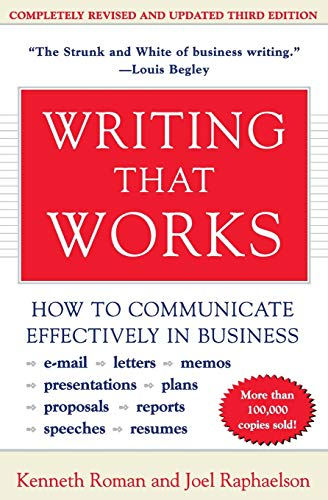
The goal of your writing is effective communication - writing that *works*
Busy people read what you write.
So you are more useful to them when your writing takes up less of their time.
The goal: invest the time to write well now to save others time in the future.
Busy people read what you write.
So you are more useful to them when your writing takes up less of their time.
The goal: invest the time to write well now to save others time in the future.
The golden rule of business writing: don't mumble.
While it is generally desirable to communicate your thoughts in a forthright manner, toning down your point and tiptoeing around it may tempt the reader to tune out and allow his mind to wander.
Just kidding.
Don't mumble.
While it is generally desirable to communicate your thoughts in a forthright manner, toning down your point and tiptoeing around it may tempt the reader to tune out and allow his mind to wander.
Just kidding.
Don't mumble.
Clearly organize your writing.
Writing well means thinking well.
• Start with an outline
• State your objective
• List out your main points
Then, number and underline your main points to guide the reader.
And finally, end with a summary.
Copy and paste this formula.
Writing well means thinking well.
• Start with an outline
• State your objective
• List out your main points
Then, number and underline your main points to guide the reader.
And finally, end with a summary.
Copy and paste this formula.
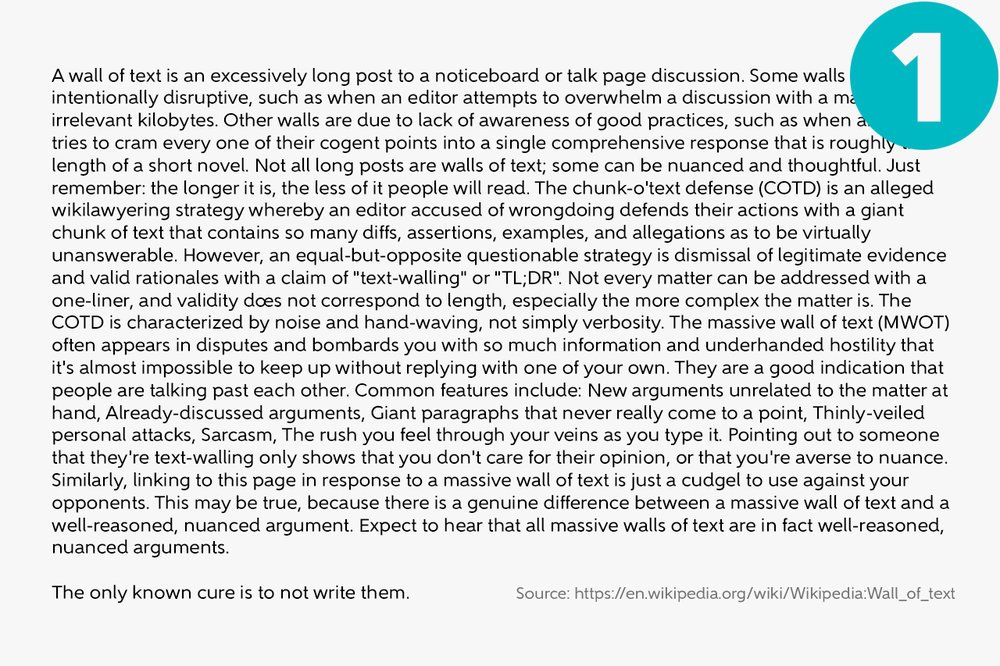
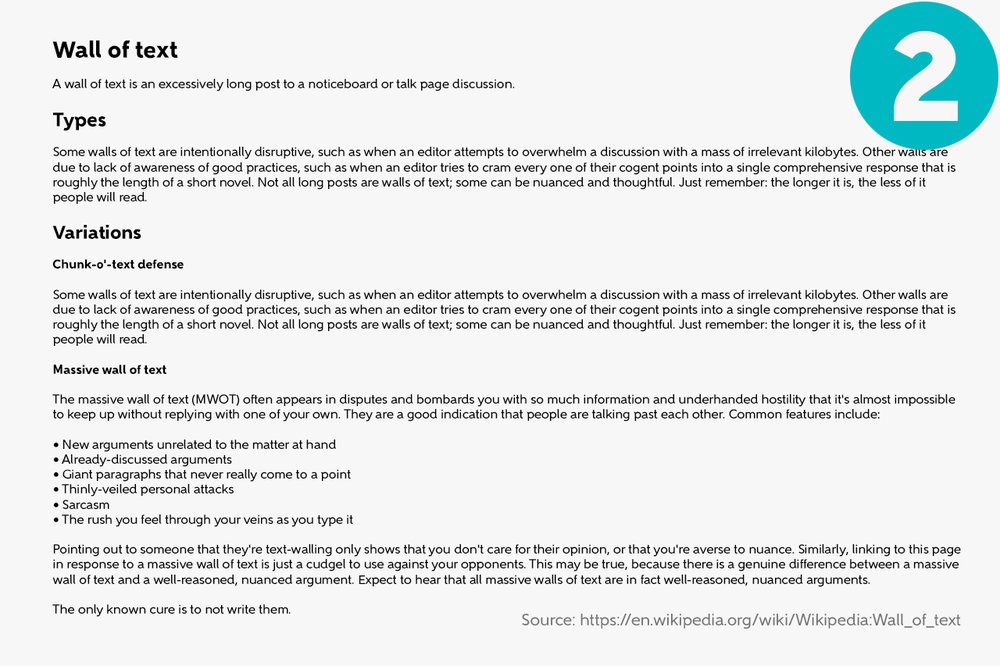
Open with short paragraphs and short sentences.
Crack open the Wall Street Journal and read the top three stories.
I bet they all start with one or two sentences.
The goal of your first sentence: get the reader to read your second sentence.
NEVER open with a Wall of Text.
Crack open the Wall Street Journal and read the top three stories.
I bet they all start with one or two sentences.
The goal of your first sentence: get the reader to read your second sentence.
NEVER open with a Wall of Text.
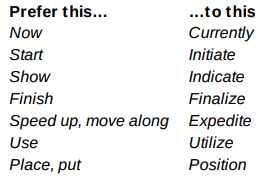
Use short words.
The goal here isn't to make your writing shorter.
The goal is to reduce friction.
Short words are easier to speak. And since your reader is *speaking* the words in their head as they read, you can make it easy for them.
Here are some easy fixes:
The goal here isn't to make your writing shorter.
The goal is to reduce friction.
Short words are easier to speak. And since your reader is *speaking* the words in their head as they read, you can make it easy for them.
Here are some easy fixes:
Use adjectives and adverbs for precision, not exclamation points.
Cut *lazy* words like very, great, awfully, and basically. These do nothing for you.
But use vigorous ones to sharpen your point:
• Tiny raise
• Moist handshake
• Crisply presented
• Baffling instructions
Cut *lazy* words like very, great, awfully, and basically. These do nothing for you.
But use vigorous ones to sharpen your point:
• Tiny raise
• Moist handshake
• Crisply presented
• Baffling instructions
Use down-to-earth language and avoid jargon.
People use jargon thinking it shows off what they know.
But they really use it to hide their lack of understanding.
An easy fix: use the Feynman Technique.
When explaining something, pretend you are explaining it to a sixth grader.
People use jargon thinking it shows off what they know.
But they really use it to hide their lack of understanding.
An easy fix: use the Feynman Technique.
When explaining something, pretend you are explaining it to a sixth grader.
Be specific.
Your biggest writing weakness: using generalities.
Don't make the reader guess.
"Our campaign was a great success and we came in under budget"
↓
"We increased click-through rates by 21% while spending 19% less than expected."
Your biggest writing weakness: using generalities.
Don't make the reader guess.
"Our campaign was a great success and we came in under budget"
↓
"We increased click-through rates by 21% while spending 19% less than expected."
Choose the right word.
• it's ≠ its
• into ≠ in to
• affect ≠ effect
• principal ≠ principle
• indifferent ≠ disinterested
When you confuse words like these, your reader may conclude you don't know any better.
And illiteracy does not breed respect.
• it's ≠ its
• into ≠ in to
• affect ≠ effect
• principal ≠ principle
• indifferent ≠ disinterested
When you confuse words like these, your reader may conclude you don't know any better.
And illiteracy does not breed respect.
Make your writing perfect.
• No typos
• No misspelling
• No errors in numbers or data
There are no excuses for these, especially with tools like Grammarly.
Spend the extra five minutes to make these fixes.
Or spend $5 per month and let software solve them for you.
• No typos
• No misspelling
• No errors in numbers or data
There are no excuses for these, especially with tools like Grammarly.
Spend the extra five minutes to make these fixes.
Or spend $5 per month and let software solve them for you.
Get to the point.
Take the time to build down what you have to say.
Then, express it confidently in simple, declarative sentences.
Especially in memos and emails, put your declaration in the subject line or as the first line.
Let your reader know exactly where you're going.
Take the time to build down what you have to say.
Then, express it confidently in simple, declarative sentences.
Especially in memos and emails, put your declaration in the subject line or as the first line.
Let your reader know exactly where you're going.

Write the way you talk. Naturally.
People think the written language and the spoken language are different.
They aren't.
• Choose a topic
• Write a paragraph about it
• Then, record yourself talking about it
Iterate until these match up.
People think the written language and the spoken language are different.
They aren't.
• Choose a topic
• Write a paragraph about it
• Then, record yourself talking about it
Iterate until these match up.
Remove the words you don't need.
• In order to → to
• Take action → act
• In the event of → if
• Equally as → equally
• Advance plan → plan
• For the purpose of → to
• At this point in time → now
Bonus: save @nateliason's banned word list: nateliason.com
• In order to → to
• Take action → act
• In the event of → if
• Equally as → equally
• Advance plan → plan
• For the purpose of → to
• At this point in time → now
Bonus: save @nateliason's banned word list: nateliason.com


In a digital, remote-first world where everyone is skilled, effective writing is the greatest differentiator.
But instead of you reading these and learning passively, you could put them into action by writing and publishing every day for 30 days:
ship30for30.com
But instead of you reading these and learning passively, you could put them into action by writing and publishing every day for 30 days:
ship30for30.com

If you enjoyed these tips:
1. Follow me @dickiebush for more threads on business writing
2. Quote tweet the top tweet with one takeaway you're going to use immediately.
3. Read more about where I found this book, from the legend David Ogilvy.
1. Follow me @dickiebush for more threads on business writing
2. Quote tweet the top tweet with one takeaway you're going to use immediately.
3. Read more about where I found this book, from the legend David Ogilvy.
Writing That Works is truly a classic that should have its place on everyone's desk.
Go ahead and grab a copy here: amzn.to
Go ahead and grab a copy here: amzn.to
Business writing, simplified:
• Be specific
• Avoid jargon
• Don't mumble
• Get to the point
• Use short words
• Organize clearly
• Write how you talk
• Create a banned words list
• Use adjectives and adverbs for precision
• Be specific
• Avoid jargon
• Don't mumble
• Get to the point
• Use short words
• Organize clearly
• Write how you talk
• Create a banned words list
• Use adjectives and adverbs for precision
And if you have a colleague who still writes emails with Walls of Text, jump back up to the top of the thread and share it.
Maybe they’ll get the message.
Maybe they’ll get the message.
جاري تحميل الاقتراحات...