
I promised to explain what physicists or quantitative scientists could do to help in the #Covid_19 pandemic. After a week of 18 hour days, some time to explain.
Bottom line: in a country where there is limited testing, you can only see COVID-19 with #mathematics.
Please RT.
Bottom line: in a country where there is limited testing, you can only see COVID-19 with #mathematics.
Please RT.
Sergei Maslov & I have been using simulations of the SEIR model of epidemics, customized for #COVID-19, to make predictions for local and Chicago hospitals, university and State administrators. Even though there are inevitable uncertainties you can still get important insights.
Last night, IL Gov. J.B. Pritzker ordered a State shelter-in-place. He said it was made after talking to health care experts, mathematicians & looking at the modeling for what will happen without taking this drastic action.
abc7chicago.com
abc7chicago.com
You can read about the mathematical modeling here:
bit.ly
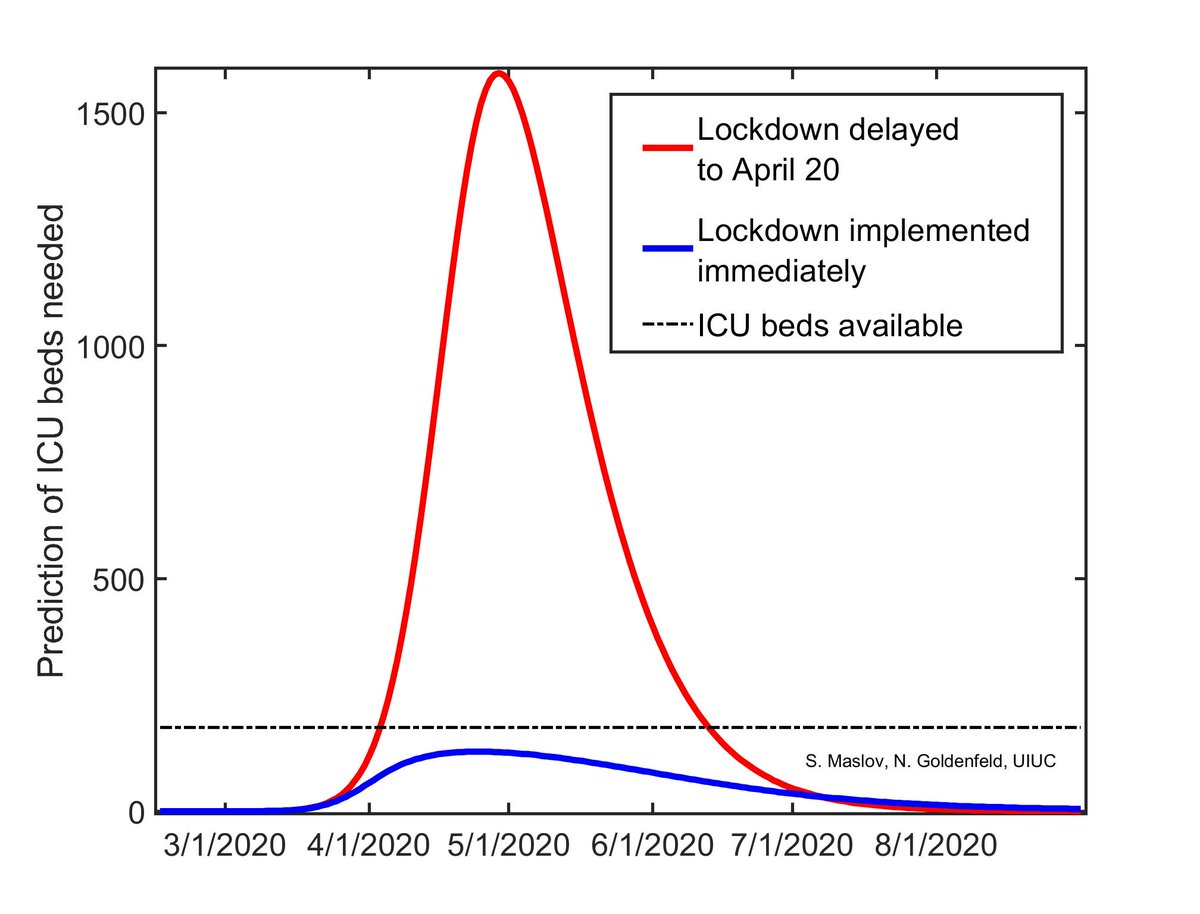
We estimated demand on ICUs in hospitals using SEIR model simulations. Ironically (considering my research) they are deterministic, well-mixed, lacking in social and spatial network effects.
bit.ly
We estimated demand on ICUs in hospitals using SEIR model simulations. Ironically (considering my research) they are deterministic, well-mixed, lacking in social and spatial network effects.
Unlike the important paper by Neil Ferguson's group on different mitigation strategies
we asked: is #flatteningthecurve mathematically possible in Illinois? Quantify the cartoons that we have all seen. We discovered it was possible only if done early.
we asked: is #flatteningthecurve mathematically possible in Illinois? Quantify the cartoons that we have all seen. We discovered it was possible only if done early.
In Illinois we are still in an earlier phase of the epidemic than New York, and we found that there is a limited time window to apply strong mitigation BEFORE hospitals overflow, so acting preventively rather than in desperation when it is too late.

We are also working with hospitals and ICUs to help plan for the case load, using modeling and data from China, Italy, Europe, NYC, etc.
Our work would not have been possible without a great scenario explorer developed by @richardneher and his team.
neherlab.org
Our work would not have been possible without a great scenario explorer developed by @richardneher and his team.
neherlab.org
In regions where there is limited testing visibility, it is difficult to plan ahead but not impossible. Testing in the US is still not nearly at the level it should be (think South Korea), so one has to work backwards from data to estimate. Cases are undersampled, so not great.
Better to use #COVID-19 positive hospital admissions, ICU cases, deaths. The extremes of the distribution are more reliably reported than cases. One can do simple estimates if you are still in exponential phase. Other tools such as this:
cmmid.github.io
cmmid.github.io
One can work with local authorities to help plan or make public policy. Also there is scientific work to be done. From large-scale detailed modeling e.g. by @alexvespi to theory questions about epidemics on networks by @barabasi & @stevenstrogatz
e.g.
bit.ly
e.g.
bit.ly
The models are still not great. We need better modeling of mitigation scenarios, spatial effects, demographic stochasticity. Mitigation especially needs modeling of network structure & spatial mapping. As more places go to lockdown or shelter-in-place, a new question arises:
How do we relax mitigation? When is it safe to do so? We need modeling to understand this in detail. It's a control theory problem, but our sensor is very poor currently, limiting our ability to answer these questions.
That's it. We need quants to beat #COVID-19
Please RT.
That's it. We need quants to beat #COVID-19
Please RT.
جاري تحميل الاقتراحات...