

في هذه السلسلة من التغريدات رح اعرض اغلب الدراسات تقريبا التي تم دراستها على تشريح وتشّكيل جذور وقنوات الأسنان
Root canal morphology and configuration
Root canal morphology and configuration
Root canal morphology and configuration in Saudi Arabian sub-population have been classified by several investigators
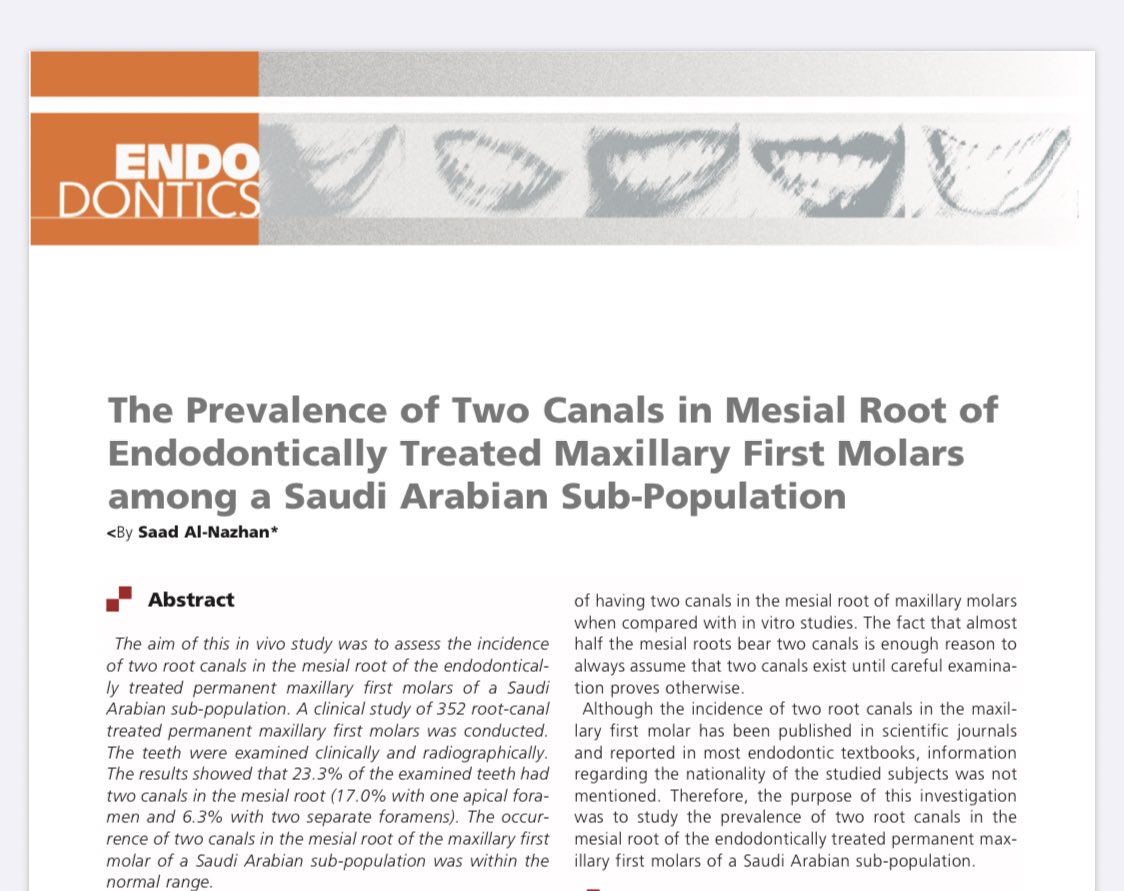
In 2005, Al-Nazhan found the mesio-buccal roots of the maxillary first molar teeth:
One canal & one foramen has (76.7%)
Two canal & one foramen has (17.0%)
Two canals & two foramen has (6.3%)
One canal & one foramen has (76.7%)
Two canal & one foramen has (17.0%)
Two canals & two foramen has (6.3%)
Al-Fouzan et al.(2013), they found the incidence of canal system in the mesio-buccal roots of maxillary 1st and 2nd molars
1st molar
one canal & one foramen(48.7%)
two canals & one foramen(33.1%)
2nd molar
one canal & one foramen(80.2%)
two canals & one foramen(13.6%)
1st molar
one canal & one foramen(48.7%)
two canals & one foramen(33.1%)
2nd molar
one canal & one foramen(80.2%)
two canals & one foramen(13.6%)

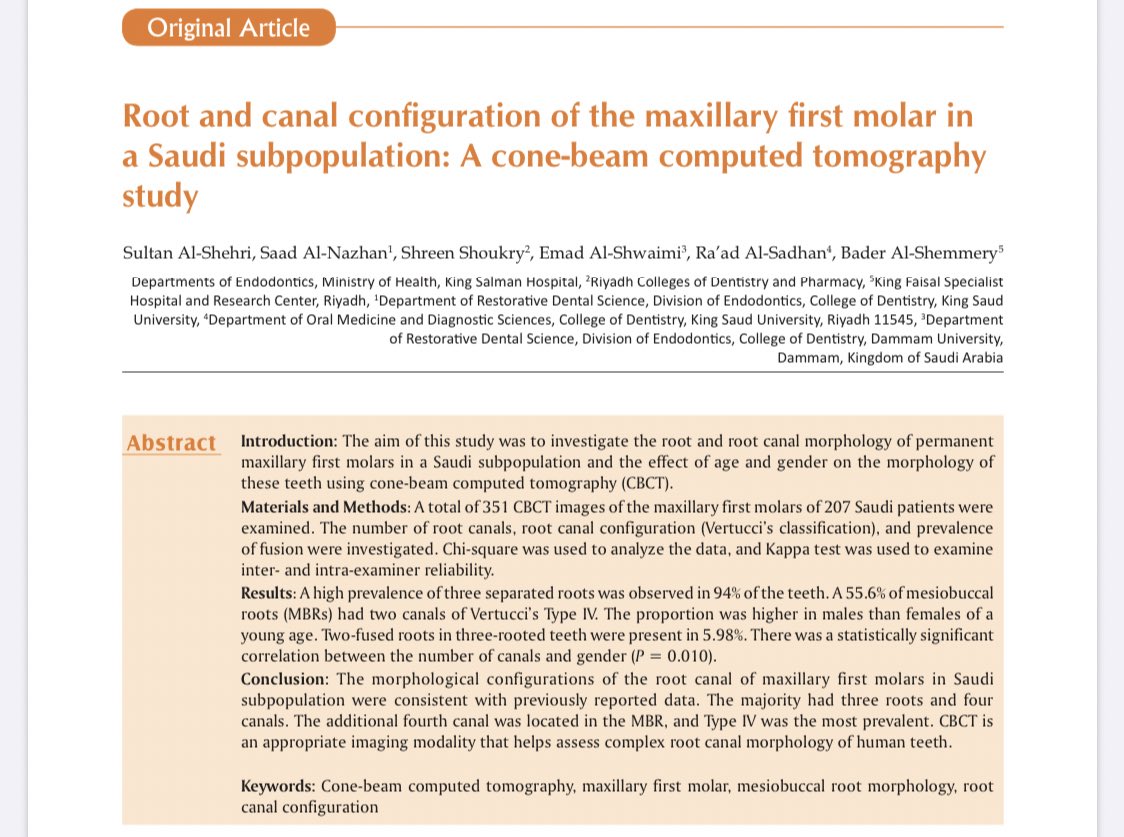
Al-Shehri et al. (2017), they were investigated the root and root canal morphology of permanent maxillary first molar:
Two canals per tooth were (3.7%),
Three canals were (40.4%),
Four canals were (55.6%) and
Five canals were (0.3%).
Two canals per tooth were (3.7%),
Three canals were (40.4%),
Four canals were (55.6%) and
Five canals were (0.3%).
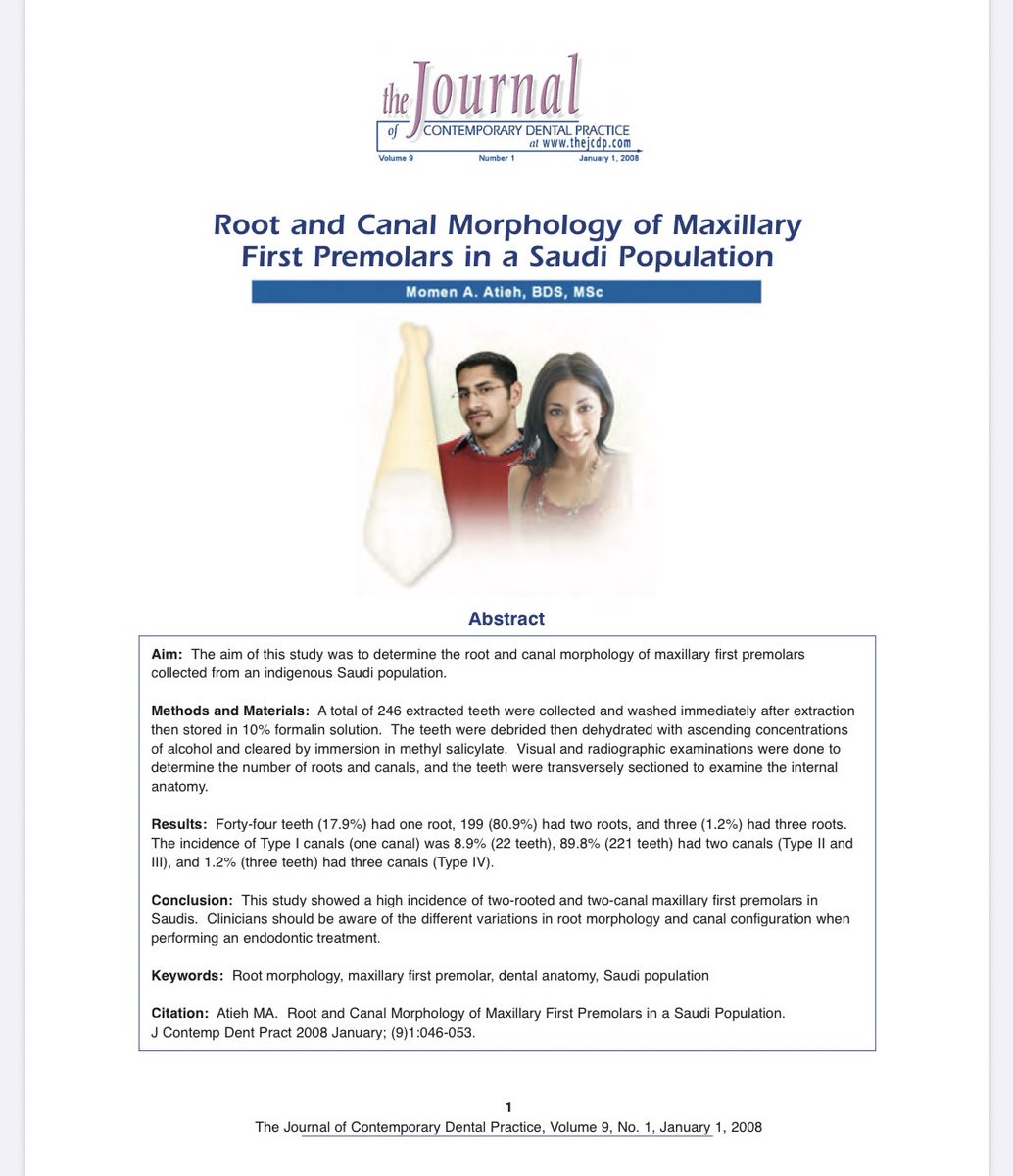
In 2008, Atieh, reported root and canal morphology of maxillary first premolars:
(17.9%) had one root
(80.9%) had two roots
(1.2%) had tree roots
(17.9%) had one root
(80.9%) had two roots
(1.2%) had tree roots
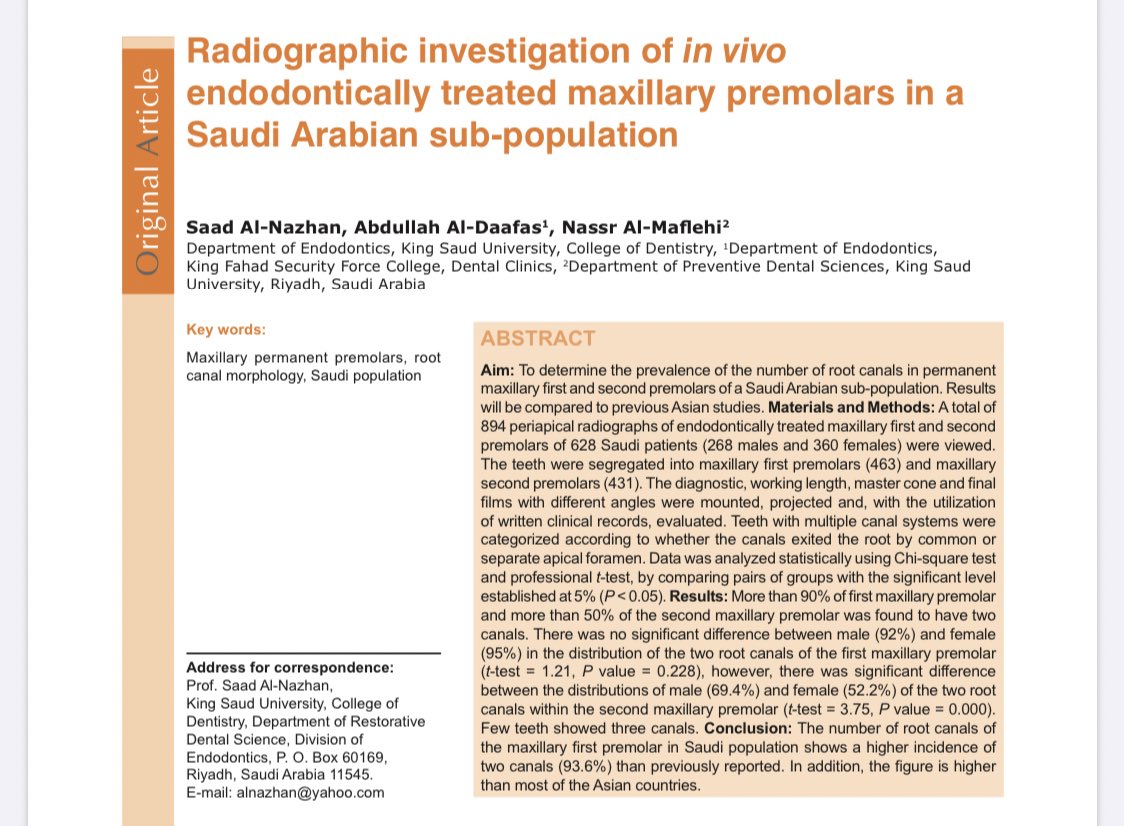
Al-Nazhan et al. (2012), they were investigated of maxillary premolars:
1st premolar
One canal (3.6%)
Two canals with two roots & two apical foramen (54%)
Three canals (2.4%)
2nd premolar
One canal (39%)
Two canals with two roots & two apical foramen (16%)
Three canals (0.9%)
1st premolar
One canal (3.6%)
Two canals with two roots & two apical foramen (54%)
Three canals (2.4%)
2nd premolar
One canal (39%)
Two canals with two roots & two apical foramen (16%)
Three canals (0.9%)
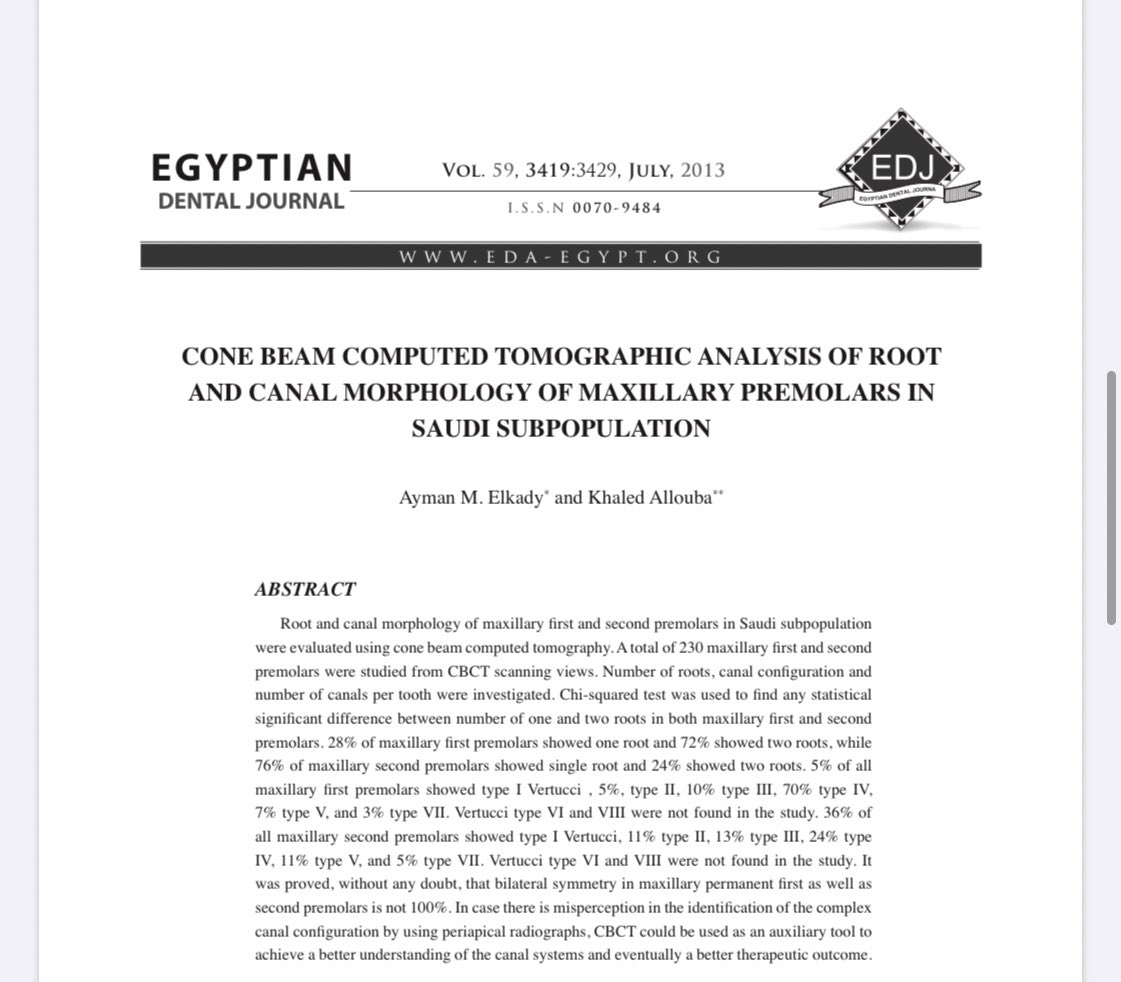
Elkady & Allouba (2013), they were analysis of root and canal morphology of maxillary premolars:
Maxillary first premolars,
(28.3%) of teeth showed one root (71.7%) showed two roots
Maxillary second premolars,
(76.4%) of teeth showed one root
(23.6%) showed two roots
Maxillary first premolars,
(28.3%) of teeth showed one root (71.7%) showed two roots
Maxillary second premolars,
(76.4%) of teeth showed one root
(23.6%) showed two roots
Alqedairi et al. (2018), they were reported the root canal morphology of maxillary first and second premolars:
1st premolars
(23.7%) had one root
(75.1%) had two roots
(1.2%) had three roots
2nd premolars
(85.2%) had one root
(14.5%) had two roots
(0.3%) had three roots
1st premolars
(23.7%) had one root
(75.1%) had two roots
(1.2%) had three roots
2nd premolars
(85.2%) had one root
(14.5%) had two roots
(0.3%) had three roots

Younes et al. (1990), reported of the extracted permanent mandibular first molars teeth (2.3%).

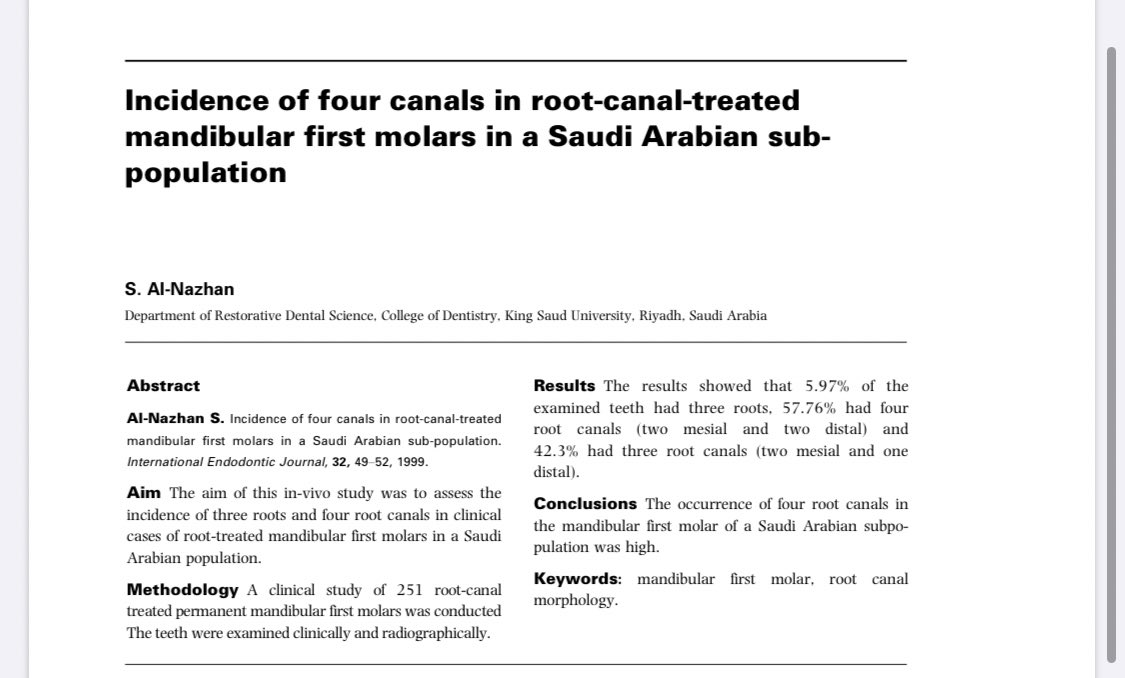
In 1999, Al-Nazhan, the results showed mandibular first molars
(5.97%) of teeth had three roots
(57.76%) had four root canals (two mesial & two distal)
(42.3%) had three roots canals (two mesial & one distal)
(5.97%) of teeth had three roots
(57.76%) had four root canals (two mesial & two distal)
(42.3%) had three roots canals (two mesial & one distal)
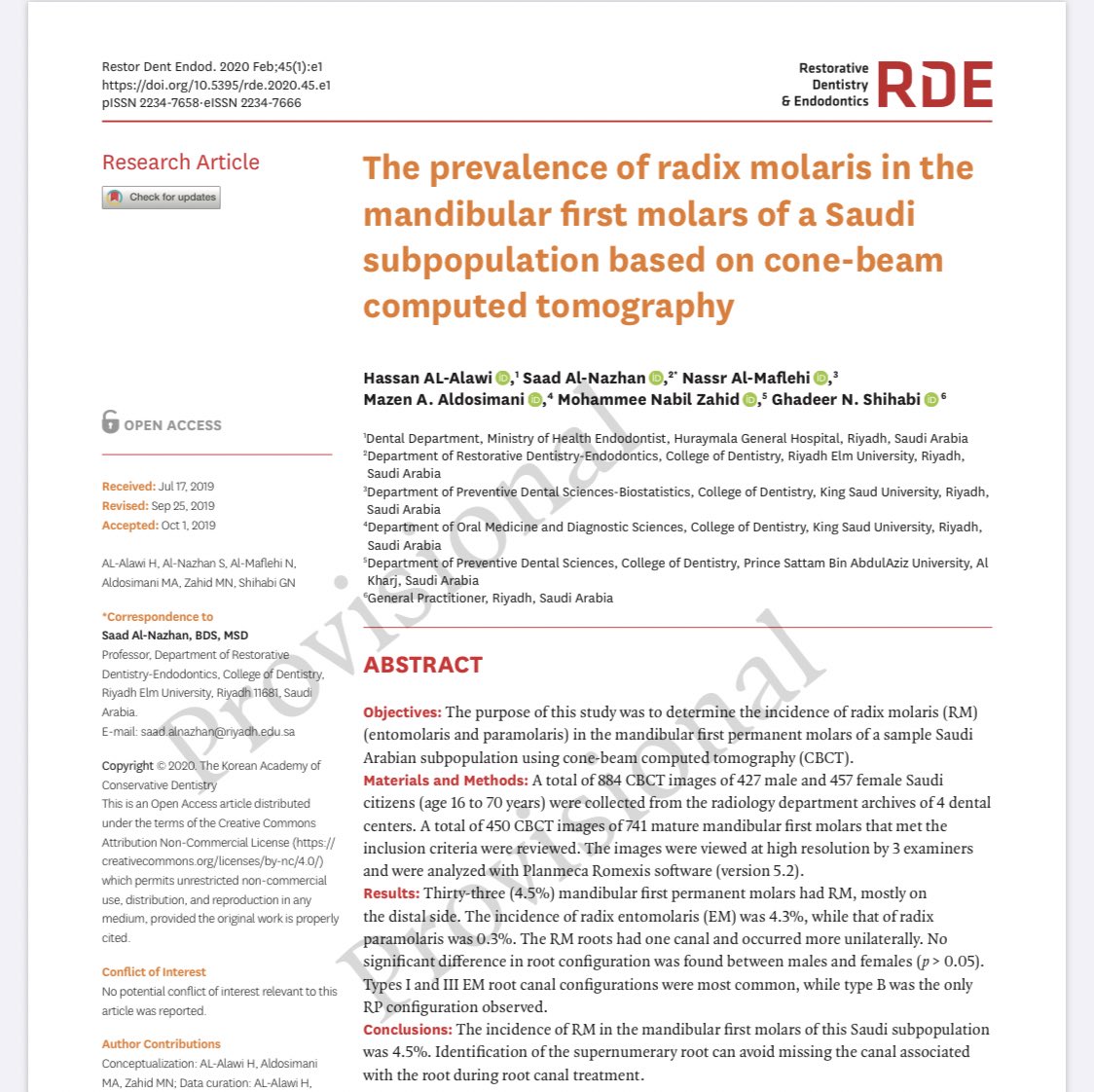
Al-Alawi et al. “It will be published in FEB(2020)”, they reported of mandibular first permanent molars has radix molaris were (4.5%).
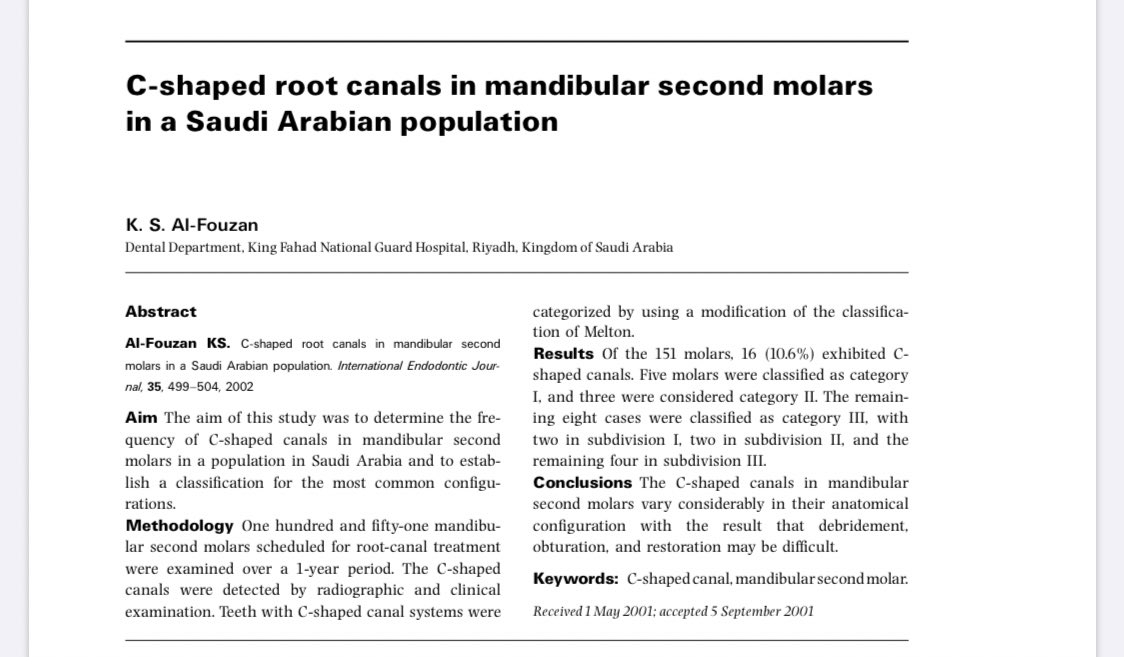
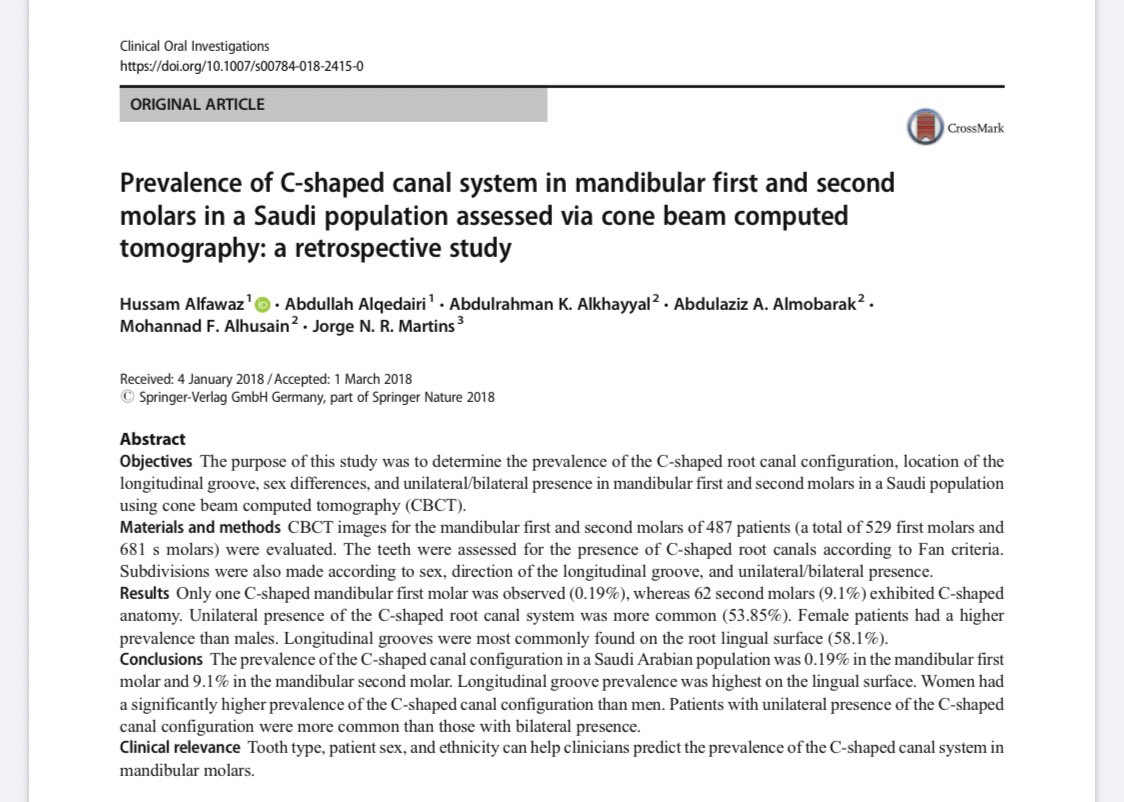
Al-Fouzan (2002), found in Saudi Arabia population in mandibular second molar teeth were (10.6%) exhibited C-shaped canals.
Al-Fawaz et al. (2018), the prevalence of the C-shaped canal configuration was (0.19%) in the mandibular first molar & (9.1%) in the mandibular second molar.
Chourasia et al. (2017), they found of mandibular first premolars in Saudi Arabian southern region sub-population:
(80%) teeth had a single root
(18%) teeth had two roots
(2%) teeth were three roots
(80%) teeth had a single root
(18%) teeth had two roots
(2%) teeth were three roots

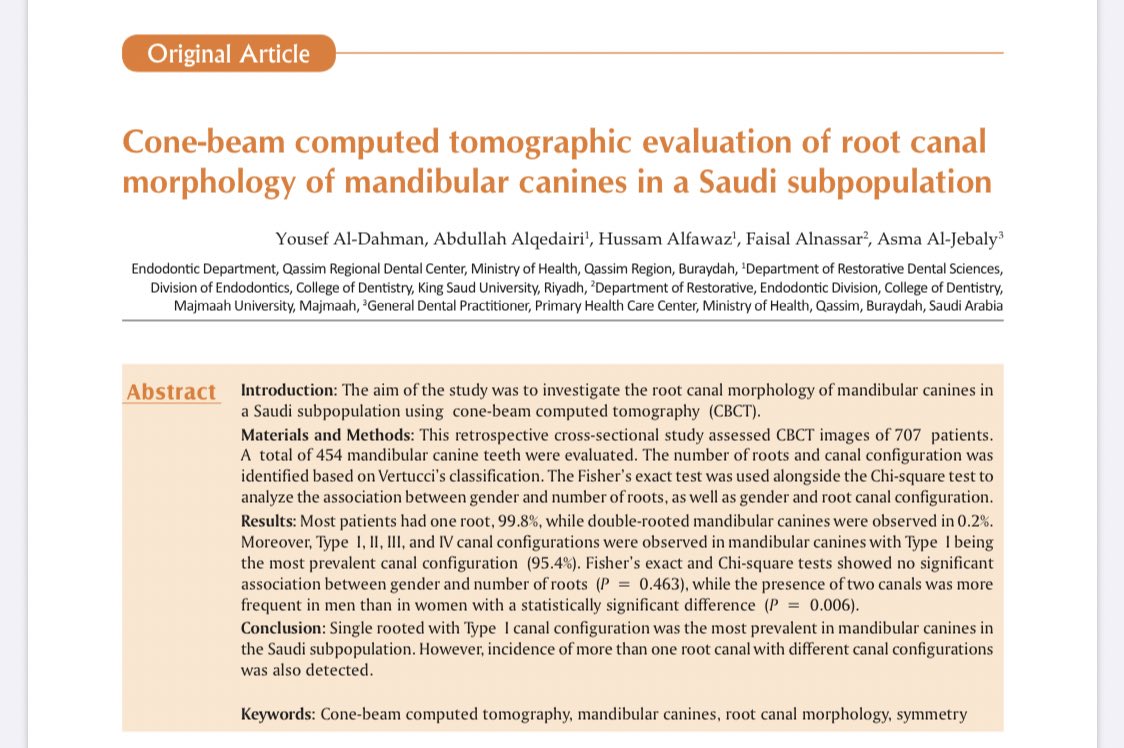
Al-Dahman et al. (2019), they were investigated the root canal morphology of mandibular canines they found, most of the teeth had one root (99.8%) and only (0.2%) had two roots.
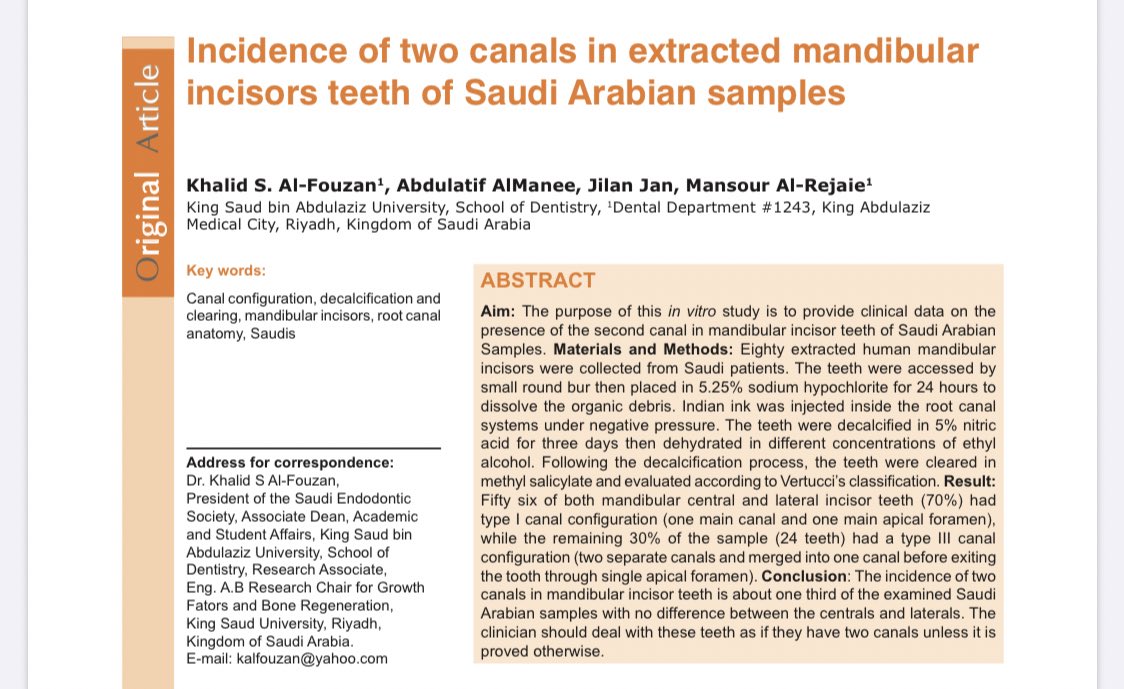
Al-Fouzan et al.(2012),they studied incidence of two canals in extracted mandibular incisors teeth
(70%) had type I
(one main canal & one main apical foramen)
(30%) had type III
(two separate canals & merged into one canal before exiting the tooth through single apical foramen)
(70%) had type I
(one main canal & one main apical foramen)
(30%) had type III
(two separate canals & merged into one canal before exiting the tooth through single apical foramen)
Al-Nazhan & Al-Shamrani (2012), they observed the prevalence of pulp stone (10.2%) of teeth.

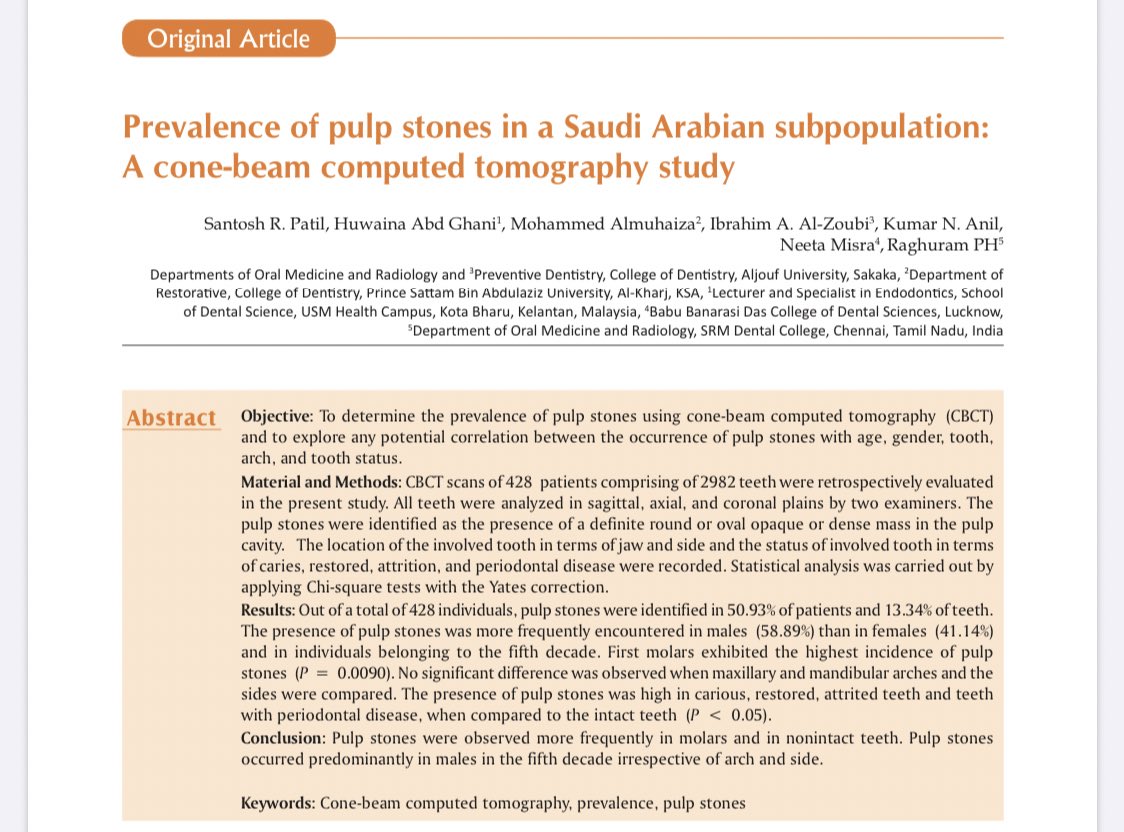
Patil et al. (2018), they identified the pulp stone were (13.34%) of teeth.
جاري تحميل الاقتراحات...